


Boom Gate Access Control: A Facility Manager’s Guide to Evaluation, Selection, and Deployment

Boom Gate Access Control

Every controlled entry point starts with the same question: how do you keep unauthorized vehicles out without slowing authorized traffic down? For parking operators, event coordinators, school administrators, and property managers across Australia, the US, and the UK, a boom gate access control system is typically the most practical answer. A single boom arm at an entry lane creates a physical checkpoint that regulates who enters, when they enter, and how fast they move through.

But selecting and deploying the right system involves more than choosing a gate and installing it. The wrong configuration leads to queuing problems during peak hours, maintenance headaches within months, or compliance gaps that create liability. This guide walks through the evaluation, selection, and deployment process—drawing on OPTRAFFIC’s experience manufacturing and supplying portable boom gates for projects ranging from school zones in Brisbane to police checkpoints in Ontario and event perimeters in London.

Why Boom Gates Remain the Default Vehicle Access Control Layer

Before evaluating specific products, it helps to understand why boom gate barriers dominate vehicle access control across so many industries. Three operational realities drive the dominance of boom gate access control as the preferred solution:

Immediate physical deterrence. Unlike signage or painted markings, a boom arm physically blocks the lane. Drivers must stop. This is why OPTRAFFIC regularly receives inquiries from facility managers who previously relied on “authorized vehicles only” signs and found them ineffective—a sign can be ignored, a steel arm cannot.

Scalable automation. A boom gate access control system integrates with credential readers (remote controls, infrared sensors) to process vehicles without manual verification. This allows a single operator to manage multiple entry points simultaneously, reducing labor costs while increasing throughput.

Regulatory acceptance. Standards such as AS 4852.2 in Australia and MUTCD in the United States explicitly address boom barrier deployment for traffic control. Compliance means the gate is not just operationally useful but legally defensible—a critical consideration for public-facing facilities and government sites.

These three factors explain why boom gates appear at parking garages, gated communities, school zones, event venues, toll booths, and emergency checkpoints worldwide. The question for most buyers is not “should I use a boom gate?” but “which boom gate configuration matches my specific site conditions?”

Matching Boom Gate Configuration to Your Site: A Scenario-Based Framework

The most common procurement mistake is selecting a boom gate based on product catalog categories (automatic vs. manual, straight arm vs. folding) rather than operational requirements. A more effective approach is to start with the site scenario and work backward to the specification.

Commercial Parking Facilities

Parking lots and garages need gates that handle high cycle counts without downtime. The critical parameters are duty cycle (must be continuous-rated for facilities processing 200+ vehicles per hour), arm length (typically 3–6 meters depending on lane width), and integration with payment or credential systems. OPTRAFFIC’s portable boom gate with infrared sensor provides hands-free boom gate access control: the sensor detects approaching vehicles and lifts the arm automatically, eliminating driver interaction delays.

Arm type consideration: For parking structures with low ceilings, a folding arm reduces the vertical clearance needed when the gate opens. OPTRAFFIC offers straight arm (default), folding arm, fence arm, and retractable arm configurations. For a detailed breakdown of each component, see What Do Boom Gate Components Include?.

Gated Communities and Residential Estates

Residential boom gate access control prioritizes security over throughput speed. The gate must restrict entry to authorized residents and pre-approved visitors. Remote control operation (30–100m range on OPTRAFFIC units) allows residents to open the gate without leaving their vehicle. For estates with guard booths, the on-board manual control panel (Up/Down, On/Off) gives security staff direct physical control.

A fence arm variant adds a mesh barrier below the boom arm, preventing pedestrians and motorcycles from ducking under the arm—a common security gap in standard straight-arm installations.

School Zones and Pedestrian-Heavy Areas

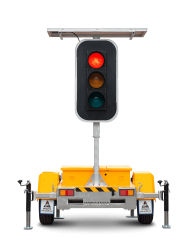
School zone deployments require high visibility and rapid deployment capability. OPTRAFFIC’s Boom Gate Trailer with Traffic Signal integrates high-brightness LED signal lights that provide clear visual guidance to both drivers and pedestrians. The trailer-mounted design allows a single operator to position the gate at drop-off/pick-up zones during school hours and relocate it afterward—no permanent installation required.

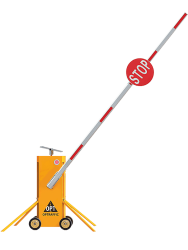
Safety standard: Boom gates deployed in school zones should comply with the visual signaling requirements of MUTCD Part 6 (US) and AS 4852.2 (Australia), including retroreflective markings on the boom arm. OPTRAFFIC arms include a 450mm diameter stop sign bolted to the arm as standard.

Events, Emergencies, and Temporary Access Control

Festivals, sporting events, emergency road closures, and police checkpoints share one requirement: the gate must be deployable in minutes, not days. This is where portable boom gates provide a decisive advantage over fixed installations.

OPTRAFFIC’s solar-powered boom gate deploys in under 30 minutes by a single person. No trenching, no wiring, no grid connection. Four adjustable legs provide stability on uneven ground. The solar panel with battery backup ensures 24/7 operation regardless of power availability—critical for disaster response scenarios where grid power may be down.

For events requiring coordinated multi-gate control, the Boom Gate Trailer supports interconnection of up to 8 units with a communication range of 1.6km in open environments, allowing centralized management of multiple entry points from a single handheld controller. This level of coordinated boom gate access control is essential for managing crowd safety at large-scale public events. For more on event-specific deployment, see The Impact of Portable Boom Gates on Event Traffic Control.

Industrial Sites, Logistics Hubs, and Mining Operations

High-volume industrial access control involves unique challenges: truck idling costs (the U.S. Department of Energy estimates 0.8 gallons of fuel wasted per hour of idling per truck), shift-change traffic surges, ESG compliance requirements, and harsh environmental conditions (dust, extreme temperatures, remote locations without grid power).

These scenarios demand boom gate systems rated for continuous heavy-duty operation with IP65 weatherproofing, rapid arm cycling to prevent queue buildup on public roads, and solar autonomy for off-grid sites. OPTRAFFIC has published a detailed operational guide covering queue theory analysis, cost-benefit modeling (solar vs. hardwired infrastructure), and MUTCD Section 4L.03 compliance engineering for these environments:

Solar Boom Gates: Modernizing Industrial Site Access Control — Full Guide

Critical Boom Gate Specifications to Verify Before Procurement

Once you have identified the right scenario category, the next step is verifying that the specific boom gate system meets the technical thresholds your site demands. These are the parameters that separate a gate that performs reliably for years from one that fails within months.

Motor and Power System Specifications

ParameterOPTRAFFIC Boom Gate SpecWhy It Matters
Motor24V DC, 100W, 4.6ADC motors operate on battery/solar power without inverters. 100W provides sufficient torque for arms up to 6m.
Motor Speed3,000 rpmHigh RPM enables fast arm cycling, reducing vehicle wait time at the gate.
Power SupplySolar panel + LFP battery (12.8V/25Ah on Trailer model)Eliminates grid dependency. LiFePO4 batteries provide 2,000+ deep discharge cycles vs. 500 for lead-acid.
Standby Time50 hours (Trailer model)Continuous operation through 2+ days of zero sunlight without external power.
Operation24/7 uninterruptible solarNo downtime for power outages. Critical for emergency response and checkpoint applications.

Weatherproofing and Durability

IP65 rating means the control electronics are fully protected against dust ingress and low-pressure water jets from any direction. This is the minimum acceptable standard for any boom gate deployed outdoors. Gates without a rated IP classification risk electrical failure in rain or dusty conditions.

Material: 1.5mm sheet metal with anti-UV powder coating. The coating prevents corrosion and UV degradation—important for sites in tropical (Australia, Southeast Asia) or desert (Middle East) climates.

Operating temperature: Industrial-grade solar boom gates typically operate from −20°C to +70°C. Batteries are housed in ventilated or insulated control boxes to maintain stable voltage across this range.

Safety and Compliance Standards by Market

Any boom gate barrier deployed on or near public roads must comply with traffic control device standards in its jurisdiction:

MarketStandardKey Requirement
Australia / NZAS 4852.2Compliance for portable traffic control devices including boom gates. Covers visibility, retroreflectivity, and operational safety.
United StatesMUTCD Parts 4 & 6Visual signaling requirements for gate barriers. Requires alternating red/white retroreflective stripes at 45° on the boom arm.
European Union / UKEN 12453Safety of power-operated gates. Covers force limitation, obstacle detection, and emergency manual release.
InternationalISO 9001, CE, EMC, RoHSQuality management, electromagnetic compatibility, and hazardous substance restrictions.

Boom Arm Type and Configuration Options

Arm TypeBest ForDescription
Straight Arm (default)Standard parking lanes, checkpointsRigid horizontal arm. Simplest mechanism, lowest maintenance.
Folding ArmLow-ceiling garages, height-restricted areasArm folds as it rises, reducing vertical clearance requirement.
Fence ArmHigh-security sites, pedestrian exclusionMesh barrier below the arm prevents ducking under. Blocks both vehicles and pedestrians.
Retractable ArmSpace-constrained installationsArm retracts into the housing rather than rising vertically.

The 450mm diameter stop sign bolted to the arm is standard on all OPTRAFFIC models and can be customized with site-specific messaging or branding.

Integrating Boom Gates with Your Existing Security Infrastructure

A standalone boom gate controls a single lane. An integrated boom gate access control system controls your entire facility’s vehicle access posture. The value multiplier comes from connecting the gate to your existing security stack.

Access Credential and Activation Methods

OPTRAFFIC boom gates support three primary activation methods, each suited to a different operational context:

Infrared sensor (hands-free, universal): The gate detects any approaching object and lifts the arm automatically. When a physical mass breaks the infrared beam’s path, the control logic triggers the motor. The gate remains open until the beam is completely clear, protecting vehicles from premature closure. This is ideal for high-volume sites with frequent third-party contractors who do not carry pre-registered credentials—no keypads, no window rolling, no delay.

Handheld remote control (supervised entry): Security staff control the gate from 30–100m distance (standard boom gate) or up to 400m (Boom Gate Trailer with 2.4GHz radio). This keeps operators safely outside the vehicle movement zone while maintaining full perimeter control—critical at sites where heavy machinery is in motion.

Manual push-button (fail-safe): Physical Up/Down buttons on the control cabinet provide backup control during remote system failures or emergency scenarios requiring immediate manual override. This ensures the gate never becomes an unmovable obstruction regardless of battery state or electronic conditions.

Multi-Gate Coordination for Large Facilities

The Boom Gate Trailer model supports interconnection of up to 8 units using 2.4GHz radio frequency communication with a 1.6km range in open environments. This enables coordinated operation across multiple entry/exit points from a single controller—critical for events, large parking facilities, or checkpoint operations with multiple lanes.

Warning messages transmitted between units include link errors, movement errors, tilt errors, lamp errors, and low battery alerts, providing real-time system health monitoring across the entire gate network.

Surveillance and Monitoring Integration

Pairing boom gates with CCTV surveillance trailers creates a layered security system where vehicle access events are both controlled (by the gate) and recorded (by the camera). OPTRAFFIC manufactures both portable boom gates and surveillance trailers, enabling single-source procurement for integrated deployments.

Boom Gate Deployment Planning: How to Avoid Common Installation Mistakes

The difference between a boom gate that operates reliably for years and one that requires constant adjustment usually comes down to decisions made during deployment—not the gate itself.

Site Assessment Checklist

Ground surface: Confirm the deployment area is level and can support the gate’s weight. OPTRAFFIC’s portable boom gate uses 4 adjustable legs that compensate for minor surface irregularities, but significant slopes or soft ground require leveling preparation.

Lane width: Measure the actual lane width to determine the required arm length. Standard arms cover 3–6 meters. For wider lanes, consider dual-gate configurations with one gate on each side.

Solar panel orientation: For solar-powered units, the panel must face the sun’s path (north-facing in the Southern Hemisphere, south-facing in the Northern Hemisphere). Ensure no structures, trees, or equipment will shade the panel during peak sunlight hours.

Infrared sensor positioning: After deployment, adjust the sensor to the appropriate height and angle for the expected vehicle types. A sensor calibrated for passenger vehicles may not detect low-profile motorcycles or high-cab trucks.

For the complete installation guide including common mistakes and prevention strategies, see Boom Barrier Gate Installation Mistakes and Prevention.

OPTRAFFIC Portable Boom Gate: 7-Step Deployment Sequence

Boom Gate Trailer

OPTRAFFIC’s portable boom gate follows a documented deployment sequence designed for single-operator execution:

Step 1: Disconnect and position the trailer at the entry point.

Step 2: Deploy the jack and adjust to the appropriate height using the 4 adjustable legs.

Step 3: Adjust the traffic signal direction and raise the antenna.

Step 4: Orient the solar panel toward sunlight.

Step 5: Open the control box, switch on the circuit breaker and control power. Adjust the infrared sensor position.

Step 6: Pair the remote controller and test sensor triggering.

Step 7: Conduct a vehicle-detection scenario test before going live.

Total deployment time: Under 30 minutes, single operator, no tools beyond what ships with the unit. For a detailed cost analysis comparing this deployment model to traditional hardwired installation, see Solar Boom Gates: Cost-Benefit Analysis.

Maintaining Boom Gate Performance Over the System’s Lifecycle

The real Application of Boom Gate-Boom Gate Access Control

Boom gates are mechanical systems with moving parts. Without maintenance, even well-specified gates degrade. The good news: OPTRAFFIC’s solar-powered design eliminates many of the maintenance burdens associated with grid-tied systems (no electrical conduit inspections, no utility coordination for power faults).

Key Maintenance Areas for Boom Gate Systems

Boom arm and pivot mechanism: Inspect for physical damage, alignment, and smooth movement. Lubricate pivot points per manufacturer schedule. A misaligned arm increases motor strain and shortens component life.

Motor and control unit: Monitor for unusual sounds during operation (grinding, clicking). The 24V DC motor is rated for high cycle counts but benefits from periodic inspection of wiring connections and terminal corrosion—especially in coastal or high-humidity environments. For motor-specific diagnostics, see Automatic Boom Barrier Gate Motor Failures: Troubleshooting Guide.

Solar panel and battery: Clean the panel surface to maintain charging efficiency. Monitor battery voltage—the Boom Gate Trailer model provides warning messages for low battery status. LiFePO4 batteries have a longer service life than lead-acid alternatives but still degrade over 2,000+ cycles. For the complete battery care guide, see Battery Maintenance for Automatic Boom Barriers.

Infrared sensor: Clean the sensor lens regularly. Dust, spider webs, or condensation can cause false triggers or missed detections.

For the complete preventive maintenance schedule, see Routine Maintenance for Automatic Boom Barriers.

Selecting the Right Boom Gate System: A Quick Decision Framework

Every site decision comes down to three variables: how many vehicles pass through per hour, whether the installation is permanent or temporary, and what compliance standards apply in your market. Match those three answers to the specification tables in this guide, and the correct boom gate access control system configuration becomes clear.

OPTRAFFIC manufactures portable solar boom gates certified to AS 4852.2, MUTCD, and EN 12966, with deployment support across Australia, North America, and Europe. To discuss your site requirements or request a specification sheet, contact the OPTRAFFIC team.

Boom Gate Access Control: Frequently Asked Questions

What is the difference between a portable boom gate and a fixed installation boom gate?

A portable boom gate is a self-contained unit with its own power supply (solar), base (trailer or legs), and control system. It deploys in under 30 minutes without trenching, wiring, or construction. A fixed installation boom gate is permanently mounted on a concrete foundation with hardwired electrical connections. Portable gates suit temporary or evolving access control needs (events, construction phases, emergency response). Fixed gates suit permanent facilities with stable entry point locations. OPTRAFFIC specializes in portable solar boom gates that deliver the security performance of fixed systems with the flexibility of temporary equipment.

How many vehicles can a boom gate process per hour?

Throughput depends on the arm cycling speed and the access control method. An infrared-sensor-activated gate (OPTRAFFIC’s default automatic mode) processes vehicles as fast as they clear the sensor zone—typically 3–6 seconds per cycle. At 6-second cycles, theoretical capacity is 600 vehicles per hour per lane. Real-world throughput is lower due to vehicle spacing, driver reaction time, and credential verification if used. For high-volume applications, the Boom Gate Trailer’s multi-unit interconnection (up to 8 gates coordinated via 2.4GHz radio) enables multi-lane configurations that multiply total throughput.

What happens if the solar power runs out on a boom gate?

OPTRAFFIC boom gates use LiFePO4 battery storage that provides 50 hours of standby time (Boom Gate Trailer model) without any solar charging. In practice, even on heavily overcast days, the solar panel provides partial charging that extends this reserve significantly. If the battery does reach critical levels, the system transmits a low-battery warning message. The physical manual override (push-buttons on the control cabinet) remains functional regardless of battery state, ensuring the gate never becomes an unmovable obstruction.

Can boom gates comply with pedestrian accessibility requirements?

Boom gates control vehicle access, not pedestrian access. For facilities that must maintain ADA/DDA-compliant pedestrian pathways, boom gates should be installed alongside a separate pedestrian access point (door, turnstile, or accessible gate). OPTRAFFIC’s compact tower dimension (1200 × 450 × 420mm) and trailer-mounted form factor allow positioning that does not obstruct adjacent pedestrian routes.

What safety features prevent a boom gate arm from closing on a vehicle?

OPTRAFFIC boom gates include infrared obstacle detection as standard. The sensor maintains the arm in the open position until the infrared beam is completely clear—meaning the vehicle has fully passed through the gate zone. The Boom Gate Trailer adds a bounce-back feature: if the arm encounters physical resistance during closing, it reverses direction immediately. These features meet the obstacle detection requirements of EN 12453 and AS 4852.2.

How does OPTRAFFIC’s portable boom gate compare to permanently installed systems?

OPTRAFFIC is a portable solar boom gate manufacturer. Compared to fixed, grid-tied systems from established brands, OPTRAFFIC’s advantage is deployment speed (30 minutes vs. 2–4 weeks), zero infrastructure cost (no trenching at $50–$150 per linear foot), and site flexibility (relocate as project phases change). The trade-off is that OPTRAFFIC’s product line focuses on portable and solar configurations rather than heavy-duty permanent installations. For sites requiring crash-rated permanent barriers (e.g., embassy perimeters, data centers), a fixed installation may be more appropriate. For a full cost-benefit comparison, see Solar Boom Gates: Solar vs. Hardwired Infrastructure Analysis.

Facebook
Twitter
LinkedIn
Email
Latest Posts