


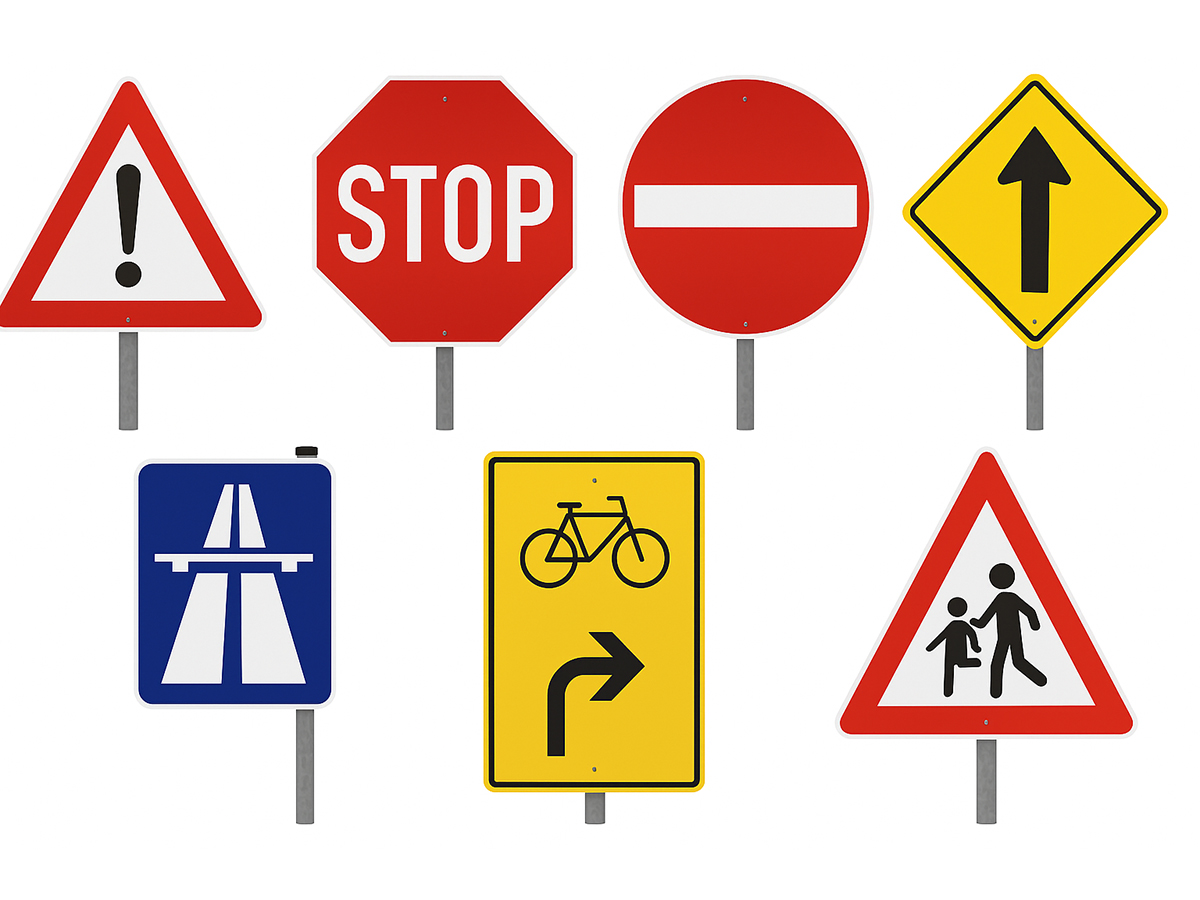
Traffic sign shapes communicate meaning before a driver reads a single word. The Manual on Uniform Traffic Control Devices (MUTCD), 11th Edition — the federal standard governing all traffic control devices on US public roads — assigns a specific shape to each category of sign. An octagon means stop. An inverted triangle means yield. A diamond means warning. These shape-to-meaning assignments are not arbitrary: they allow drivers to recognize a sign’s intent from a distance, in darkness, and even when the sign face is obscured by snow or sun glare.
According to the Federal Highway Administration (FHWA), roughly 40% of all reported US traffic crashes occur at or near intersections — locations where traffic sign recognition directly affects driver decision-making. Understanding traffic sign shapes and their meanings is therefore a foundational road safety skill, not merely a licensing test requirement.
This guide covers every standard traffic sign shape used on US roads, the MUTCD chapter that governs it, the message category it carries, and the design principles that explain why each shape was chosen.

Why Traffic Sign Shapes Carry Meaning
The MUTCD establishes shape as a primary coding system for traffic signs, working alongside color and legend. MUTCD Chapter 2A explains the rationale: because drivers must process sign information at speed — often in under two seconds — shape provides instant pre-attentive recognition before the brain consciously reads text. A driver approaching an unfamiliar intersection can identify a stop sign by its octagonal silhouette in the headlights before the red color or ‘STOP’ lettering resolves.
The MUTCD’s shape-coding system is also designed for redundancy. Every sign communicates through at least two channels — shape and color — so that color-blind drivers, drivers in low-light conditions, and drivers approaching from the rear can still interpret the sign’s category correctly.
The five MUTCD design principles behind traffic sign shapes
| Design Principle | Explanation | US Example |
| Spatial compatibility | Sign placement aligns with the driver’s expected decision point — a warning sign appears before the hazard, not at it | A curve warning (W1-2) is placed 250–750 ft before the curve depending on posted speed (MUTCD Table 2C-4) |
| Conceptual compatibility | Shape, color, and symbol match the natural expectation of the message | The inverted triangle of a YIELD sign suggests ‘give way’ through its downward-pointing form |
| Physical representation | Icons mirror real-world objects or scenarios so meaning is intuitive | Pedestrian crossing signs depict a walking figure; school signs depict children |
| Frequency consistency | Repetition of shape-color combinations reinforces driver recognition of critical warnings | The diamond + yellow combination appears on every warning sign, creating a consistent recognition pattern |
| Redundancy (dual coding) | Shape and color together convey the message, so that color-blind drivers or those in low-light conditions can still interpret the sign correctly | A stop sign’s octagonal shape communicates ‘stop’ even when the red color is obscured by snow or fading |
One important clarification on a widely cited rule: the claim that ‘the more sides a shape has, the more critical the message‘ is a useful memory aid, not a MUTCD principle. The octagon (8 sides) is reserved for STOP — the most critical regulatory instruction — and the circle is used for railroad crossings and prohibitions. But this relationship does not hold linearly across all shapes. The MUTCD assigns shapes based on convention, legibility, and distinctiveness, not strictly on side count.
Traffic Sign Shapes and What Each One Means
Traffic sign shapes in the United States follow a standardized system defined in the MUTCD. The following sections cover each shape, its MUTCD designation, the type of message it carries, and the specific signs that use it.
Octagon — Stop Signs
The octagonal shape is used exclusively for stop signs in the United States and in most countries worldwide. No other traffic sign uses an octagon. Under MUTCD Section 2B.04, the stop sign (designation R1-1) must be a red retroreflective octagon with white legend and border. Standard sizes are 30 in × 30 in for conventional roads and 36 in × 36 in for expressways and high-speed roads.
The octagon was chosen because its unique shape — unmatched by any other road sign — allows recognition from the rear. When a driver approaches a stopped vehicle at an intersection, they can identify the stop sign even before the front face is visible. This rear-recognition property is a deliberate MUTCD requirement.
- Color: Red with white legend and border
- MUTCD: Section 2B.04; designation R1-1
- Message category: Regulatory — mandatory stop
- Key rule: No other sign uses this shape; retroreflective sheeting must meet ASTM D4956 Type III minimum (Type IX recommended on high-speed roads)
Optraffic Safety Expert Insight: The octagonal shape provides critical rear-side recognition at busy intersections. However, shape alone does not guarantee full site safety. The MUTCD mandates specific reflectivity and size standards for all regulatory signs. Optraffic ensures every product meets these rigorous legal requirements. We recommend reviewing our Compliance Standards for MUTCD Stop Signs to ensure your next bulk order meets all roadway regulations.
Inverted Triangle — Yield Signs
The downward-pointing equilateral triangle is used exclusively for yield signs (MUTCD designation R1-2, governed by Section 2B.08). The inverted triangle was standardized in the United States in 1971, aligning with international practice under the Vienna Convention on Road Signs and Signals, which most of Europe and many other countries follow.
The shape was chosen because the downward-pointing form visually suggests ‘giving way’ — the lower vertex points toward the road the driver must yield to. The sign uses a red border with white interior and red ‘YIELD’ legend. Standard size is 36 in × 30 in on conventional roads.
- Color: White background, red border and legend
- MUTCD: Section 2B.08; designation R1-2
- Message category: Regulatory — yield right of way
- Key rule: Used at merge points, roundabout entries, and uncontrolled intersections where stop is not warranted
Diamond — Warning Signs
The diamond shape (a square rotated 45°) is the standard US shape for warning signs, covered by MUTCD Chapter 2C. Warning signs alert drivers to hazards, changes in road conditions, or situations that require a reduction in speed or increased attention. The diamond is not used internationally — European and Vienna Convention countries use equilateral triangles for warnings — but in the United States the diamond-warning pairing is one of the most deeply established shape-meaning associations in road design.
Standard warning signs use a yellow background with black legend. In temporary traffic control zones (construction and maintenance areas), the background changes to orange, while the diamond shape is retained. This color-shift within the same shape tells drivers they are entering a work zone — a higher-risk environment requiring additional caution.
- Color: Yellow background, black legend (permanent); orange background, black legend (work zones)
- MUTCD: Chapter 2C (permanent warning); Chapter 6F (temporary/work zone warning)
- Message category: Warning — hazard or condition ahead
- Examples: Curve ahead (W1-2), intersection ahead (W2-1), pedestrian crossing (W11-2), road work ahead (W20-1)
- Key rule: Diamond shape is used for warnings only; MUTCD Table 2C-4 specifies placement distances from hazard based on posted speed
Rectangle — Regulatory and Guide Signs
The rectangular shape covers the largest and most diverse category of US traffic signs. MUTCD Chapter 2B governs regulatory signs (vertical rectangle) and Chapter 2D governs guide signs, which use both vertical and horizontal rectangles depending on the information they carry.
Vertical rectangles are used for regulatory signs — those that carry the force of law. A white background indicates a regulatory instruction (speed limit, turn restriction, lane usage). A red background indicates prohibition (Do Not Enter, Wrong Way). These are the signs drivers must obey rather than simply consider.
Horizontal rectangles are used for guide signs — those that provide route information, distances, and directions. Interstate highway signs (green background, white legend) are the most familiar example. Blue rectangles indicate service facilities (fuel, food, lodging). Brown rectangles indicate recreational and cultural interest areas.
- Vertical rectangle colors: White (regulatory instruction), Red (prohibition), Black & white (speed limit)
- Horizontal rectangle colors: Green (route guidance), Blue (services), Brown (recreation/tourism)
- MUTCD: Chapter 2B (regulatory), Chapter 2D (guide)
- Key rule: A rectangular sign with white background is a regulatory sign — it conveys a legal requirement, not a suggestion
Pentagon — School Zone and School Crossing Signs
The five-sided pentagon (pointed top) is used exclusively for school zone and school crossing signs in the United States (MUTCD Section 2B.45 and Section 7B.06). The unique shape ensures that school-related signs are instantly distinguishable from all other warning and regulatory signs, even without reading the legend.
School zone signs use a fluorescent yellow-green background — a color introduced into the MUTCD in 1993 specifically for pedestrian and school signs because research showed it has higher conspicuity than standard yellow, particularly at dawn and dusk when school zones are often active.
- Color: Fluorescent yellow-green background, black legend
- MUTCD: Section 2B.45 (school speed limit); Section 7B.06 (school crossing)
- Message category: Warning/regulatory — school zone or pedestrian crossing
- Key rule: Pentagon shape is reserved exclusively for school-related signs; no other sign category uses this shape
Circle — Railroad Advance Warning Signs
The circle is used for railroad advance warning signs (designation W10-1, governed by MUTCD Chapter 8B). The circular yellow sign with a black ‘X’ and ‘RR’ legend warns drivers that a railroad crossing is ahead. The circle is also used in some regulatory contexts: a red circle with a diagonal bar indicates prohibition (combined with other symbols to create ‘No Entry,’ ‘No Bicycles,’ etc.).
- Color: Yellow with black legend (railroad warning); red with white bar (prohibition)
- MUTCD: Chapter 8B (railroad); applicable regulatory chapters for prohibition
- Key rule: At-grade railroad crossings also use a Crossbuck sign (X-shaped, white, designation R15-1) placed directly at the crossing
Pennant — No Passing Zone Signs
The pennant is a horizontal isosceles triangle — wider at the left and tapering to a point at the right. It is used exclusively for the No Passing Zone sign (designation R4-1, governed by MUTCD Section 2B.27). The pennant is always mounted on the left side of the road, facing oncoming traffic, at the beginning of a no-passing zone. Its unique shape allows identification from a distance without requiring the driver to read the sign text.
- Color: Yellow background, black legend
- MUTCD: Section 2B.27; designation R4-1
- Key rule: Mounted on left side only; often used together with a yellow center line pavement marking and a Do Not Pass regulatory sign on the right
Traffic Sign Shapes Quick Reference
The table below provides a complete reference for all standard traffic sign shapes used on US roads, their MUTCD series, color, and primary message type.
| Shape | Color | Message Type | MUTCD Series | Key Rule / Note |
| Octagon | Red | STOP | R1-1 | The only octagonal sign; reserved exclusively for stop control (MUTCD Section 2B.04) |
| Equilateral Triangle (inverted) | Red & White | YIELD | R1-2 | Inverted triangle is globally recognized for yield; used at merge points and roundabout entries |
| Diamond | Yellow or Orange | Warning | W series | Standard warning shape for hazards, curves, intersections ahead; orange used in work zones (MUTCD Chapter 2C) |
| Rectangle (vertical) | White, Red, or Green | Regulatory / Guide | R & D series | Regulatory signs are vertical rectangle with white background; guide signs use green background (MUTCD Chapter 2B, 2D) |
| Rectangle (horizontal) | Brown, Blue, or Green | Service / Guide | D & I series | Horizontal rectangles used for service info (blue), recreational areas (brown), and general guidance |
| Pentagon (pointed top) | Yellow-green | School zone | S series | Five-sided shape used exclusively for school zone and school crossing signs (MUTCD Section 2B.45) |
| Circle | Yellow or Red | Railroad / No passing | R & W series | Circle warns of railroad crossings; red circle with bar indicates prohibition (no entry, no passing) |
| Pennant (horizontal triangle) | Yellow | No passing zone | R4-1 | Three-sided horizontal triangle; used only for no-passing zone signs on the left side of the road |
| Crossbuck (X shape) | White | Railroad crossing | R15-1 | Placed at at-grade railroad crossings; shape alone communicates crossing regardless of lighting |
Road Sign Shapes by Message Type: What Each Shape Tells You
Knowing the meaning of each traffic sign shape allows drivers to respond correctly before reading the sign text — a critical advantage at highway speeds. The following breakdown organizes shapes by the type of message they convey.
Shapes that require immediate action
Octagon (Stop): Come to a complete halt before the stop line or intersection edge. No rolling stops. Wait for a safe gap before proceeding.
Inverted triangle (Yield): Slow to a speed that allows you to stop if necessary. Give right of way to all conflicting traffic. You are not required to stop unless traffic requires it.
Circle with bar (Prohibition): Do not perform the action shown. A red circle with a horizontal white bar, combined with a symbol, prohibits that action (no entry, no left turn, no bicycles).
Shapes that warn of a hazard ahead
Diamond (Warning): A condition requiring caution or speed reduction exists ahead. Reaction is advisory — the MUTCD does not legally require drivers to reduce speed unless a regulatory sign also specifies a reduced limit, but failing to adjust to conditions is a contributing factor in crash liability.
Circle (Railroad advance warning): A railroad crossing is ahead. Reduce speed, prepare to stop if a train is present or approaching. Railroad crossings with active warning devices (flashing lights, gates) are governed by a separate device sequence.
Shapes that convey rules and information
Rectangle (Regulatory): White-background vertical rectangles carry legal requirements — speed limits, turn restrictions, lane rules. These are not suggestions. Violating a regulatory sign is a traffic offense in all US states.
Rectangle (Guide): Green, blue, and brown rectangles provide route information, service locations, and points of interest. They are informational — no compliance action is required.
Pentagon (School zone): A school zone or crossing is ahead. In most US states, school zone speed limits are legally enforceable only during posted hours or when lights are flashing. Penalties for violations in school zones are typically doubled.
Pennant (No passing zone): Passing is prohibited from this point forward until the no-passing zone ends. Passing in a no-passing zone is a moving violation in all US states.
A Brief History of Traffic Sign Shapes in the United States

The standardized shape system now governed by the MUTCD evolved over several decades of trial, inconsistency, and federal intervention.
- 1915: The first stop sign appeared in Detroit, Michigan — black text on white, with no standardized shape.
- 1920s: The Mississippi Valley Association of State Highway Departments proposed an early shape-based system: circles for railroads, octagons for stop, crossbucks for railroad crossings. The yellow diamond for warning was introduced in this period.
- 1935: The first edition of the MUTCD was published jointly by the American Association of State Highway Officials (AASHO) and the Public Roads Administration, establishing the foundation of the current shape-color-legend system.
- 1954: Stop signs changed from yellow to red following the introduction of retroreflective sheeting materials that made red practical for nighttime visibility.
- 1971: The inverted triangle yield sign was standardized, aligning the US with international practice.
- 1993: Fluorescent yellow-green was introduced for pedestrian and school signs after research demonstrated higher conspicuity at dawn and dusk.
- 2023: The 11th Edition of the MUTCD took effect, the first comprehensive update since 2009. It added provisions for accessible pedestrian signals, new work zone device requirements, and updated retroreflectivity standards for sign sheeting.
The 11th Edition MUTCD is the currently applicable federal standard as of its effective date in November 2023. States are required to adopt it or a compliant state supplement; compliance timelines vary by jurisdiction.
Dynamic Traffic Signs: When Static Shapes Are Not Enough
The shape-coding system described above applies to static signs — fixed devices with a permanent face. In work zones, high-volume highways, and special events, traffic conditions change faster than static signs can communicate. This is where dynamic message devices complement the static sign system.
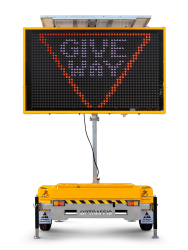
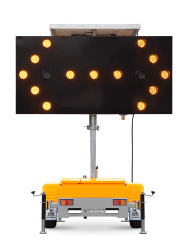
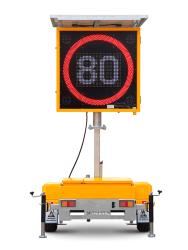
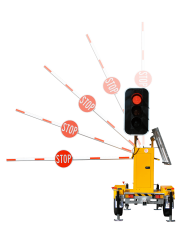
Portable Variable Message Signs (VMS boards) and arrow boards do not replace the static sign shapes that the MUTCD mandates — they extend the system into real-time communication. A VMS board upstream of a work zone can display changing lane status, queue length, and detour instructions that a diamond-shaped ‘Road Work Ahead’ sign cannot. An arrow board at a lane-closure taper provides the directional display required by MUTCD Section 6F.57 in a form that updates as the work zone configuration changes.
For contractors and road authorities: static traffic sign shapes set the regulatory floor — every MUTCD-required sign must be present and compliant. Dynamic devices like VMS boards and arrow boards build on that foundation to address conditions that static signs cannot anticipate. Both are required components of a compliant temporary traffic control setup under MUTCD Part 6.
Need Traffic Control Equipment That Matches MUTCD Shape and Compliance Requirements?
Whether you are managing a work zone, a special event, or a long-term road project, the traffic sign shapes required by the MUTCD are only part of the compliance picture. Temporary traffic control setups under MUTCD Part 6 also require advance warning devices, channelizing equipment, and in many cases dynamic message display.
OPTRAFFIC supplies MUTCD-, AS/NZS-, and EN 12966-compliant portable VMS boards and solar-powered arrow boards to contractors, road authorities, and rental companies across the United States and Australia. Contact our team for product specifications and deployment guidance.
This article provides general educational information about US traffic sign standards and should not be relied upon as legal or engineering advice. Always consult the applicable edition of the MUTCD, your state DOT supplemental specifications, and a qualified traffic engineer for site-specific compliance determinations.
FAQ
What shape is a stop sign and why?
A stop sign is octagonal — an eight-sided polygon. Under MUTCD Section 2B.04, the octagon is reserved exclusively for stop signs in the United States. No other traffic sign uses this shape. The octagon was chosen because its unique silhouette allows drivers to recognize a stop sign from the rear, in darkness, and at distance before the red color or ‘STOP’ text is legible — a deliberate safety redundancy built into the shape itself.
What does a diamond-shaped sign mean?
A diamond-shaped sign means warning. Under MUTCD Chapter 2C, the diamond shape is used for all permanent warning signs in the United States. A yellow diamond indicates a hazard, road condition, or situation requiring caution ahead — such as a curve, intersection, or pedestrian crossing. An orange diamond indicates a temporary warning in a work zone. The diamond shape is not used for warnings in Europe, where equilateral triangles serve that purpose.
What does a triangular road sign mean?
In the United States, an inverted triangle (pointing downward) means yield. The yield sign (MUTCD R1-2, Section 2B.08) uses a white face with a red border and instructs drivers to give right of way to conflicting traffic. A pointing-up triangle is not a standard shape in the US system. In Europe and countries following the Vienna Convention, a red-bordered triangle pointing upward is used for warning signs — the opposite of US practice.
What does a rectangular road sign mean?
A rectangular sign can be either regulatory or informational, depending on its orientation and color. A vertical rectangle with a white background is a regulatory sign carrying a legal requirement — such as a speed limit, turn restriction, or lane rule. A horizontal rectangle is typically a guide sign providing route information or directions. Green rectangles give highway route guidance; blue rectangles indicate service facilities; brown rectangles mark recreational areas.
What are the shapes of traffic signs and their meanings?
The standard traffic sign shapes and their meanings under the MUTCD are: octagon = stop; inverted triangle = yield; diamond = warning; vertical rectangle = regulatory; horizontal rectangle = guide/informational; pentagon = school zone; circle = railroad warning or prohibition; pennant = no passing zone. Each shape is assigned exclusively or primarily to its message category to allow pre-attentive recognition before the driver reads the sign text.
Why are warning signs diamond-shaped in the US but triangular in Europe?
The United States did not adopt the Vienna Convention on Road Signs and Signals (1968), which standardized the upward-pointing triangle for warnings across Europe, Asia, and most of Africa. The US MUTCD system developed independently from the 1930s onward and had already established the diamond as the warning shape before international standardization efforts began. Both systems achieve the same goal — a distinctive, dedicated shape for warnings — through different conventions.
What does a pentagon-shaped sign mean?
A pentagon-shaped sign (five-sided, with the point at the top) means school zone or school crossing. Under MUTCD Section 2B.45, this shape is reserved exclusively for school-related signs. School zone signs use a fluorescent yellow-green background, which was adopted in 1993 after research demonstrated that this color has higher conspicuity than standard yellow, particularly during the dawn and dusk hours when school zones are most active.