


Hire fleets get two kinds of enquiry. One wants a unit for a three-day event, moved twice while it is there. The other wants a camera on a gate for eight months, never touched. Historically those are two different products, which means two lines of stock, two sets of spares and two utilisation curves to manage. A convertible unit answers both, and the question becomes when to detach a camera tower from its trailer rather than which product to buy. The Optraffic team supplies surveillance trailers and camera trailers where the tower lifts off the chassis with a forklift and runs unchanged on the ground.
Key Takeaways
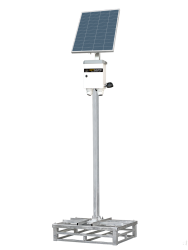
- Forklift-detachable tower: Reaches positions a towed trailer cannot enter, in minutes with one operator.
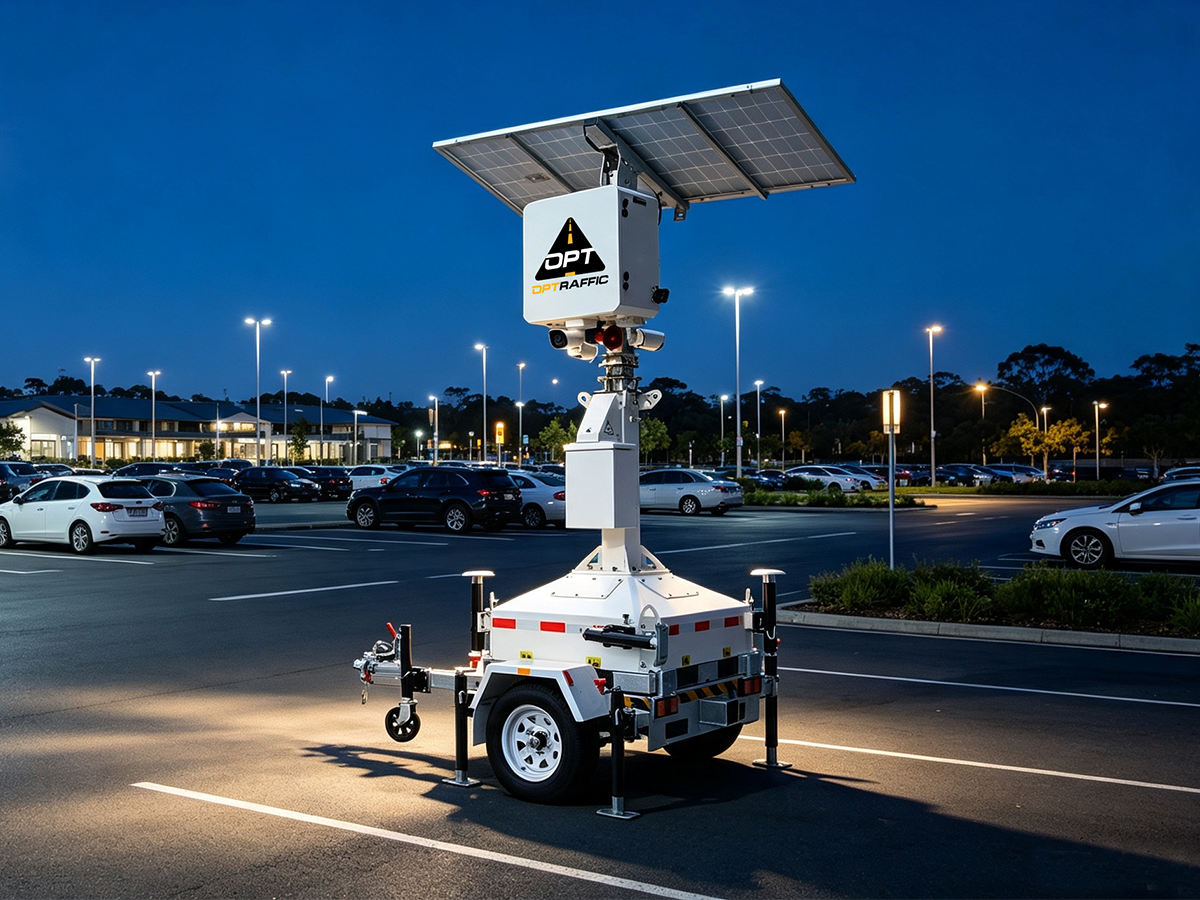
- Self-contained tower: Keeps solar, battery, storage and connectivity on the tower, so nothing stays behind on the chassis.
- Four outriggers: Hold the tower stable through a months-long static deployment without the wheels underneath.
- Interchangeable chassis: Frees a chassis to serve other jobs while towers stay deployed on site.
- Bundled Web System: Manages towers identically whether they sit on a chassis or on the ground.
One unit. Two deployment modes.
The Optraffic Mini Solar CCTV Tower Dual Trailer carries solar, battery, recording and 4G/5G on the tower itself, so it runs unchanged in either mode.
Detachable Camera Tower vs Trailer Mounted Is a Deployment Decision
Suppliers describe this as a product feature. It is better understood as two deployment modes for the same unit, each suited to a different contract.
Detachable camera tower vs trailer mounted comes down to one question: how often will this position change?
- Trailer mode suits work that moves. A construction front advancing weekly, an event running three days, a diversion that shifts with the programme. Hitch, tow, set down.
- Detached mode suits a position held for months. A gate, a fuel compound, a substation boundary, a yard that will not change shape until handover.
The unit does not change. What changes is whether the chassis stays underneath it.
Choosing the unit class comes first, before either mode matters. That comparison sits in surveillance trailer versus compact camera tower.
Mobile and Fixed Surveillance in One Unit Removes the Two-Stock Problem
Rental inventories usually split along the same line the enquiries do. Trailer-mounted units go out on short, moving jobs. Fixed towers or poles go out on long static ones. Each category carries its own idle periods.
Mobile and fixed surveillance in one unit collapses that split. The same asset takes an event booking in March and a nine-month gate position in April. Three things follow for a fleet:
- Utilisation smooths out. A quiet event season no longer strands stock that can only do events.
- Spares and training simplify. One unit type, one set of parts, one briefing for crews.
- Quoting gets easier. A fleet can bid on both enquiry types from the same availability list.
The trade-off is that converting takes a lift, which the section further below covers honestly.
Coverage itself does not change between modes. It is set by pixel density and distance, not by what the tower stands on, and that calculation sits in how far a security camera trailer can see.
Chassis Turnover in a Hire Fleet Is the Argument Most Suppliers Miss
This is the part that matters to a rental business, and it has nothing to do with cameras.
A chassis is a transport asset. A tower is the asset that earns hire revenue. When the two are permanently joined, a tower parked on a site for four months takes a chassis out of service for four months alongside it.
Chassis turnover in a hire fleet changes that arithmetic:
| Fleet model | Chassis required for N deployed towers | What happens during a long hire |
|---|---|---|
| Tower fixed to chassis | N | Chassis sits idle under a static tower |
| Tower detachable, chassis interchangeable | A transport pool, sized by move frequency | Chassis returns to depot and serves other jobs |
The second model only works if any chassis of the same type accepts any tower. That interchangeability is what turns a pool into a pool rather than a set of matched pairs.
The practical sizing question becomes a transport one:
Chassis needed ≈ (moves per month × hours per move) ÷ (available chassis hours per month)
A fleet running long static contracts needs far fewer chassis than towers. A fleet running short event hires needs closer to parity. Most fleets run both, which is exactly why the two modes matter.
Outriggers for Static Surveillance Tower Deployment Change Two Things
Taking the wheels away does more than free a chassis.
Outriggers for static surveillance tower deployment give a wider, lower-loaded footprint than a trailer’s own legs. Load spreads across four points rather than through two wheels and a jockey wheel. On reinstated ground or a compacted pad, that is the difference between a stable position and a slow lean.
The second change is one hire fleets raise in enquiries. A trailer-mounted unit has a tow hitch, and a tow hitch is how equipment leaves a site without permission. A tower standing on outriggers has nothing to couple to. It has to be lifted, which needs plant and time.
That is a deterrent, not a guarantee. It sits alongside the other setup decisions in mobile camera tower deployment mistakes.
What Forklift Placement of a Camera Tower Actually Requires
The trade-off deserves stating plainly, because it is real.
Forklift placement of a camera tower needs a forklift on site and a licensed operator to run it. In Australia, operating a forklift is high risk work and requires the relevant licence. Safe Work Australia sets out the duties in its forklifts information sheet, and SafeWork NSW publishes practical forklift guidance for employers and operators.
For most sites this costs nothing extra. Construction yards, logistics depots and industrial parks already run forklifts. For a remote or greenfield position with no plant on site, trailer mode is the sensible choice.
Three points to confirm before planning a lift:
- A forklift with adequate capacity is available on the day, not merely on the site inventory.
- The operator holds the current licence for that class of plant.
- The set-down pad is level and compacted before the tower arrives, not afterwards.
Once placed, the tower runs exactly as it does on the chassis. Solar, battery, storage and connectivity all sit on the tower, so nothing is left behind. Power and data planning are therefore unchanged, and they are covered in will a solar camera trailer run through winter and how much data does a camera trailer use.
Choosing Between the Two Modes
| Deployment profile | Duration | Moves expected | Site access | Suggested mode |
|---|---|---|---|---|
| Event or festival | Days | Several | Open vehicle access | Trailer |
| Advancing construction front | Weeks | Weekly or more | Variable | Trailer |
| Gate or weighbridge on a long build | Months | None | Usually open | Detached |
| Long-term yard or compound position | Months | None | Forklift on site | Detached |
| Mixed booking, event then static hire | Varies | At changeover | Depot handles conversion | Both, converted between hires |
| Remote greenfield position | Any | Occasional | No plant on site | Trailer |
Conclusion
Decide the mode from the contract, not from the brochure. Short and moving means trailer. Long and fixed, or hard to reach, means lifting the tower off and sending the chassis back to work.
Optraffic builds the tower as a self-contained unit that runs identically in either mode, with chassis that interchange across units of the same type. The Web System is supplied with the equipment, so a detached tower and a trailer-mounted one appear side by side in the same view at no extra cost. Wider deployment context for Australian projects sits in the mobile surveillance guide for Australian infrastructure sectors. To work through modes for a specific site, contact the Optraffic team with the positions and access routes.
FAQ
Does a detached tower still work normally?
Yes. Solar, battery, recording and connectivity sit on the tower itself. Detachable camera tower vs trailer mounted changes the footprint and the transport, not the surveillance function. Mobile and fixed surveillance in one unit means the same hardware serves both booking types.
How long does it take to detach or remount a tower?
Minutes, with a forklift and one operator. The lift is the constraint, not the unit.
Can any chassis be used to collect a deployed tower?
Any chassis of the same type. That interchangeability is what makes chassis turnover in a hire fleet work, because collection does not wait for one specific trailer.
Is a detached tower more stable than a trailer-mounted one?
On soft or reinstated ground, usually. Outriggers for static surveillance tower deployment spread load across four points rather than through wheels.
What stops a detached tower being stolen?
There is no hitch to couple to, so removal requires plant and time. Site access controls still matter, and this is a deterrent rather than a guarantee.



Lighting First or Recording First? CCTV-Ready Light Tower vs Camera Trailer for Integrators and Hire Fleets
CCTV-ready light tower vs camera trailer: compare whose camera runs, which load gets night power, and how hire fleets use one unit for two jobs.
VMS Trailers for Renewable Energy Zone Construction: Oversize Deliveries, Detours and Community Notice
How VMS trailers support renewable energy zone construction: oversize delivery warnings, detours, night moves and community notice on REZ routes.
Imported vs Australian-Built VMS Trailers: Where Each Has the Edge
Imported vs Australian-built VMS trailers: where each has a real advantage, what compliance requires of both, and how to choose for your fleet.
What Should a VMS Trailer Quote Include in Australia? Line Items to Compare Before You Sign
What should a VMS trailer quote include? Ten line items to compare, from delivery and registration to software fees, warranty and local spare parts.
When to Order VMS Trailers for Bushfire Season: A Region-by-Region Guide for Australian Hire Fleets
When to order VMS trailers for bushfire season: a region-by-region guide for hire fleets, with order-by months, stock top-ups and pre-season checks.
What Makes a VMS Trailer Mine-Spec? Site Entry Requirements for Western Australian Mine Sites
Mine-spec VMS trailer requirements under WA’s 2026 mine traffic code: visibility, ID, isolation, documents and how to order a unit that passes site entry.