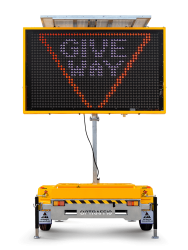
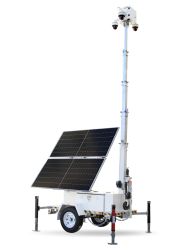
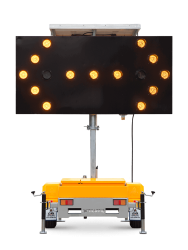

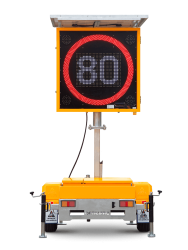
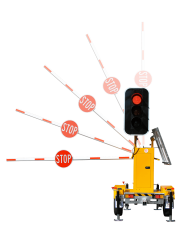



A wind turbine blade convoy leaves the Port of Newcastle after dark. Ahead lie highway junctions, country towns, school bus routes and farm gates. Every road user along that route needs to know what is coming and when. Renewable energy zone construction runs that movement hundreds of times, for years. This guide explains where variable message sign trailers fit on REZ delivery routes and construction sites. It also covers how contractors and hire fleets can source a fleet sized for a multi-year programme from Optraffic.
Key Takeaways
- Solar-battery VMS trailers: Run for weeks on remote REZ roads without refuelling trips or grid power.
- Remote message control: Updates delivery windows and detour messages along a whole route from one login, with no subscription fee.
- Five-colour and full-colour faces: Show pictograms and detour graphics that text-only boards cannot carry.
- Factory-direct DDP supply: Delivers project-scale fleets with freight, customs clearance and import duties handled to site.
- Local distributor stock: Covers urgent additions within about one to two weeks through Jaybro and OPTraffic WA.
Why Renewable Energy Zone Construction Needs VMS Trailers
Renewable energy zones concentrate years of heavy construction into regional road networks. The Central-West Orana REZ, the first REZ planned for NSW, shows the scale. It covers over 20,000 square kilometres around Dubbo, Dunedoo and Mudgee. It aims to generate over 6 gigawatts from wind, solar and battery projects.
Getting the components there is its own project. EnergyCo’s Port to REZ program is upgrading 19 locations between the Port of Newcastle and Elong Elong. EnergyCo states that the first oversize overmass (OSOM) movements to the REZ start in mid-2026, and continue from 2028. Deliveries to the Central-West Orana and New England REZs share a route from Newcastle to Muswellbrook before splitting.
That creates three layers of traffic work at once:
- Road upgrade works along the delivery route, often at night.
- OSOM deliveries carrying blades, towers and transformers.
- Site construction traffic at each wind or solar farm access point.
Each layer changes daily. Static signs cannot keep up. That is where traffic management for wind farm construction turns to VMS trailers.
Oversize Wind Turbine Delivery Traffic Management: Where VMS Trailers Fit
Oversize wind turbine delivery traffic management depends on warning road users before a convoy reaches them. Pilot and escort vehicles travel with the load. A VMS trailer works ahead of it, often hours ahead.
| Location on the route | What the VMS message does | Typical message type |
|---|---|---|
| Port exit and urban corridors | Warns commuters of night OSOM movements | Delivery dates and times |
| Highway sections | Gives advance notice of slow, wide loads | “Oversize loads at night, expect delays” |
| Road upgrade sites | Manages lane closures during Port to REZ works | Closures, speed reductions, night work |
| Town approaches | Prepares local traffic before a convoy passes | Delay warnings, alternative routes |
| Local road junctions | Alerts farm, school bus and resident traffic | Delivery windows, detours |
| Site access points | Manages construction traffic in and out | Truck entry warnings, speed limits |
OSOM Rules That Shape the Messaging
Under the Heavy Vehicle National Law, OSOM vehicles are formally Class 1 load-carrying vehicles. In NSW, operators submit a traffic management plan in NHVR Go with the access permit application. Transport for NSW standardised pilot and escort requirements in 2025. Loads wider than 4.6 metres or longer than 30 metres need two pilot vehicles. Loads wider than 5.5 metres or longer than 35 metres need three.
A VMS trailer does not replace pilots or escorts. It adds advance warning that the permit conditions do not cover. Drivers learn about the convoy before they meet it, and plan around it.
OSOM Delivery Advance Warning: Night Moves, Detours and Long Programmes
OSOM delivery advance warning matters most where REZ traffic meets everyday traffic. Three situations come up repeatedly.
Night Deliveries
Oversize components often move at night to avoid peak traffic. EnergyCo has issued night work notifications for Port to REZ sites. One covered the Golden Highway at Elong Elong in May 2026. A VMS trailer placed before a night work zone tells drivers what to expect, after daytime notices have gone unread.
Long-Term Detours
Road upgrades can divert traffic for weeks. A changeable sign carries the detour while it is new. Once drivers adjust, some plans swap it for static signs and move the VMS elsewhere. A fleet that moves between sites gets more use from each unit.
Overlapping Projects
Several wind and solar farms can share the same roads. Their delivery windows can clash. Coordinated messaging across one corridor needs every sign on the same system, so one operator can update all of them.
All roadside messages still need approval from the road authority. In NSW, Transport for NSW remains the road authority and lead agency for the network. Use the wording your approved traffic management plan allows.
Community Notice for REZ Construction Traffic
Community notice for REZ construction traffic is part of every project’s social licence. Residents along a delivery route live with years of extra trucks, night movements and road works.
A roadside sign reaches people that newsletters and websites miss:
- Farmers moving stock or machinery across roads
- School bus drivers planning around delivery windows
- Tourists and through traffic who never see a local notice
- Local businesses affected by detours
A clear, current message on the approach to town builds patience. An outdated message, or none, builds complaints. Remote control lets the project team change the sign the moment a schedule moves.
What a VMS Fleet for Renewable Energy Projects Needs
A VMS fleet for renewable energy projects faces conditions closer to mining than to city roadworks.
| Requirement | Why it matters on a REZ programme | What to check |
|---|---|---|
| Solar autonomy | Signs sit on long regional corridors far from depots | Battery capacity and autonomy in the worst month |
| Remote control across a corridor | One operator updates dozens of signs along one route | One login for every unit, and message scheduling |
| On-site control | Mobile coverage drops out on regional roads | Handheld control when 4G fails |
| Colour capability | Detour graphics and pictograms read faster than text | Five-colour or full-colour face options |
| Durability | Unsealed roads, dust and heat wear equipment down | Sealed cabinets, corrosion protection, testing records |
| Fleet scale over time | Demand grows as construction ramps up to 2028 | Staged supply and consistent specification |
Power sizing for regional sites follows the method in how to size a solar power system for a VMS trailer. Sites with mine-style access rules can borrow from mine-spec VMS trailer requirements.
Sourcing a VMS Fleet for a Multi-Year REZ Programme
A REZ programme needs units now and more units later. Plan the fleet in two parts.
- A core fleet ordered to one specification. Large fleet orders can be quoted factory-direct by Optraffic. Factory-direct orders ship on DDP (Delivered Duty Paid) terms. Optraffic arranges freight, customs clearance and import duties to your delivery address. The factory also provides after-sales support directly.
- Top-ups from local stock. Jaybro covers the East Coast. OPTraffic WA, Optraffic’s Western Australian distributor, covers WA from Maddington, Perth. Both hold local stock and spare parts, with standard units in about one to two weeks.
Optraffic team tests every VMS trailer in-house before dispatch. The Optraffic Web System comes with each trailer at no subscription fee. It shows every sign’s location, battery state and live message from one login. An open API connects units to a contractor’s own platform. Project sites that also need security monitoring can add solar CCTV trailers to the same order.
For the ordering process, see the bulk VMS trailer purchase guide. To compare suppliers, use the template in what a VMS trailer quote should include. The national checklist sits in the buyer’s guide to what to check before buying a VMS trailer in Australia. More energy-sector equipment guidance sits in the energy and mining industry guide.
FAQ
How are VMS trailers used in wind farm construction?
They warn road users of oversize deliveries, detours, night work and site access traffic. Traffic management for wind farm construction uses them where messages change daily.
Do VMS trailers replace pilot vehicles for oversize loads?
No. Pilot and escort vehicles travel with the load under permit conditions. OSOM delivery advance warning from a VMS trailer works ahead of the convoy.
When do oversize deliveries to the Central-West Orana REZ start?
EnergyCo states that the first OSOM movements start in mid-2026 and continue from 2028. Port to REZ road upgrades at 19 locations prepare the route.
How many VMS trailers does a REZ project need?
It depends on route length, upgrade sites and access points. A VMS fleet for renewable energy projects usually starts with a core fleet, then adds units as construction ramps up.
Can large REZ contractors buy VMS trailers factory-direct?
Yes. Optraffic quotes large fleet orders factory-direct on DDP terms, with after-sales support from the factory. Local stock through Jaybro and OPTraffic WA covers urgent additions.
Conclusion
Renewable energy zones turn regional roads into delivery corridors for years. Oversize convoys, night works, detours and site traffic all change faster than static signs can follow. VMS trailers carry that changing message to farmers, commuters, school buses and tourists before they meet it. Optraffic supplies core REZ fleets factory-direct on DDP terms. Jaybro and OPTraffic WA cover top-ups from local stock. Send Optraffic team your route plan and fleet size to start a quote.


What to Check Before Buying 500 Portable Changeable Message Signs: 7 Batch Delivery Checks for Rental Fleets
What to check before buying 500 portable changeable message signs: one build across batches, spares, DDP delivery and per-shipment tests.
How to Plan Message Signs for Weekend Highway Closures: Lessons from Atlanta’s I-285 Westside Closures
How to plan message signs for weekend highway closures: 5 steps, a 48-hour checklist and fleet control lessons from Atlanta’s I-285 closures.
Does EN 12966 Apply to LED Modules? What the Standard Covers and What a Datasheet Cannot Prove
Does EN 12966 apply to LED modules? See what the standard covers, what a module datasheet proves and 5 questions to ask a supplier.
Build vs Buy a Vehicle-Mounted Message Sign: What Fleets and Integrators Should Check
Build vs buy a vehicle-mounted message sign? Compare compliance, controls, mounting and support before you choose.
Work Zone Speed Feedback Trailer Placement: Where to Set It Up and When to Move It
Work zone speed feedback trailer placement explained: where DOT rules and research say to set the trailer, when to move it and what fleets must log.
WZDx Device Feed Requirements: What Work Zone Contractors and Hire Fleets Must Supply
WZDx device feed requirements explained for contractors and hire fleets: what the feed holds, what DOT specs ask for and how to prepare equipment.