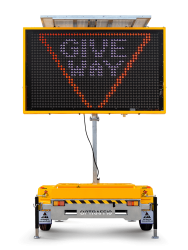
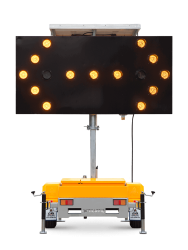



Truck-Mounted VMS for UK TMA Fleets
EN 12966-baseline message boards with attenuator-compatible mounting, supplied factory-direct to contractors and hire fleets.

Why UK Compliance Trips Up Fleets That Already Operate Elsewhere
A contractor buying a truck-mounted VMS for the first time often assumes compliance is a single checkbox: the hardware either meets a recognized standard or it doesn’t. That assumption holds less well in the UK than in most other markets. Optraffic’s team recently supplied truck VMS units to an Irish plant hire and construction contractor preparing for roadwork, and the question that came up wasn’t about the display hardware itself — it was about which UK framework actually governs whether that hardware can legally go on the road.
This is a common friction point for fleets that already run TMA message boards to a different market’s standard. A unit built to EN 12966, fully functional and legible, can still fail to clear UK deployment if the operator hasn’t separately confirmed TSRGD authorization and Chapter 8 display positioning. The hardware standard and the legal-use standard are not the same thing in the UK, and treating them as interchangeable is where fleets run into trouble mid-project rather than during specification. For background on how a TMA message board differs from a standard truck-mounted VMS in the first place, see that comparison guide. See Optraffic’s variable message sign range for TMA-compatible truck-mounted models.
Key Takeaways
- TMA message boards: Must meet UK Chapter 8 display legibility and mounting rules before deployment on live carriageways.
- Attenuator-equipped trucks: Require VMS units rated for the host vehicle’s mounting and vibration specifications.
- TSRGD authorization: Governs which temporary signs, including VMS displays, can legally appear on UK roads.
- Optraffic Web System: Lets hire fleets update TMA message content remotely across dispersed UK worksites.
- EN 12966-compliant hardware: Forms the manufacturing baseline UK buyers should confirm before Chapter 8 sign-off.
Chapter 8 and TSRGD: The Two Frameworks That Apply
UK temporary traffic signage sits under two related but distinct authorities, and confusing them is the root of most compliance gaps:
- Traffic Signs Manual Chapter 8 sets out display design, legibility, and deployment guidance for temporary traffic control, including VMS used on TMA trucks during mobile and static roadworks. Chapter 8 answers the question: if this sign is legally allowed on the road, how should it be displayed and positioned?
- TSRGD (Traffic Signs Regulations and General Directions) governs which signs are legally authorized for use on public roads in the first place, separate from how they should be displayed once authorized. TSRGD answers a different question: is this sign type permitted on UK roads at all?
A truck-mounted VMS used in the UK needs to satisfy both. Meeting one without the other leaves a fleet exposed — either running an unauthorized sign type correctly displayed, or an authorized sign type poorly positioned relative to the work area.
What a TMA Message Board Must Meet for UK Roads
| Requirement area | What Chapter 8 covers | What TSRGD covers |
|---|---|---|
| Display legibility | Character size, contrast, message clarity | — |
| Mounting position on host vehicle | Placement relative to attenuator and lane closure | — |
| Sign authorization | — | Whether the sign type is legally permitted for temporary use |
| Message content standards | Approved message formats and symbols | — |
Buyers should confirm both columns before deployment, not just one. A VMS unit that meets Chapter 8 display standards but isn’t a TSRGD-authorized sign type still can’t legally go on the road, and the reverse applies too — an authorized sign displayed incorrectly still creates a Chapter 8 compliance gap even though the sign itself is legal.
Host-Vehicle and Hardware Specs to Verify Before Ordering
TMA trucks impose mounting and durability requirements that a standard trailer-mounted VMS doesn’t face, and these specs need confirming before a unit ships, not after it arrives on site. Before specifying a truck-mounted VMS for a UK TMA fleet, confirm each of the following:
- Mounting compatibility with the attenuator unit. The VMS bracket must clear the attenuator’s crush zone and must not interfere with its function in an impact. A bracket positioned incorrectly can compromise the attenuator’s primary safety function, not just the sign’s visibility.
- Vibration and shock rating. A truck-mounted display experiences more road vibration than a stationary trailer unit, particularly on UK motorway surfaces where sustained highway speeds are common. A display rated only for trailer-level vibration may fail prematurely on a TMA truck.
- Manufacturing compliance baseline. Most UK-deployed VMS hardware is built to EN 12966, the underlying European display standard, which Chapter 8 guidance assumes as a manufacturing baseline even though Chapter 8 itself governs UK-specific deployment rules on top of that baseline.
The Department for Transport‘s Traffic Advisory Leaflet 01/15 on Variable Message Signs sets out further detail on VMS use for temporary traffic management, and is worth reviewing alongside Chapter 8 itself before finalizing a spec. Treating TAL 01/15 as a secondary reference, rather than skipping it because Chapter 8 seems sufficient, catches details that a Chapter 8 read-through alone can miss.
What Happens When Compliance Is Confirmed Too Late
The practical cost of treating UK VMS compliance as a single checkbox usually shows up mid-project, not at purchase. A fleet that specifies hardware first and checks TSRGD authorization afterward risks a unit that arrives on site but can’t legally deploy — forcing a delay while the operator sources an authorized alternative, or a scramble to document compliance retroactively. Confirming both Chapter 8 and TSRGD requirements during specification, before the order is placed, avoids that gap entirely.
Comparing UK Requirements to Other Markets
Contractors running fleets across multiple countries often ask how UK requirements compare to what they’ve already specified elsewhere, particularly when a single fleet operates across borders. For a side-by-side look at the equivalent requirements in Australia, see this guide on VMS requirements for TMA trucks under VicRoads and NSW, which covers a broadly similar two-layer structure — deployment guidance alongside separate sign authorization — under a different set of authorities. US-based fleets working to MUTCD and MASH TL-3 requirements can see the TMA message board MUTCD compliance guide for that market’s equivalent standards. None of the three frameworks map directly onto each other, which is exactly why a hardware standard like EN 12966 doesn’t substitute for confirming local deployment rules.
Updating Message Content Across a UK Fleet
Hire companies running TMA message boards across multiple UK worksites need to update display content without visiting each truck individually. A job that moves between sites, or a closure type that changes mid-project, often means the displayed message needs to change too — and driving out to reprogram each unit in person doesn’t scale past a handful of trucks. Optraffic’s Web System lets a fleet manager push message updates remotely, which matters most when message content needs to reflect a specific closure type under Chapter 8’s approved formats without pulling a truck off an active job to do it.
FAQ
Does a truck-mounted VMS need separate approval for UK roads beyond EN 12966?
Yes. EN 12966 covers the hardware manufacturing standard, but UK deployment also requires compliance with Chapter 8 display guidance and TSRGD sign authorization, which are UK-specific requirements layered on top of the manufacturing baseline.
What’s the difference between Chapter 8 and TSRGD for VMS trucks?
Chapter 8 covers how a VMS unit should be displayed and positioned during roadworks. TSRGD governs whether that sign type is legally authorized to appear on UK roads at all — a fleet needs both, not either.
Do TMA trucks in the UK need a different VMS mounting than standard truck-mounted VMS?
Yes. The VMS bracket must clear the attenuator’s crush zone and withstand the vibration typical of UK TMA truck deployment, which differs from a standard truck-mounted VMS without an attenuator.
How does UK TMA VMS compliance compare to Australian VicRoads and NSW requirements?
Both require jurisdiction-specific sign authorization and display standards, but the frameworks differ in structure and naming — UK relies on Chapter 8 and TSRGD, while Australia applies VicRoads and NSW-specific guidelines under AS 4852.2.
Conclusion
UK TMA VMS compliance runs on two tracks that buyers sometimes treat as one, and that assumption is where most compliance gaps start. Chapter 8 governs how the sign displays and positions on site. TSRGD governs whether it’s authorized to be there in the first place. A truck-mounted VMS built to EN 12966 covers the manufacturing baseline that both frameworks assume, but neither Chapter 8 nor TSRGD compliance follows automatically from meeting that baseline alone.
For contractors and plant hire companies running equipment across the UK and Ireland, or comparing requirements against US or Australian fleets operating under a different set of standards entirely, the practical fix is straightforward: confirm both frameworks during specification, not after the unit arrives on site. A fleet that builds this check into its ordering process avoids the far more expensive version of the same problem — a truck sitting idle on a job site while paperwork catches up to hardware that was never in question to begin with.




Lighting First or Recording First? CCTV-Ready Light Tower vs Camera Trailer for Integrators and Hire Fleets
CCTV-ready light tower vs camera trailer: compare whose camera runs, which load gets night power, and how hire fleets use one unit for two jobs.
VMS Trailers for Renewable Energy Zone Construction: Oversize Deliveries, Detours and Community Notice
How VMS trailers support renewable energy zone construction: oversize delivery warnings, detours, night moves and community notice on REZ routes.
Imported vs Australian-Built VMS Trailers: Where Each Has the Edge
Imported vs Australian-built VMS trailers: where each has a real advantage, what compliance requires of both, and how to choose for your fleet.
What Should a VMS Trailer Quote Include in Australia? Line Items to Compare Before You Sign
What should a VMS trailer quote include? Ten line items to compare, from delivery and registration to software fees, warranty and local spare parts.
When to Order VMS Trailers for Bushfire Season: A Region-by-Region Guide for Australian Hire Fleets
When to order VMS trailers for bushfire season: a region-by-region guide for hire fleets, with order-by months, stock top-ups and pre-season checks.
What Makes a VMS Trailer Mine-Spec? Site Entry Requirements for Western Australian Mine Sites
Mine-spec VMS trailer requirements under WA’s 2026 mine traffic code: visibility, ID, isolation, documents and how to order a unit that passes site entry.