


Off-grid surveillance for utility-scale solar and battery storage.
A finished solar farm has a fence, permanent power and an operations team. A solar farm under construction has none of those, and it has the copper.
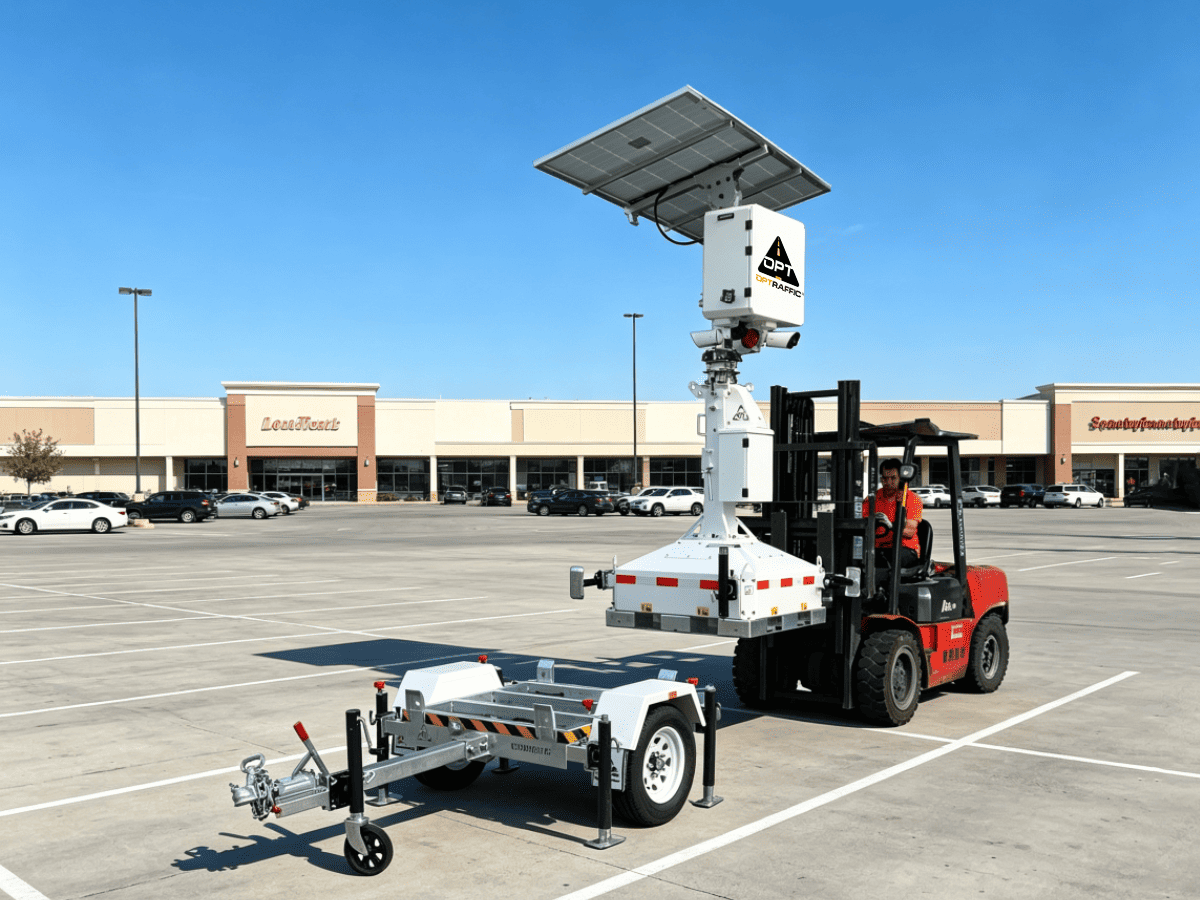
That gap is where most losses happen, and it is the window a cctv trailer for sale is usually bought to cover. This guide works through how EPC contractors, owners and equipment hire fleets should configure mobile surveillance across the build, and where a camera trailer stops being the right tool.
Key Takeaways
- Off-grid solar and battery power: Operates from the first day of site clearing, before permanent power exists.
- Relocatable mast and camera package: Follows the work front as the active area moves across a large parcel.
- On-board recording with local retention: Holds footage when cellular coverage fails at rural parcel edges.
- Rapid redeployment between phases: Moves from laydown yard to inverter pads without a new installation.
- Single-platform fleet view: Shows unit status across dispersed positions on one screen.
Why Construction Phase Security at a Solar Farm Is the Real Exposure Window
The asset changes character three times during a build, and so does the risk.
During clearing and civil works, the site holds plant and fuel. During racking and module installation, it holds panels, tools and staged materials. During electrical work, it holds the thing that draws organised crews: copper.
Construction phase security solar farm planning fails when it treats the parcel as one static risk. Perimeter fencing often arrives late, or in sections. Permanent power and lighting arrive later still. Staff presence ends at shift close, and the site sits open overnight across hundreds of acres.
The Timing Problem Nobody Budgets For
Security procurement typically happens at mobilisation. The highest-value exposure arrives months later, during cable pulling and termination.
Sites that install nothing until the first theft then buy under pressure, at whatever rate is available, for whatever position the first incident happened to occur. Planning coverage by phase avoids both problems.
Solar Farm Copper Theft Prevention: What Crews Actually Target
Solar farm copper theft prevention starts with knowing which materials move and which do not.
| Target | Why it is taken | Where it sits during the build |
|---|---|---|
| Copper feeder and collection cable | High scrap value per foot, easy to transport | Trenches, reels in laydown, cable pulls |
| Connectors and lugs | Small, high copper content | Staged with cable, on racks |
| Inverters and transformers | Copper windings, resale value | Pads, often before energisation |
| Modules | Resale channels exist | Racked rows and pallets |
| Tools, fuel and plant | Opportunistic | Laydown yard, compound |
Federal agencies now treat this as an infrastructure problem rather than ordinary property crime. In May 2026, CISA issued a cross-sector fact sheet on copper wire theft, covering the hazards to responders and the disruption caused when criminal actors strip energy and transportation infrastructure (CISA).
Solar sites show the same pattern at project scale. In May 2026, Nash County, North Carolina law enforcement reported roughly 2,000 feet of copper wiring and around 40 connectors taken from two solar farms after perimeter fencing was cut, with combined reported losses of about $11,000.
The material value is rarely the real number. Replacement cable, crew remobilisation, re-termination, re-testing and schedule delay all follow, and a site hit once is commonly hit again.
Camera Trailer for Solar Farm Security: What the Site Does to the Equipment
A camera trailer for solar farm security faces conditions that differ from an urban construction site.
Scale. A utility-scale parcel can run to hundreds or thousands of acres. No single position covers it. Coverage has to be planned around chokepoints rather than area.
No grid. Nothing on site is energised for months. Any unit that needs mains power needs a generator, fuel deliveries and someone to service it.
Distance and connectivity. Parcel edges sit far from towers. Cellular coverage varies across a single site, and a position that works at the compound may not work at the far boundary.
Dust and ground conditions. Access tracks are unsealed. Units move over rough ground repeatedly.
Off-Grid Surveillance for Renewable Projects Has One Non-Negotiable
Off-grid surveillance for renewable projects must survive the season, not the week. A power system sized for summer generation fails in December at the same latitude.
Two specification points follow. Autonomy should be stated in consecutive low-generation days, not in nominal hours. Recording should continue locally when the link drops, so a coverage gap does not become an evidence gap.
Configuring Coverage by Project Phase
Phase-based planning is what separates a working deployment from a unit parked at the gate for eighteen months.
| Project phase | Primary risk | Camera positions that matter | Configuration priority |
|---|---|---|---|
| Site clearing and civils | Plant, fuel, opportunistic entry | Access gate, laydown yard | Mobility, fast redeployment |
| Racking and module install | Panels, tools, staged materials | Laydown yard, active work front | Mast height over racked rows |
| Electrical and cable pulling | Copper cable, connectors | Cable reels, trench runs, inverter pads | Night performance, retention capacity |
| Commissioning and energisation | Inverters, transformers, substation | Substation compound, pad areas | Fixed-position stability, longer stay |
| Early operations | Repeat targeting after first incident | Previously hit locations, gates | Long autonomy, low attendance |
Two rules apply across the phases. Units should move with the work front rather than hold a position chosen at mobilisation. And previously targeted locations deserve coverage after the incident, because repeat visits are common.
Camera Trailer Coverage for Utility Scale Sites: How Many Units
Camera trailer coverage for utility scale sites is a chokepoint problem, not a perimeter problem. Fencing a parcel boundary with cameras is neither affordable nor necessary.
Count these instead:
- Vehicle access points. Anyone removing cable in quantity needs a vehicle. Gates and informal track entries come first.
- Laydown and staging areas. Concentrated value, and usually a small number of locations.
- Active cable pull zones. These move weekly, which is why relocatable units beat fixed installations here.
- Inverter and substation pads. High value, fixed position, long dwell.
A workable starting point is one unit per vehicle access point, one per active laydown area, and one following the electrical work front. Owners then adjust after the first month based on what the footage shows about actual approach routes.
Informal entries matter more than the main gate. Crews frequently enter through gaps in partial fencing, neighbouring parcels or unsealed farm tracks. A camera on the formal gate alone records the one route thieves do not use.
Battery Storage Site Security in the US Differs From Solar
Battery storage site security US planning starts from different geometry. A battery energy storage site concentrates high value in a small footprint, and it stays valuable after commissioning.
Three differences change the configuration:
- Smaller area, higher density. Fewer positions cover the site, but each position carries more value behind it.
- Permanent exposure. Solar sites become lower-risk once energised and staffed. Battery sites often remain unstaffed permanently.
- Access control emphasis. Knowing who entered and when matters more where the site is normally empty.
The same construction-window logic applies in other markets, covered for Australian projects in our guide to solar farm security camera trailers in Western Australia.
Many battery projects sit adjacent to a solar farm and share an access road. Coverage planning should treat them as one deployment with two risk profiles rather than two separate procurements.
Recording Rules Still Apply on Private Industrial Sites
Site ownership does not remove the recording rules. Three checks belong in the deployment plan.
- State recording consent law. Audio recording is governed separately from video, and consent requirements vary by state. Specify whether audio capture is enabled at all.
- Signage. Notice of recording is standard practice and supports both deterrence and the evidentiary position afterwards.
- Worker monitoring. Cameras covering active work areas record employees and contractors. Employment counsel should confirm the approach where footage could be used in a personnel context.
Retention deserves a decision rather than a default. Insurance and subrogation claims on theft and damage often surface months after an incident, and retention should be specified against that window.
What a Camera Trailer Does Not Solve
Three limits belong in any honest procurement discussion.
Detection is not response. A unit that records an intrusion at 2 am changes nothing unless someone is watching and someone can respond. Monitoring service and response protocol are separate decisions from equipment.
Coverage is not a fence. Cameras raise the probability of identification. They do not physically stop access, and on a partially fenced parcel they should be planned alongside physical measures.
Footage is not always usable. A camera positioned for area coverage rarely produces the identification-quality image an investigation needs. Chokepoint positions at vehicle entries produce better evidence than wide-area views across rows.
Conclusion
Solar and storage projects concentrate their exposure in the months before the site becomes what the security design assumed. No fence, no permanent power, no staff, and copper on the ground.
Plan coverage by phase, place units at vehicle chokepoints rather than boundaries, size power for the worst generation month, and keep recording local when the link drops. Re-cover any location that has already been hit.
Optraffic manufactures solar-powered camera trailers with on-board recording and supplies its fleet management platform with the equipment, so dispersed units across a large parcel appear in one view. Contact the Optraffic team to plan phase-by-phase coverage for a specific project.
FAQ
How many camera trailers does a utility-scale solar site need?
Start from chokepoints. Camera trailer coverage for utility scale sites typically means one unit per vehicle access point, one per laydown area, and one following the electrical work front.
When should security be deployed on a solar build?
At mobilisation, not at first incident. Construction phase security solar farm exposure peaks during cable pulling, but plant and fuel are at risk from clearing onward.
What makes battery storage sites different?
Density and permanence. Battery storage site security US planning covers a smaller footprint that stays valuable and usually unstaffed after commissioning.
Do camera trailers work without cellular coverage?
Yes, with local recording. Off-grid surveillance for renewable projects should keep recording when the link drops, so a connectivity gap does not become an evidence gap.
Does recording on private land avoid consent rules?
No. Audio is regulated separately from video and varies by state, signage remains standard practice, and footage covering workers raises employment considerations.



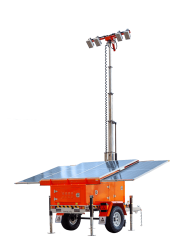
Lighting First or Recording First? CCTV-Ready Light Tower vs Camera Trailer for Integrators and Hire Fleets
CCTV-ready light tower vs camera trailer: compare whose camera runs, which load gets night power, and how hire fleets use one unit for two jobs.
VMS Trailers for Renewable Energy Zone Construction: Oversize Deliveries, Detours and Community Notice
How VMS trailers support renewable energy zone construction: oversize delivery warnings, detours, night moves and community notice on REZ routes.
Imported vs Australian-Built VMS Trailers: Where Each Has the Edge
Imported vs Australian-built VMS trailers: where each has a real advantage, what compliance requires of both, and how to choose for your fleet.
What Should a VMS Trailer Quote Include in Australia? Line Items to Compare Before You Sign
What should a VMS trailer quote include? Ten line items to compare, from delivery and registration to software fees, warranty and local spare parts.
When to Order VMS Trailers for Bushfire Season: A Region-by-Region Guide for Australian Hire Fleets
When to order VMS trailers for bushfire season: a region-by-region guide for hire fleets, with order-by months, stock top-ups and pre-season checks.
What Makes a VMS Trailer Mine-Spec? Site Entry Requirements for Western Australian Mine Sites
Mine-spec VMS trailer requirements under WA’s 2026 mine traffic code: visibility, ID, isolation, documents and how to order a unit that passes site entry.