


Temporary Reversible Lane Operation: How Message Signs Support Peak and Event-Day Lane Reversals
Tell Drivers Which Way Each Lane Runs
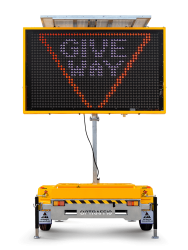
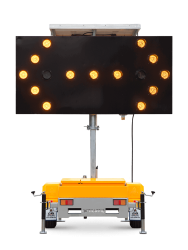
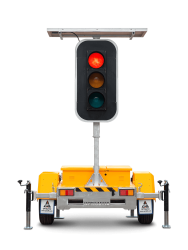
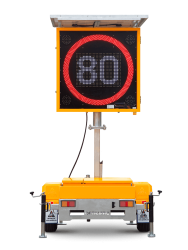
Solar full-matrix message sign trailers with remote control and radar speed warnings.

A stadium empties all at once. Every car wants to leave in the same direction. The road has two lanes outbound and two lanes inbound, and the inbound lanes sit almost empty. Temporary reversible lane operation turns that empty capacity into an exit route. It only works if drivers understand which way each lane runs, and when that changes. Agencies and hire fleets use variable message signs to carry that information upstream of the reversal. The Optraffic team builds solar message sign trailers with remote control for these short, high-pressure operations. This guide covers what MUTCD allows, where signs go, and how to word each phase.
Key Takeaways
- Remote message control: Switches lane reversal messages from a phone at each transition, without crews entering live lanes.
- Full-matrix message display: Shows lane arrows and closed-lane symbols, not just text, at reversal approaches.
- Radar speed warning: Displays an overspeed message to drivers approaching a lane reversal transition too fast.
- Bundled fleet software: Tracks every sign along the corridor by GPS, with no subscription fee.
- Solar-powered message signs: Run event-day and seasonal reversals without generators or refuelling trips.
When Temporary Reversible Lane Operation Makes Sense
Short answer: Use a temporary reversal when peak demand runs one way for a short, predictable period.
Permanent reversible lanes need overhead signals, gantries and control systems. That investment makes sense on daily commuter corridors. Many corridors only need a reversal a few times a year. Others need a trial before an agency commits funding.
| Use case | Typical duration | Why a temporary setup fits |
|---|---|---|
| Event-day egress | One to two hours after the event | Demand peaks one way, then returns to normal |
| Seasonal or holiday peaks | Weekends or holiday periods | Permanent equipment would sit idle most of the year |
| Trial before permanent signals | Weeks or months | Agencies test demand and driver behaviour first |
| Capacity shift during a nearby closure | Length of the closure | A parallel route absorbs diverted traffic in one direction |
The FHWA Managing Travel for Planned Special Events handbook shows a temporary reversible lane operation on a two-lane arterial. Crews used cones and road shoulders to create temporary four-lane operation. That approach depends on clear driver information at every entry point. For signal timing and crowd flows on event days, see how temporary signals support event traffic management.
What MUTCD Section 2B.26 Allows for Reversible Lane Control
Short answer: MUTCD allows changeable message reversible lane signs. Portable signs still do not replace required overhead control.
The MUTCD 2009 Edition, Section 2B.26 sets out how agencies sign reversible lanes. Three points matter most for temporary operations:
- Reversible Lane Control signs may be static or changeable message type.
- Post-mounted reversible lane signs only supplement overhead signs or signals.
- Signs and markings alone may control a reversal only under three conditions. Only one lane reverses, an engineering study supports it, and the lane pattern stays simple.
Overhead lane-use control signals sit in MUTCD Chapter 4M of the 2009 Edition. Missouri’s Engineering Policy Guide on lane-use control signals shows how one state applies them. States have now adopted the 11th Edition, so check section numbers in your state manual.
| Device | Main role | When it is needed | Limits |
|---|---|---|---|
| Overhead lane-use control signals | Show lane status over each lane: green arrow, red X | Complex or multi-lane reversals | Fixed gantries; slow and costly to install |
| Overhead reversible lane control signs | State lane direction and hours over the lane | Single-lane reversals that meet MUTCD conditions | Need overhead mounting points |
| Reversible lane message signs (portable) | Advance notice, transition warnings, hours and detours | Upstream of every entry point, on all reversal types | Supplement, not replace, required overhead control |
For what a green arrow or red X means to drivers, see lane control signs and their meanings. This split keeps a plan honest. Portable message signs carry the information drivers need before they reach the reversed section. Overhead devices control the lanes themselves.
Reversible Lane Message Sign Placement
Short answer: Place message signs before every point where drivers can still choose a lane or a route.
Reversals fail at the edges. Drivers enter from side streets, ramps and the far end of the corridor. Each entry needs its own warning. Use this order to plan placement:
- Map every entry point to the reversed section, including side streets and driveways.
- Place a message sign upstream of each major entry, before the last lane choice.
- Add a sign at the transition zone where lanes change direction.
- Place a sign at the far end for drivers approaching against the reversal.
- Check sight distance at each location, especially near queues and curves.
Phoenix runs a long-standing weekday reversal on 7th Street and 7th Avenue. The City of Phoenix reversible lane page notes the use of overhead and roadside signs. They show hours, direction and left-turn bans. Temporary operations need the same information, delivered by portable signs. Reversals form one part of wider traffic safety equipment planning.
Peak-Hour Reversible Lane Entry Points
A peak-hour reversible lane draws drivers who use the corridor daily. Regulars learn the pattern fast. Visitors do not. Signs at entry points should target the driver who has never seen the reversal before.
Writing Lane Reversal Transition Messages
Short answer: Give each phase one idea. Change the message from notice, to operation, to reset.
Lane reversal transition messages must work in a few seconds of reading time. Drivers approach at speed, often in heavy traffic. MUTCD guidance for portable changeable message signs limits a message to two phases.
| Reversal phase | Timing | Example message |
|---|---|---|
| Advance notice | Days or hours before the first reversal | LANE REVERSAL / SAT 9PM–11PM |
| Transition | While crews or signals switch lanes | LANES CHANGING / USE RIGHT LANE |
| Active reversal | While the reversal runs | LEFT LANE / OUTBOUND ONLY |
| Reset | After lanes return to normal | NORMAL LANES / RESUMED |
Follow these wording rules:
- Make each phase understandable on its own.
- Name the lane and the direction, not just “reversal.”
- Use times drivers can check against a clock.
- Avoid abbreviations visitors may not know.
- Remove the message as soon as the reversal ends.
For more wording patterns, see these safety messages that improve driver compliance.
Full-Matrix Lane Arrow Display
Text alone can confuse drivers in multi-lane reversals. A full-matrix lane arrow display shows arrows and closed-lane symbols across the sign face. Drivers read a symbol faster than a sentence. Three-line message signs display text only. They suit simple notices, but not lane graphics. For the difference between the two formats, see what a full-matrix message sign is. For multi-lane guidance, compare multi-screen message signs for lane guidance and detours.
Speed Warnings in the Transition Zone
Transitions carry the highest risk. Drivers meet cones, merges and opposing traffic in a short distance. A radar-equipped message sign measures approaching speed. When a driver exceeds the set threshold, the sign shows an overspeed warning message. It does not display the driver’s speed. This keeps attention on the lane change ahead.
Remote Lane Reversal Message Updates
Short answer: Remote control lets one supervisor switch every sign at each transition, without crews walking into live lanes.
A reversal changes messages several times in one session. Sending a crew to each sign means more people near live traffic. It also means messages change at different times along the corridor. Drivers then see conflicting information.
Remote lane reversal message updates solve both problems. A 4G-connected sign accepts new messages from a phone, tablet or PC. A supervisor switches all signs at the planned transition time. GPS on each unit confirms the sign sits in the right place. This guide to web-based traffic device management for rental fleets covers the checks that matter.
Software costs deserve a close look. Many fleet platforms charge a monthly fee per device. Event and seasonal units may sit idle for weeks. Some manufacturers bundle the fleet software with the hardware at no added cost. Compare five-year software costs before you buy.
Uptime matters as much as software. A reversal cannot start if a sign fails at an entry point. Proven LED modules, sealed enclosures and low-maintenance designs keep units ready between events. Solar power removes the need for generators near crowds.
Testing a Reversible Lane Before Building Permanent Signals
Short answer: Run a temporary reversal first, measure how drivers respond, then decide on permanent control.
Cities already work this way. Calgary uses temporary signs and pylons for manual reversals. It uses them near construction and when testing permanent systems, according to the City of Calgary lane reversal page. The city notes that some transitions take up to 10 minutes.
Reversible lanes also face public review. In May 2026, Phoenix began reviewing its 7th Street and 7th Avenue reversible lanes, as KTAR reported. The study will review options up to removal, with a final report due to council in the fall. A temporary trial gives agencies evidence before they build or remove anything.
Use this checklist for testing a reversible lane before permanent signals:
- Define the trial period and the hours of each reversal.
- Sign every entry point with portable message signs.
- Record queue lengths and travel times before and during the trial.
- Log driver complaints and near misses at each transition.
- Review sign placement after the first week, and move units where drivers hesitate.
FAQ
Can portable message signs replace lane-use control signals?
No. MUTCD treats post-mounted reversible lane signs as a supplement to overhead signs or signals. Portable message signs carry advance notice, transition warnings and hours. Overhead devices still control lane status where MUTCD requires them.
Which message sign type can show lane arrows?
A full-matrix message sign can show arrows and lane symbols. Three-line message signs show text only. Choose full-matrix units for multi-lane reversals.
How long does a lane reversal transition take?
It depends on the corridor and the method. Calgary notes that some of its transitions take up to 10 minutes. Manual reversals with cones usually take longer than signal-controlled ones.
Why are some cities reviewing reversible lanes?
Some residents report confusion and safety concerns. Phoenix launched a study in 2026 to review its reversible lanes, including removal. Clear signing at every entry point addresses part of that concern.
Conclusion
Temporary reversible lane operation adds capacity exactly when one direction needs it. It works only when drivers know which lane to use, and when that changes. Message signs at every entry point, clear phase-by-phase wording and remote switching make that possible. Optraffic supplies solar full-matrix message sign trailers with radar speed warnings for these operations. Every unit connects to the Optraffic Web System at no added software cost. Agencies and hire fleets can contact the Optraffic team to plan signs for their next lane reversal.
Facebook
Twitter
LinkedIn
Email
Newsletter
Subscribe to our Newsletter & Event right now to be updated.
Latest Posts


Latest Posts
What to Check Before Buying 500 Portable Changeable Message Signs: 7 Batch Delivery Checks for Rental Fleets
What to check before buying 500 portable changeable message signs: one build across batches, spares, DDP delivery and per-shipment tests.
2026-11-11
How to Plan Message Signs for Weekend Highway Closures: Lessons from Atlanta’s I-285 Westside Closures
How to plan message signs for weekend highway closures: 5 steps, a 48-hour checklist and fleet control lessons from Atlanta’s I-285 closures.
2026-11-11
Does EN 12966 Apply to LED Modules? What the Standard Covers and What a Datasheet Cannot Prove
Does EN 12966 apply to LED modules? See what the standard covers, what a module datasheet proves and 5 questions to ask a supplier.
2026-11-10
Build vs Buy a Vehicle-Mounted Message Sign: What Fleets and Integrators Should Check
Build vs buy a vehicle-mounted message sign? Compare compliance, controls, mounting and support before you choose.
2026-11-10
Work Zone Speed Feedback Trailer Placement: Where to Set It Up and When to Move It
Work zone speed feedback trailer placement explained: where DOT rules and research say to set the trailer, when to move it and what fleets must log.
2026-11-05
WZDx Device Feed Requirements: What Work Zone Contractors and Hire Fleets Must Supply
WZDx device feed requirements explained for contractors and hire fleets: what the feed holds, what DOT specs ask for and how to prepare equipment.
2026-11-04