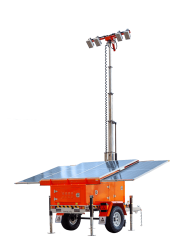



Service life on a hybrid light tower is not set by the component with the longest published rating. It is set by whichever component reaches the end of its working life first — and on a solar hybrid unit that is almost never the solar panels. Trace the four subsystems by their real limiting factor, and a clearer answer emerges: the battery bank’s cycle count and the generator’s accumulated run hours decide when a hybrid tower needs serious money spent on it, and both of those are governed by how the tower is operated rather than how it was built.
Key Takeaways
- Nothing on the tower fails as a unit: the battery bank and generator reach end of life first and are both replaceable, while panels, LED fixtures, mast, and trailer typically outlast several bank replacements.
- The gel battery bank is the first consumable: its life is measured in charge cycles, and cycle count falls as depth of discharge increases — making daily operating practice, not purchase specification, the deciding factor.
- Generator hours are what hybrid operation actually changes: because solar carries the routine load, the 5KW gasoline generator on an Optraffic Hybrid Light Tower accumulates hours far more slowly than an engine in a generator-only light plant, spreading its service life across more calendar years.
- Runtime headroom protects the bank, not just the shift: Optraffic’s published figure of over 30 hours on a full charge means a ten- or twelve-hour shift runs in the shallow part of the discharge range, where cycle life is longest.
- Panel and LED ratings from stationary installations do not transfer to a trailer: on a towed unit the limiting factor is transport damage and connector fatigue, and the 50,000-hour LED figure marks 70% lumen output rather than a failure point.
- Frequent switching does not shorten LED life: that behaviour belongs to fluorescent and metal halide sources, which is why timer and motion-based lamp scheduling cuts both battery cycling and generator hours at once.
What Actually Limits a Solar Hybrid Light Tower’s Lifespan
Component ratings published in isolation invite the wrong conclusion. A tower is not “good for 25 years” because its panels are; it needs its first significant intervention when the shortest-lived subsystem reaches end of life.
| Subsystem | Optraffic specification | What actually limits it in service |
|---|---|---|
| Solar panels | 4 × 455W | Physical damage from transport, hail, and lifting — not light-induced degradation |
| Battery bank | 4/6 × 200Ah DC 12V deep cycle gel | Cycle count at the depth of discharge routinely used |
| Generator | 5KW gasoline | Accumulated run hours and adherence to service intervals |
| LED fixtures | 4/6 × 100W, 60,000–90,000 lm | Thermal stress and mechanical shock; lumen depreciation over a long horizon |
| Trailer and mast | 6.5 m square telescopic, galvanised frame | Corrosion and cumulative towing stress |
Read down the right-hand column and the ranking is clear. On a hybrid unit in regular service, the battery bank and the generator are the two subsystems that will demand attention first — and they are the two whose life is decided by operating pattern, not by purchase decision.
Generator Run Hours: The Variable Hybrid Operation Actually Changes
This is the mechanism that makes the hybrid configuration different, and it is routinely explained backwards. A hybrid tower’s components are not individually more durable than a generator-only tower’s. What changes is the rate at which one of those components ages.
A generator-only light plant accumulates engine hours on every hour it lights the site. Every hour of operation is an hour on the service clock, and the maintenance schedule — oil, filters, plugs, eventual major work — advances with it.
On the Optraffic hybrid unit, the solar array and gel bank carry the load first. The 5KW gasoline generator engages only when the charge cycle has not kept up: extended overcast periods, winter deployments, or continuous operation where the bank has no daytime window to recover. Across a season, that pattern can leave the engine with a fraction of the hours an equivalent generator-only unit would have logged.
The consequences follow directly:
- Service intervals arrive less frequently, because they are measured in engine hours rather than calendar time on site.
- The engine’s overall service life stretches across more calendar years, since the same total hours are spread over a longer period.
- Fuel handling and refuelling trips drop, which on remote deployments is often the larger operating cost.
Two variables control how much of that benefit a given site actually realises: how often the charge cycle falls short, and how heavily the lamps are run. Sites with good irradiance and defined shift hours convert most of it. Sites running continuous operations in winter convert less, because the generator is doing more of the work — which is precisely why they specified hybrid in the first place.
For fleets weighing whether a site profile justifies the hybrid configuration at all, the decision is a separate question from service life; the selection trade-offs are set out in Optraffic’s comparison of solar hybrid light towers and diesel for construction sites.
Battery Cycle Life in a Hybrid Light Tower
The gel bank is the component most likely to reach end of life first, and its life is measured in cycles rather than years.
Every discharge and recharge consumes one cycle, but the number of cycles available is not fixed — it varies inversely with how deeply the bank is drawn. A bank routinely taken to a shallow depth of discharge delivers substantially more cycles than the same bank taken deep every night. This is a property of the chemistry, not a quality difference, and it is why two identical towers on two different sites can reach bank replacement years apart.
Optraffic’s published runtime of over 30 hours on a full charge matters here for a reason that is easy to miss. A tower covering a ten- or twelve-hour shift from a bank rated for over thirty hours of continuous operation is not working near the bottom of its capacity — it is operating in the shallow part of the discharge range, where cycle life is longest. Runtime headroom is therefore not only about surviving a cloudy week; it is about how many years the bank lasts.
Three operating practices materially extend gel bank life:
- Avoid habitual deep discharge. The damage is cumulative and irreversible, and it surfaces months after the habit that caused it.
- Keep the charge path clear. A bank that never quite reaches full charge sits in a partial state that accelerates ageing. Panel soiling and shading are the usual culprits, and charge controller selection determines how much array output actually reaches the bank — the difference between MPPT and PWM controller architectures is measurable in low light, and implementations differ further, as the comparison of Epever and Victron MPPT units shows.
- Manage heat. Sustained high ambient temperature accelerates chemical ageing in every lead-acid variant, gel included. A unit parked in full sun in a hot climate ages faster than an identical unit in a temperate one.
Where a bank has already lost capacity, the symptom is a tower that once ran all night and now stops early — a pattern with several possible causes, worked through in order in the guide to diagnosing a light tower that stops after two hours. Buyers specifying replacement banks or comparing chemistries across a fleet order will find usable capacity and cycle life covered in the guide to how battery type affects portable light tower performance.
At end of life, disposal is regulated. Spent lead-acid batteries, including gel cells, fall under EPA hazardous waste and universal waste provisions and must not enter general waste streams.
Solar Panel and LED Service Life on a Mobile Trailer
Published figures for both of these subsystems come from stationary installations, and applying them unadjusted to a towed trailer produces an over-optimistic picture.
Solar panels. Warranty periods in the 25-year range describe roof-mounted and ground-mounted arrays that are installed once and never moved. A light tower array is towed over rough ground, lifted, parked among plant and materials, and exposed to hail and site debris. The realistic limiting factor is mechanical damage and connector fatigue, not the slow light-induced degradation those warranties are written around. Panels on a mobile unit are best treated as an inspection item rather than a fit-and-forget component.
LED fixtures. The familiar 50,000-hour figure is not a failure point. Under the US Department of Energy’s guidance, LED luminaire lifetime is conventionally expressed as the point at which output has fallen to 70% of initial levels across the population, derived from IES LM-80 test data and TM-21 projections. The fixture keeps working past that point; it simply produces less light. On a work site, that gradual decline shows up as an area that no longer meets its required illuminance long before any lamp fails outright.
One claim worth correcting, because it appears widely and is wrong for this technology: LEDs are not degraded by frequent switching. That behaviour belongs to fluorescent and metal halide sources, whose electrodes and arc tubes suffer at each start. Optraffic’s LED fixtures start instantly with no warm-up period, which is what makes timer and motion-based lamp scheduling viable — and scheduling reduces both battery cycling and generator hours at once.
Hybrid Light Tower Maintenance Schedule by Component
Service life responds more to maintenance discipline than to any specification on the order form.
| Component | Routine task | Why it affects service life |
|---|---|---|
| Solar panels | Clean; inspect glass, frame, and connectors after transport | Soiling and shading create the charge deficit that drives deep cycling |
| Battery bank | Monitor state of charge; avoid habitual deep discharge | Cycle life falls sharply as depth of discharge increases |
| Generator | Follow the manufacturer’s hour-based service intervals; check fuel condition on units that sit idle | Gasoline engines are sensitive to stale fuel during long solar-only periods |
| LED fixtures | Clean lenses; check mounting hardware after towing | Vibration loosens fixings; dirty lenses reduce delivered light |
| Mast and trailer | Inspect the telescopic sections, lifting mechanism, and galvanised surfaces | Corrosion and towing stress are the trailer’s real ageing mechanisms |
The generator entry carries a point specific to hybrid units. On a tower where solar covers most of the load, the engine may sit unused for long stretches — and stale fuel, not wear, becomes the more common cause of a generator that will not start when it is finally needed. Periodic exercise and fuel management matter more on a hybrid than on a generator-only unit.
Fleet operators managing multiple units across sites will find the interaction between bank size, mast height, and lamp configuration set out in Optraffic’s complete guide to light towers, and the deployment patterns that drive duty cycle in the review of mobile lighting tower use on construction sites.
Frequently Asked Questions
How long does a solar hybrid light tower last overall?
There is no single figure, because the tower does not fail as a unit. The battery bank and generator reach end of life first and are both replaceable; panels, LED fixtures, mast, and trailer typically outlast several bank replacements. A well-maintained hybrid unit is best understood as a chassis with two consumable subsystems.
Which component fails first on a hybrid light tower?
The battery bank, in most fleets. Its life is measured in cycles, and cycle count falls as depth of discharge increases — making it the subsystem most sensitive to daily operating practice.
Do generator hours really affect a hybrid tower’s service life?
Directly. Service intervals and engine wear are measured in run hours. Because solar carries the routine load on a hybrid unit, the same engine accumulates hours far more slowly than one in a generator-only light plant, spreading its service life across more calendar years.
Do the solar panels need replacing during the tower’s life?
Rarely on their own. Panel replacement on a mobile unit is usually triggered by physical damage from transport or site impact rather than by age-related output loss.
Does running the tower without the generator extend its life?
It extends the generator’s life while consuming battery cycles. Operating primarily on solar is the right default, but sites that regularly run the bank deep to avoid starting the engine are trading engine hours for bank life — usually a poor exchange, since the bank is the more expensive consumable.
Conclusion
Asking how long a solar hybrid light tower lasts is really asking two narrower questions: how many cycles the gel bank will deliver at the depth of discharge the site actually uses, and how many hours accumulate on the gasoline generator once solar has taken most of the load. Panels, LED fixtures, mast, and trailer are long-horizon components that rarely determine the timing of a major spend. Fleets that monitor state of charge, keep the charge path clean, and follow hour-based engine servicing extend both consumables well past the point reached by fleets that simply run the units until something stops.
Optraffic manufactures the Hybrid Light Tower in three configurations, supplying rental fleets, contractors, mine operators, and government agencies across the US, UK, and Australian markets.




Lighting First or Recording First? CCTV-Ready Light Tower vs Camera Trailer for Integrators and Hire Fleets
CCTV-ready light tower vs camera trailer: compare whose camera runs, which load gets night power, and how hire fleets use one unit for two jobs.
VMS Trailers for Renewable Energy Zone Construction: Oversize Deliveries, Detours and Community Notice
How VMS trailers support renewable energy zone construction: oversize delivery warnings, detours, night moves and community notice on REZ routes.
Imported vs Australian-Built VMS Trailers: Where Each Has the Edge
Imported vs Australian-built VMS trailers: where each has a real advantage, what compliance requires of both, and how to choose for your fleet.
What Should a VMS Trailer Quote Include in Australia? Line Items to Compare Before You Sign
What should a VMS trailer quote include? Ten line items to compare, from delivery and registration to software fees, warranty and local spare parts.
When to Order VMS Trailers for Bushfire Season: A Region-by-Region Guide for Australian Hire Fleets
When to order VMS trailers for bushfire season: a region-by-region guide for hire fleets, with order-by months, stock top-ups and pre-season checks.
What Makes a VMS Trailer Mine-Spec? Site Entry Requirements for Western Australian Mine Sites
Mine-spec VMS trailer requirements under WA’s 2026 mine traffic code: visibility, ID, isolation, documents and how to order a unit that passes site entry.