
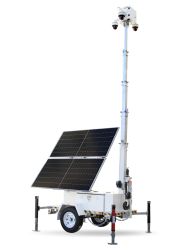
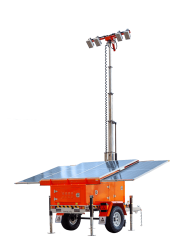
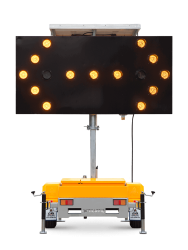

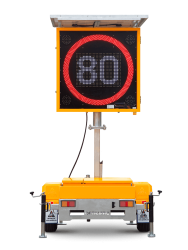



Most hire fleets built their message sign stock around three-line boards. Contractors knew them, and agencies wrote them into plans. Job tickets now ask for more. Contractors want lane-status graphics, detour arrows and symbol messages. A three-line board cannot draw any of them. This guide shows how to approach replacing three-line message signs with full-matrix units without overbuying. It also shows where Optraffic solar full-matrix sign trailers fit a staged fleet plan.
The Optraffic team reviewed one setting before writing this guide: frame flash timing. That setting decides whether a full-matrix unit can stand in for an arrow board. At the default 0.5 seconds on and 0.5 seconds off, a frame flashes 60 times per minute. MUTCD caps arrow board displays at 40. Each phase therefore needs adjusting before arrow use, and this guide shows the settings that work.
Key Takeaways
- Full-matrix display: Renders MUTCD graphics, symbols and free-form text that three-line boards cannot draw.
- Adjustable frame flash timing: Sets arrow displays inside the MUTCD range of 25 to 40 flashes per minute.
- Bundled fleet software: Manages three-line and full-matrix units from one login with no subscription fee.
- Light-sensing brightness control: Adjusts LED output automatically and extends message board service life.
- 360-degree rotatable display: Aims the screen at traffic without repositioning the trailer on narrow shoulders.
Why the Three-Line vs Full-Matrix Fleet Mix Is Shifting
The three-line vs full-matrix fleet mix used to be an easy call. Three-line boards covered most work zone messages. Full-matrix units looked like a premium extra.
That balance changes when message content changes. A lane closure message now often needs a lane-status graphic. A detour message often needs an arrow beside the street name. Neither fits a fixed grid of characters.
If full-matrix terminology is new to your team, start with this explainer on what a full-matrix message sign is.
Idle Units Point to a Mismatched Mix
A split fleet shows the problem in its booking calendar. Graphic-capable units stay booked. Three-line units wait in the yard. Dispatchers then make one of three bad choices:
- They turn the job away.
- They send a three-line board and ask the client to simplify the message.
- They cross-hire a graphic unit from a competitor.
Each choice costs margin or goodwill. None of them shows up as a line item, so the cost stays hidden.
Graphic Requests a Three-Line Board Turns Away
Three-line boards display characters inside fixed cells. They can approximate an arrow with characters like “<<<“. They cannot draw a lane-status symbol, a speed limit sign face or a true directional arrow. When a traffic management plan specifies a graphic, the three-line board drops out of the bid.
Line count is a separate question from matrix type. A comparison of 2-line, 3-line and 5-line changeable message signs covers that trade-off.
Full-Matrix Graphics for Detour and Lane Messages: What the Swap Adds
Full-matrix graphics for detour and lane messages are the main reason fleets swap units. A full-matrix panel controls every pixel. It can place a graphic and text side by side on one screen.
The table below maps common job types against both sign types.
| Job type | Three-line board | Full-matrix unit | Fleet note |
|---|---|---|---|
| Text-only advance warning | Fully capable | Fully capable | Either unit works |
| Lane closure with lane-status graphic | Text only | Graphic plus text | Full-matrix preferred |
| Detour with directional arrow and street name | Character arrows only | True arrow plus text | Full-matrix preferred |
| Speed limit symbol message | Not supported | MUTCD symbol supported | Full-matrix required |
| Arrow board simulation | Not suited | Possible with correct flash timing | Check state specification |
| Long-term static message, rare changes | Fully capable | Fully capable | Keep three-line units here |
The pattern is clear. Three-line boards still cover text jobs well. Full-matrix units win every job that needs a picture.
For the display mechanics behind this table, read full-matrix vs line-matrix vs character-matrix message signs.
Matching Graphic Content to Driver Reading Time
Graphics help only when drivers read them quickly. Keep each frame to one idea. Pair a graphic with no more than one short text line. Test the message at the approach speed before the unit leaves the yard.
Using a Full-Matrix Sign as Arrow Board Backup: What MUTCD Allows
A full-matrix sign as arrow board backup is the second reason fleets swap. It lets one unit cover an arrow job when the arrow board stock runs short.
The MUTCD 2009 Rules Behind Arrow Simulation
The MUTCD 2009 Edition, Section 6F.61 sets two relevant rules:
- Paragraph 26 (Option): a portable changeable message sign may simulate an arrow board display.
- Paragraph 15 (Standard): arrow board displays flash 25 to 40 times per minute. Flashing mode needs a minimum element on-time of 50 percent.
FHWA confirmed the position in an official interpretation issued in December 2012. A PCMS that simulates an arrow board may use the flashing modes an arrow board uses.
Frame Settings That Meet the Flash Rate
Equal on and off times give exactly 50 percent on-time. The flash rate then depends on cycle length. The table converts common settings.
| On time (s) | Off time (s) | Flashes per minute | Within MUTCD 6F.61 range? |
|---|---|---|---|
| 0.5 | 0.5 | 60 | No — too fast |
| 0.75 | 0.75 | 40 | Yes — upper limit |
| 0.8 | 0.8 | 37.5 | Yes |
| 1.0 | 1.0 | 30 | Yes |
| 1.2 | 1.2 | 25 | Yes — lower limit |
Save a compliant arrow program as a named template. Crews then load it on site instead of rebuilding frame timing.
Backup, Not Blanket Replacement
The MUTCD wording is “may,” not “shall.” An agency or contract can still require a dedicated arrow board. High-speed approaches may also need a larger arrow display than a portable sign panel provides.
Version also matters. FHWA required states to adopt the 11th Edition, or a conforming state manual, by January 18, 2026. Check the current state manual before relying on arrow simulation.
Fleets outside the US work under different rules. UK crews should check Traffic Signs Manual Chapter 8. Australian crews should check AS 1742.3 and the state road authority.
The regulatory detail sits in can a full-matrix PCMS simulate an arrow board.
Modeling Full-Matrix PCMS Rental Utilization Before You Buy
Full-matrix PCMS rental utilization decides whether the swap pays. Model it from your own job history, not from a brochure.
Follow these steps:
- Pull twelve months of job tickets. Tag each ticket as text, graphic or arrow.
- Count the turn-aways. Include jobs you declined, simplified or cross-hired.
- Rank units by booked days. The lowest-booked three-line units are the first candidates for replacement.
- Replace at end of life. Retire three-line boards as they age out, rather than disposing of working stock early.
- Set a review point. Recheck the booking data after one full season.
Pricing Graphic Capability in the Day Rate
Fleets take two common approaches. Some charge a premium tier for graphic-capable units. Others make graphics standard and compete on availability. Your local market decides which works. Either way, track graphic jobs separately so the premium or the volume shows in the numbers.
Checking DOT Eligibility Before Ordering
Contractors on state work often need units from an approved list. Confirm eligibility before you order. The guide on how full-matrix PCMS get on state DOT qualified products lists explains the process.
Full-Matrix Sign Fleet Management Software for a Mixed Fleet
Full-matrix sign fleet management software becomes urgent once the fleet holds two sign types. A mixed fleet on two platforms doubles the logins and the training.
Avoiding Per-Unit Subscription Costs
Some suppliers sell the sign, then charge a monthly fee per unit for remote control. That fee compounds as the fleet grows. A bundled web platform, supplied with the hardware at no extra cost, removes that overhead.
A single platform also lets dispatchers:
- Switch a unit between text messages and an arrow program remotely.
- Check battery state before a crew drives out.
- Schedule messages for night closures.
- Confirm unit location at the end of a hire.
A separate guide to managing a mixed traffic control equipment fleet covers the account setup in detail.
LED Reliability Protects Uptime
A graphic unit earns nothing while it waits for repair. Look for automatic brightness control driven by temperature and light sensors. It lowers LED output when full brightness is not needed and extends module life. Also check that LED modules swap individually. A failed module then becomes a short service task, not a panel replacement.
Setup Features That Save Crew Time
A 360-degree rotatable display lets crews aim the screen without moving the trailer. That matters on narrow shoulders and urban lanes. A hydraulic mast raises the display without hand-cranking. Solar charging with gel batteries supports continuous off-grid operation.
These features support the wider traffic safety goal: fewer crew minutes exposed beside live traffic.
When to Keep Three-Line Message Signs in the Fleet
Knowing when to keep three-line message signs protects the budget. A full swap is rarely the right first move.
Keep three-line units for:
- Long-term static messages. Months-long closures with one message do not need graphics.
- Contracts that specify three-line boards. Some plans still name the format directly.
- Price-sensitive clients. Text-only jobs at a lower day rate still fill the calendar.
- Surge capacity. Older three-line units cover peak season overflow.
The explainer on what a three-line message sign is covers where the format still fits best.
Conclusion
Replacing three-line message signs with full-matrix units works best as a staged decision. Start with job ticket data. Replace the lowest-booked units as they age out. Keep three-line boards for static and price-sensitive work.
Full-matrix units add graphics, symbol messages and arrow board backup where agencies accept it. The Optraffic team supplies these units with the Optraffic Web System at no additional cost. Fleet managers run three-line and full-matrix units from one login. Optraffic builds the display, trailer, power system and software in-house. Buyers deal with one supplier and avoid third-party markups.
Contact the Optraffic team to review your current fleet mix and job history.
FAQ
Is replacing three-line message signs with full-matrix units worth it for a small fleet?
It depends on your job mix. Count the graphic and arrow jobs you turned away last year. If that number is steady, replacing three-line message signs with full-matrix units as boards age out usually pays. If most jobs are text-only, keep the current mix.
Can a full-matrix sign replace an arrow board?
It can act as a full-matrix sign as arrow board backup. MUTCD 2009 Section 6F.61 Paragraph 26 lets a PCMS simulate an arrow board display. Agencies can still require a dedicated arrow board, so check the state specification first.
What flash settings meet MUTCD for arrow simulation?
Use equal on and off times between 0.75 and 1.2 seconds. That gives 25 to 40 flashes per minute with 50 percent on-time. A setting of 0.8 seconds on and 0.8 seconds off gives 37.5 flashes per minute.
Does full-matrix sign fleet management software cost extra?
It depends on the supplier. Some charge a monthly fee per unit. Others bundle full-matrix sign fleet management software with the hardware at no extra cost. Ask for the five-year software cost before you compare hardware prices.
When should I keep three-line message signs?
Keep them for long-term static messages, contracts that name three-line boards and price-sensitive clients. Knowing when to keep three-line message signs stops you replacing units that still earn steady hire income.


What to Check Before Buying 500 Portable Changeable Message Signs: 7 Batch Delivery Checks for Rental Fleets
What to check before buying 500 portable changeable message signs: one build across batches, spares, DDP delivery and per-shipment tests.
How to Plan Message Signs for Weekend Highway Closures: Lessons from Atlanta’s I-285 Westside Closures
How to plan message signs for weekend highway closures: 5 steps, a 48-hour checklist and fleet control lessons from Atlanta’s I-285 closures.
Does EN 12966 Apply to LED Modules? What the Standard Covers and What a Datasheet Cannot Prove
Does EN 12966 apply to LED modules? See what the standard covers, what a module datasheet proves and 5 questions to ask a supplier.
Build vs Buy a Vehicle-Mounted Message Sign: What Fleets and Integrators Should Check
Build vs buy a vehicle-mounted message sign? Compare compliance, controls, mounting and support before you choose.
Work Zone Speed Feedback Trailer Placement: Where to Set It Up and When to Move It
Work zone speed feedback trailer placement explained: where DOT rules and research say to set the trailer, when to move it and what fleets must log.
WZDx Device Feed Requirements: What Work Zone Contractors and Hire Fleets Must Supply
WZDx device feed requirements explained for contractors and hire fleets: what the feed holds, what DOT specs ask for and how to prepare equipment.