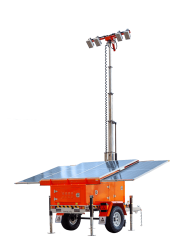



When portable light plants will not start, the engine is already reporting something specific, and the report is in how it fails. A portable light plant that does not turn over at all points somewhere completely different from one that cranks strongly but never fires. Working from that first distinction saves most of the guesswork, and it stops crews from replacing parts that were never at fault. This guide maps each starting symptom on portable light plants to its likely cause, what to check first, and the point at which the unit should go to a qualified technician instead.
Key Takeaways
- The first question on any portable light plant is whether the engine cranks. No crank points to battery, connections, or starter circuit. Cranks but does not fire points to fuel, air, or ignition.
- Diesel and gasoline engines fail differently at start. Spark plugs exist only on gasoline units; diesel starting problems in cold weather usually involve glow plugs or intake heaters instead.
- A protective shutdown is not a fault. Low oil pressure and high temperature shutdowns are the system working — resetting and restarting without diagnosis risks the engine.
- Air in a diesel fuel system will prevent starting even with a full tank. After running dry or changing a filter, the system needs bleeding before it will fire.
- Fuel injection service is not a field task. High-pressure injection components require specialist equipment and go to a qualified technician.
- Light plant service intervals follow the hour meter, not the calendar. A unit that ran 300 hours in a month needs attention before one that ran 20 over the same period.
Starting Symptoms in Portable Light Plants and What They Point To
Start here. Match the symptom the crew actually observes on the portable light plant, then work the shortest path to the cause rather than checking systems in sequence.
| Symptom observed | Likely cause | Check first | Field-fixable? |
|---|---|---|---|
| No crank, no sound at all | Flat battery, isolator off, loose terminal, blown fuse | Battery voltage and terminal tightness | Yes |
| No crank, single click | Battery low or starter solenoid | Battery under load; solenoid connections | Usually |
| Slow, laboured crank | Weak battery, poor connection, thick oil in cold | Battery voltage under crank; oil grade for temperature | Yes |
| Cranks normally, never fires | Fuel starvation, air in fuel system, ignition fault | Fuel level and quality; filter condition | Usually |
| Fires briefly then dies | Air in fuel, blocked filter, fuel pickup issue | Fuel filter and water separator | Usually |
| Cranks, black smoke, no start | Fuel present but poor combustion — air restriction | Air filter condition | Yes |
| Cranks, white smoke, no start (cold) | Cold start aid not working on a diesel unit | Glow plug or intake heater circuit | Sometimes |
| Starts, runs, shuts down after seconds | Protective shutdown operating | Oil level and coolant temperature — do not simply restart | Diagnose first |
| Knocking, grinding, or seizure on crank | Internal mechanical damage | Stop immediately | No — technician |
The rule the table encodes: anything that cranks is an electrical system doing its job, so look at fuel, air, and ignition. Anything that will not crank is upstream of the engine entirely. And anything that starts and then shuts itself down has already been diagnosed by the machine — the task is to read the reason, not to override it.
Battery and Starting Circuit: When a Portable Light Plant Will Not Crank
A no-crank condition on a portable light plant is almost always electrical, and the fault is usually in a connection rather than in the battery itself.
Work in this order:
- Confirm the isolator or master switch is on and any emergency stop is released. This accounts for more no-crank calls than any component failure.
- Measure battery voltage at rest, then again while cranking. A battery that reads acceptable at rest but collapses under load is failing internally.
- Inspect terminals for corrosion and looseness. Resistance at a loose terminal presents exactly like a flat battery, and cleaning the contact faces resolves it.
- Check the earth strap where it bonds to the frame. A corroded or painted contact face is a common, easily missed fault.
- Check fuses and the starter solenoid connections before condemning the starter motor.
Cold weather compounds all of this on portable light plants: available battery capacity falls while the oil the starter has to turn thickens. Units deployed into sustained low temperatures should start the season with a charged, tested battery rather than one carried over from summer. The care routine that keeps batteries serviceable between deployments is covered in the guide to battery care for electric light towers.
Fuel System Faults: When the Light Plant Cranks but Will Not Fire
Strong cranking with no firing moves the diagnosis to fuel, and on diesel light plants the most common cause is air rather than an empty tank.
- Confirm fuel level and quality. A unit idle for months may have degraded fuel, water accumulation, or microbial growth in the tank.
- Check the water separator and drain it. Water reaching the injection system prevents starting and damages components.
- Inspect the primary fuel filter. A restricted filter starves the engine at cranking speed even when it would pass fuel at idle.
- Bleed the system after running dry or changing a filter. Air trapped in a diesel fuel line will prevent starting regardless of how full the tank is — this is the single most common “it has fuel but won’t start” scenario.
- Verify fuel type. Filling a diesel unit with gasoline, or the reverse, is uncommon but immediately obvious in the symptoms and requires draining rather than troubleshooting.
What is not a field task: injectors, injection pumps, and high-pressure lines. These operate at pressures that make improvised service genuinely hazardous, and correct function depends on calibration equipment. Where the diagnosis points into the injection system, the unit goes to a qualified technician.
Tank capacity and consumption also determine how often a unit runs itself dry in the first place, which is covered in the guide to fuel capacity of a light tower generator.
Air Intake and Exhaust Restriction on Portable Light Plants
A portable light plant that cranks, produces black smoke, and will not start is usually being starved of air rather than fuel.
- Inspect the air filter. On dusty sites this loads far faster than any calendar interval anticipates, and a heavily loaded filter prevents starting outright.
- Check the intake path for debris, nesting, or a displaced pre-cleaner after transport or storage.
- Clear the exhaust outlet. Blockage from debris or animal nesting during storage produces hard starting and immediate stalling.
- Look for a collapsed intake hose, which restricts airflow without any visible obstruction.
Filter service intervals should come from the machine’s manual and be shortened for dusty conditions rather than taken from a general figure. Recording hour meter readings at each service is what makes an interval verifiable instead of estimated.
Diesel Versus Gasoline Light Plants: Ignition and Cold Start Aids
Spark plugs are a gasoline component. Applying a gasoline ignition checklist to a diesel portable light plant wastes time and leaves the actual cold start system unexamined.
| Component | Diesel light plant | Gasoline light plant |
|---|---|---|
| Ignition method | Compression ignition | Spark ignition |
| Spark plugs | Not fitted | Inspect and replace per schedule |
| Ignition coil | Not fitted | Test if no spark present |
| Cold start aid | Glow plugs or intake air heater | Choke or enrichment circuit |
| Typical cold-start symptom | Cranks, white smoke, no fire | Cranks, no fire, no fuel smell at plug |
| Stop switch type | Fuel solenoid — engine stops when fuel is cut | Ignition circuit — engine stops when spark is cut |
The stop switch difference matters diagnostically. A diesel engine that cranks but will not fire may have a fuel shutoff solenoid that is not energising — the engine is being starved deliberately by a failed component, and no amount of fuel system work will find it. Engine type and its implications for a given fleet are covered in the guide to choosing the right engine for a construction lighting unit.
Oil, Lubrication, and Protective Shutdowns in Light Plant Engines
A light plant that starts and then shuts down after a few seconds has usually not failed — it has protected itself, and the correct response is to read the reason rather than restart.
- Check oil level before anything else. Low oil pressure shutdown is the most common protective trip, and it operates before damage occurs rather than after.
- Check coolant level and radiator condition where the shutdown is temperature-related. A blocked radiator core on a dusty site produces this within minutes of starting.
- Do not repeatedly restart through a shutdown. Each restart runs the engine in the condition the protection was guarding against.
- Inspect oil condition, not just level. Oil that is dark and gritty, or that has risen in level, indicates contamination that needs investigation before further running.
- Look for leaks at seals and gaskets where level has dropped between services.
Overheating specifically has its own causes and prevention measures on diesel units, set out in the guide to preventing diesel light tower overheating.
When a Portable Light Plant Engine Failure Goes to a Technician
Three findings end field diagnosis on a portable light plant regardless of how straightforward the rest of the check was.
- Knocking, grinding, or a seized crank. Internal mechanical damage; further cranking makes it worse.
- Any diagnosis pointing into the fuel injection system. High-pressure components require specialist equipment.
- A protective shutdown that recurs after level and temperature have been corrected. The sensor is reporting something that has not been found yet.
Where the complaint is not a starting failure at all — the unit starts and runs but output is wrong, intermittent, or the lights behave oddly — the fault is more likely electrical than mechanical, and the symptom mapping in the guide to cable problems in a mobile lighting tower is the better starting point. General servicing that prevents most of these failures appearing in the first place is covered in the maintenance routine for generator light towers.
FAQ: Portable Light Plant Starting Failures
Why does a portable light plant crank but not start?
Cranking confirms the battery and starter circuit are working, so the fault is in fuel, air, or ignition. On diesel units, air trapped in the fuel system after running dry or changing a filter is the most common cause.
Do diesel light plants have spark plugs?
No. Diesel engines use compression ignition. The equivalent cold-start components are glow plugs or an intake air heater, and those are what to check when a diesel unit cranks with white smoke and will not fire.
Why does a light plant start then shut down immediately?
Usually a protective shutdown for low oil pressure or high temperature. Check oil and coolant levels before restarting — repeatedly restarting runs the engine in exactly the condition the protection exists to prevent.
Can fuel injectors be cleaned on site?
No. Injection system components operate at high pressure and depend on calibration, so this work goes to a qualified technician with the correct equipment.
How often should a portable light plant air filter be changed?
Follow the machine’s manual and shorten the interval for dusty conditions. Service by hour meter rather than by calendar, and record the reading at each service so intervals can be verified.
The tank is full but the engine will not start — what now?
On a diesel unit, check for air in the fuel system and a blocked filter or water separator. A full tank does not guarantee fuel is reaching the injection pump.
Conclusion
Diagnosing portable light plants that will not start comes down to one branch taken early: does it crank or not. No crank sends the check upstream to battery, connections, and the starter circuit. Cranking without firing sends it to fuel, air, and — on gasoline units only — ignition. Starting followed by an immediate shutdown means the machine has already diagnosed itself and is waiting for someone to read the reason. Working that branch first, rather than checking systems in the order they appear in a manual, is what turns a stalled shift on a construction project into a short repair. Where the diagnosis reaches the injection system or an internal mechanical noise, field work stops and the unit goes to a technician, whichever configuration in the light tower range it happens to be.


What to Check Before Buying 500 Portable Changeable Message Signs: 7 Batch Delivery Checks for Rental Fleets
What to check before buying 500 portable changeable message signs: one build across batches, spares, DDP delivery and per-shipment tests.
How to Plan Message Signs for Weekend Highway Closures: Lessons from Atlanta’s I-285 Westside Closures
How to plan message signs for weekend highway closures: 5 steps, a 48-hour checklist and fleet control lessons from Atlanta’s I-285 closures.
Does EN 12966 Apply to LED Modules? What the Standard Covers and What a Datasheet Cannot Prove
Does EN 12966 apply to LED modules? See what the standard covers, what a module datasheet proves and 5 questions to ask a supplier.
Build vs Buy a Vehicle-Mounted Message Sign: What Fleets and Integrators Should Check
Build vs buy a vehicle-mounted message sign? Compare compliance, controls, mounting and support before you choose.
Work Zone Speed Feedback Trailer Placement: Where to Set It Up and When to Move It
Work zone speed feedback trailer placement explained: where DOT rules and research say to set the trailer, when to move it and what fleets must log.
WZDx Device Feed Requirements: What Work Zone Contractors and Hire Fleets Must Supply
WZDx device feed requirements explained for contractors and hire fleets: what the feed holds, what DOT specs ask for and how to prepare equipment.