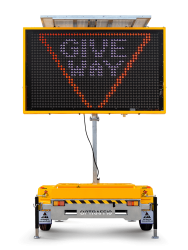
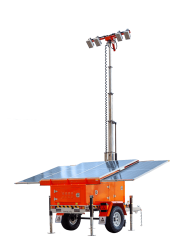
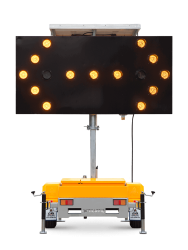
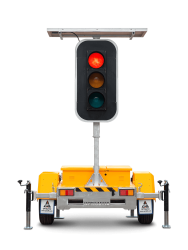



Portable LED Message Sign Colour Rules Australia: AS 4852.2, RGB Boards and Council Approval
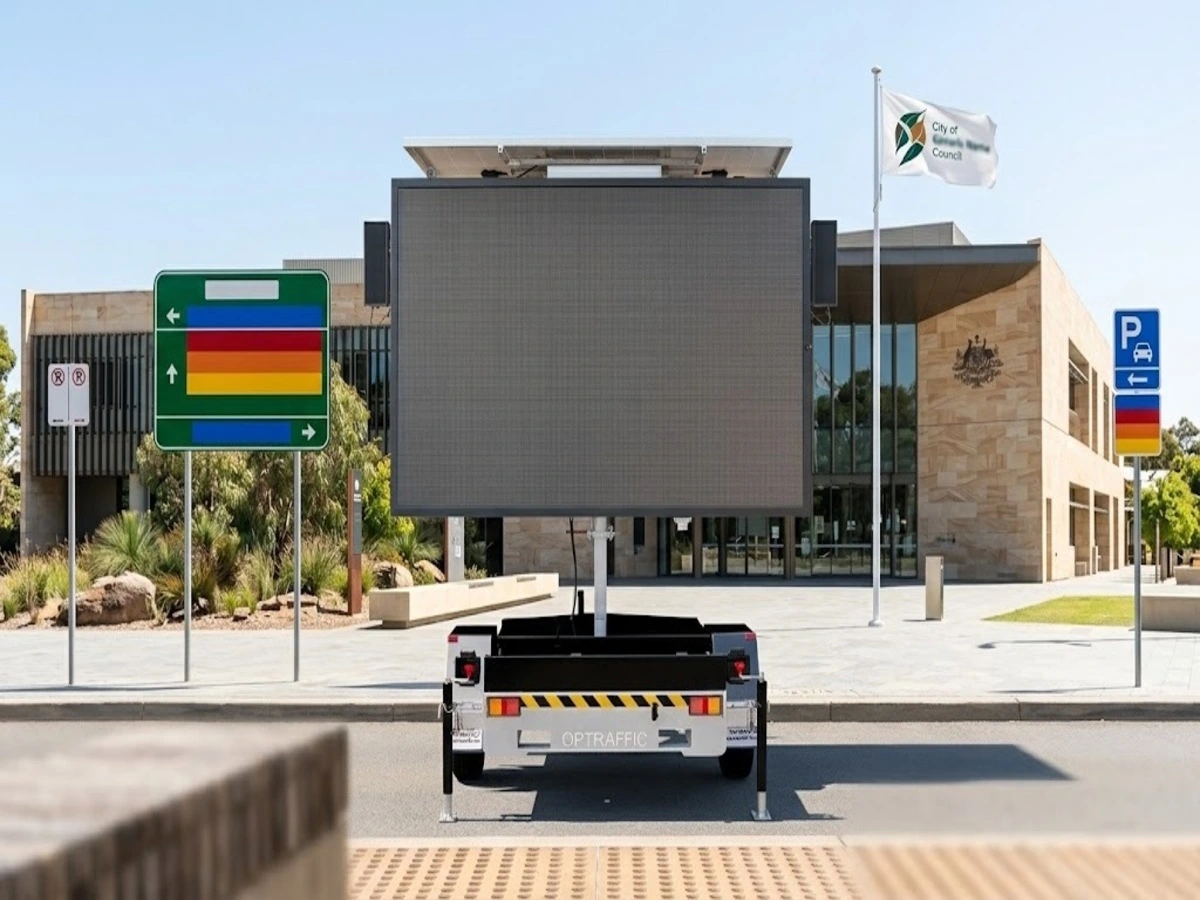
An Australian hire fleet gets two enquiries in the same week. A council wants a board for a festival, with the event branding on screen. A civil contractor wants boards for a highway work zone.
Same trailer, same screen, completely different rules. One deployment answers to a traffic standard. The other answers to a planning process the hire company probably has not read.
Portable LED message sign colour rules Australia operate across those two tracks, and fleets get caught when they assume the traffic standard covers both. Our team supplies full-colour message signs into Australian hire fleets and council contracts, and this is the question that comes up before any specification question.
Key Takeaways
- Optraffic P4 panels: Render event graphics and route diagrams while remaining configurable for compliant traffic messaging.
- Optraffic Web System: Switches a unit between event content and work zone messaging remotely at no subscription cost.
- Automatic brightness control: Adjusts output for daylight legibility and night dimming under residential council conditions.
- Modular rear-access panels: Let a fleet service one module on site rather than returning a unit from a regional deployment.
- Free fleet software: Keeps mixed amber and full-colour stock on one platform across state boundaries.
What AS 4852.2 Colour Requirements Actually Govern
Start with what the standard is for. AS 4852.2 covers portable variable message signs used for traffic management and driver information on Australian roads. It is a performance standard, not a content rulebook.
It sets requirements across four areas that matter to a colour decision:
| Area | What the standard addresses | Why it constrains colour |
|---|---|---|
| Chromaticity | The colour co-ordinates a displayed colour must fall within | A colour that drifts outside its region is non-compliant, not just off-shade |
| Luminance | Output levels across ambient conditions | Different colours reach different luminance at the same drive level |
| Luminance ratio | Contrast between legend and background | Determines legibility more than raw brightness does |
| Beam width | The angular spread of the displayed light | Governs where the message is legible from |
Two consequences follow for fleets.
First, AS 4852.2 colour requirements apply to the sign as a traffic control device. They do not tell you what a screen may show at a private event. That is a separate question, covered further down.
Second, a full-colour panel does not fail the standard by being capable of many colours. It has to be configured so that the colours it uses for traffic messages sit where the standard expects them.
Third, and easily missed: the Australian Standard is a floor, not a ceiling. State road authorities publish their own portable VMS requirements that sit on top of it. Transport for NSW’s portable variable message signs standard requires compliance with AS 4852.2 and then adds further requirements, with any departure routed through a formal concessions process rather than left to the contractor’s judgement. Read the state document alongside the standard, not instead of it.
AS 4852.2 Luminance Class Portable Sign Selection
The AS 4852.2 luminance class portable sign requirement is where over-specification and under-specification both cost money. A class suited to a high-speed rural approach behaves differently in a suburban street at night.
Luminance also interacts with colour in a way buyers underestimate. Colours do not reach equal brightness at the same drive current. A configuration tuned for one colour will not deliver the same contrast in another.
Temporary traffic management context sits with Austroads. Its Guide to Temporary Traffic Management now covers nine updated parts, with the guidance page revised in May 2026, and Austroads publishes a mapping document linking the earlier AS 1742.3 (2009) content to AS 1742.3 (2019) and the AGTTM.
RGB Full Colour vs 5 Colour VMS Board: What the Difference Actually Is
Australian tender documents and hire catalogues often specify a “5 colour” board. Overseas suppliers quote RGB full colour. Buyers assume these are the same category at different price points. They are not.
| 5 colour board | RGB full colour panel | |
|---|---|---|
| How colour is produced | A fixed palette of discrete colours | Red, green and blue mixed per pixel |
| Typical content | Text, arrows, simple symbols in set colours | Maps, pictograms, logos, video |
| Colour consistency | High — each colour is a defined output | Depends on calibration and module matching |
| Graphic capability | Limited to the palette | Effectively unlimited |
| Power draw | Lower | Higher, and content-dependent |
| Best fit | Traffic messaging on public roads | Event, council information and off-highway content |
The RGB full colour vs 5 colour VMS board decision therefore is not about which is better. It is about which job the unit does most often.
Three guides for AU fleets:
- A fleet doing only work zone hire rarely needs RGB. Traffic messages live inside a small palette anyway.
- A fleet chasing event and council work needs at least one RGB unit. No fixed palette displays a site map or a sponsor mark.
- Mixed fleets should not standardise on one format. The two formats serve different revenue lines.
Colour consistency deserves particular attention on RGB stock, because a mixed-age panel can show visible variation. We cover the field symptoms in RGB LED module reliability for hire fleets.
The Three-Reader Test
Here is a framing worth adopting, because the audience for an Australian portable sign has quietly expanded. Every colour and luminance decision now answers to three readers.
Reader one: the driver. The traditional case. Legibility, contrast and viewing distance.
Reader two: the vehicle camera. Modern vehicles run traffic sign recognition systems that read signs optically. Austroads research into variable speed limit sign readability found LED flicker to be the primary issue affecting readability by these systems, and found that multiplexed displays can affect camera-based performance. Standards Australia has since made updates to AS 4852.1, AS 4852.2 and AS 5156 addressing readability, and New Zealand’s electronic signage specifications are under review.
Reader three: the approving authority. A council, a road authority, or a project client, deciding whether the content is permitted at all.
A specification that satisfies only the first reader will pass a yard inspection and still create problems. The camera question in particular is new enough that most hire catalogues do not mention it.
Four questions worth putting to any supplier during procurement:
- What refresh rate does the panel run, and is it fixed or content-dependent? Flicker is the readability factor Austroads identified.
- Is the display multiplexed, and at what scan rate? Austroads found multiplexed displays can affect camera-based performance.
- Which edition of AS 4852.2 was the unit tested against? Standards Australia has issued readability-related updates.
- Does the test certificate cover the configuration being supplied? A certificate against one luminance or colour configuration does not automatically cover another.
None of these questions has a single correct answer yet. There is no formalised standard for LED flicker metrics, and no industry consensus on how much mitigation belongs in the camera rather than the sign. Asking them still tells you whether a supplier has considered the problem.
Council Approval for Advertising on a Message Sign Is a Separate Regime
This is where fleets doing event work get exposed. AS 4852.2 compliance says nothing about whether a screen may display a sponsor logo.
Content on a portable sign falls into three categories, and each has a different approval path:
| Content type | Example | Governed by | Who normally holds the obligation |
|---|---|---|---|
| Traffic control message | Lane closed, detour, reduced speed | AS 4852.2, AS 1742.3, AGTTM, state authority requirements | Traffic management designer |
| Public information | Event timings, site access, community notice | Road authority or landowner conditions | Event organiser or authority |
| Advertising or sponsor content | Brand marks, promotional messages | Local planning and signage controls; landowner consent | Client, not the hire company |
Three practical rules our team gives Australian hire customers:
- Ask where the unit will physically stand. Road reserve, council land and private land attract different controls.
- Get the consent position in writing before dispatch. The obligation almost always sits with the client, but the hire company gets the call when an officer objects.
- Treat a unit that crosses onto the road reserve as a different device. Sponsor content acceptable inside a showground is not acceptable on the approach road.
Council approval for advertising on a message sign varies between local government areas more than between states. Fleets working across councils should expect to answer the question separately for each one rather than assuming a precedent carries.
Full Colour VMS Trailer for Australian Events: Where the Format Pays
Event and council work is where a full colour VMS trailer for Australian events earns a premium over an amber board.
Content that justifies the format:
- Site and parking maps at showgrounds and regional events
- Multilingual notices in metropolitan council areas
- Pictograms for audiences moving on foot
- Sponsor content, where the location and consent allow it
- Community information across long-duration council works
Content that does not justify it:
- Standard work zone messaging on a rural highway
- Anything a compliant amber board already displays correctly
- Positions where a static sign would carry the same message
The allocation logic is the same one we apply in other markets, set out in when a job needs a full-color message sign. Venue-side content planning sits in full-color message signs for venue wayfinding, and artwork preparation in preparing content for an outdoor LED message sign.
Australian fleets also run long distances between depots and sites. A colour unit deployed to a regional council job cannot easily come back for a content change. Our units update remotely over 4G through the Optraffic Web System, supplied with the equipment at no additional cost, and crews load content on site over Wi-Fi where regional coverage fails.
Fleets specifying their first colour unit should start with how to choose a full-color LED message sign. Mixed amber and colour stock runs on one platform across our VMS board range, with sector context on our traffic safety page. State-by-state regulatory detail sits in our Australia portable VMS regulations guide.
FAQ
Does AS 4852.2 allow full-colour portable signs?
The standard sets performance requirements rather than banning formats. AS 4852.2 colour requirements govern chromaticity, luminance and luminance ratio, so a full-colour panel must be configured to meet them when used for traffic messaging.
Is a 5 colour board the same as full colour?
No. A 5 colour board produces a fixed palette of discrete colours. The RGB full colour vs 5 colour VMS board difference is that RGB mixes red, green and blue per pixel, which is what makes maps and logos possible.
Do we need council approval to show a sponsor logo?
Usually yes, and it depends on where the trailer stands. Council approval for advertising on a message sign falls under local planning and signage controls, separate from any traffic standard.
Which luminance class should we specify?
Match it to the deployment, not to the highest available. An AS 4852.2 luminance class portable sign specified for high-speed rural approaches can be excessive in a suburban street at night.
Do vehicle cameras affect how we specify a sign?
Increasingly. Austroads research identified LED flicker as the main factor affecting readability by camera-based traffic sign recognition, and Standards Australia has updated the relevant sign standards in response.
Does AS 4852.2 compliance cover every state?
It is the baseline, not the whole requirement. State road authorities publish their own portable VMS standards on top of it, and Transport for NSW routes any departure through a formal concessions process.
Should an Australian hire fleet standardise on one format?
Rarely. A full colour VMS trailer for Australian events and an amber board serve different revenue lines, so most fleets are better served by mixed stock.
Conclusion
Two rulebooks apply to an Australian portable sign, and only one of them is a traffic standard.
AS 4852.2 tells you whether the sign performs as a traffic control device. It does not tell you whether a council will accept a sponsor logo at a regional show. Fleets that treat the standard as covering both questions find out during the deployment rather than before it.
The format decision follows the same split. Work zone hire rarely needs RGB. Event and council work rarely works without it. And a third reader has now joined the driver and the approving officer, because vehicle cameras are reading these signs too.
Our team works with hire companies, councils and traffic management contractors across Australia and New Zealand. Contact Optraffic to discuss format selection for a mixed fleet, or for support answering colour and luminance questions in a tender response.
Facebook
Twitter
LinkedIn
Email
Newsletter
Subscribe to our Newsletter & Event right now to be updated.
Latest Posts



Latest Posts
Lighting First or Recording First? CCTV-Ready Light Tower vs Camera Trailer for Integrators and Hire Fleets
CCTV-ready light tower vs camera trailer: compare whose camera runs, which load gets night power, and how hire fleets use one unit for two jobs.
2026-10-09
VMS Trailers for Renewable Energy Zone Construction: Oversize Deliveries, Detours and Community Notice
How VMS trailers support renewable energy zone construction: oversize delivery warnings, detours, night moves and community notice on REZ routes.
2026-10-08
Imported vs Australian-Built VMS Trailers: Where Each Has the Edge
Imported vs Australian-built VMS trailers: where each has a real advantage, what compliance requires of both, and how to choose for your fleet.
2026-10-07
What Should a VMS Trailer Quote Include in Australia? Line Items to Compare Before You Sign
What should a VMS trailer quote include? Ten line items to compare, from delivery and registration to software fees, warranty and local spare parts.
2026-10-06
When to Order VMS Trailers for Bushfire Season: A Region-by-Region Guide for Australian Hire Fleets
When to order VMS trailers for bushfire season: a region-by-region guide for hire fleets, with order-by months, stock top-ups and pre-season checks.
2026-10-05
What Makes a VMS Trailer Mine-Spec? Site Entry Requirements for Western Australian Mine Sites
Mine-spec VMS trailer requirements under WA’s 2026 mine traffic code: visibility, ID, isolation, documents and how to order a unit that passes site entry.
2026-10-02