
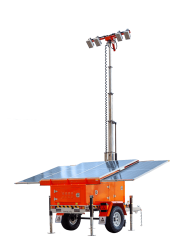
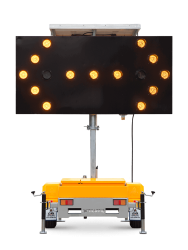

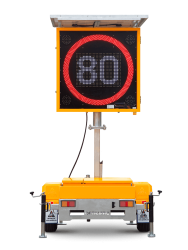
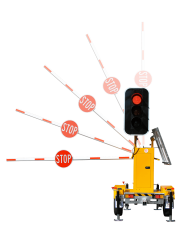



Mine-Spec VMS Trailers, Fitted at the Factory
Send your site’s plant entry standard. We build and test to it before dispatch.

A VMS trailer that passes a road authority can still fail at a mine gate. The site inspector checks for beacons, flags, reflective marking, an ID number and isolation points. Miss one and the unit goes back down the access road. So what makes a VMS trailer mine-spec? It meets the mine’s own plant entry standard, which WA’s new mine traffic code now frames. This guide explains that standard and how to order portable VMS units that pass it on the first inspection.
Key Takeaways
- Factory-fitted mine-spec options: Install the site’s listed visibility, marking and isolation items before the trailer leaves the factory.
- Pre-dispatch testing: Checks every mine-spec VMS trailer in-house before shipment, so defects surface before the gate inspection.
- Solar-battery power: Runs access-road signs without diesel refuelling trips into operating areas.
- Remote message control: Changes road closure and blasting warnings over 4G without sending a worker to the sign.
- OPTraffic WA: Provides sales, spare parts and servicing for WA mine-spec units from Maddington, Perth.
Why a Mine-Spec VMS Trailer Matters Under WA’s 2026 Mine Traffic Code
A mine-spec VMS trailer matters more now because WA has a new approved code for mine roads. The WA Government released the Road and Traffic Management at Western Australian Mines code of practice on 4 August 2026. It responds to incidents, near misses and fatalities involving mine roads and traffic.
Three points in the WA mine road and traffic management code matter to anyone supplying equipment:
- Roads are a principal mining hazard. The Work Health and Safety (Mines) Regulations 2022 classify roads and mobile plant areas this way. Sites must manage them inside a principal mining hazard management plan.
- The code carries legal weight. It is approved under the Work Health and Safety Act 2020. Courts may treat it as evidence of what is reasonably practicable.
- Outside plant must meet site standards. Mine operators must make sure non-mine-owned plant complies with the site traffic management plan.
That third point is where hire fleets and contractors meet the rule. A VMS trailer brought onto site by a contractor is non-mine-owned plant. It must match the site’s standard, not the supplier’s catalogue.
What Are the Mine Site Plant Entry Requirements for a VMS Trailer?
Mine site plant entry requirements differ between operators, but the code sets the common framework. Section 2.4.1 lists what a site’s plant standard should cover. It also says non-mine-owned plant should be inspected and risk assessed before work starts.
| Code requirement | What a site typically checks on a VMS trailer |
|---|---|
| Visibility: lights, beacons, reflective strip, flags | Beacon, flag or whip, reflective marking on the trailer and mast |
| Identification visible from a distance | A unique unit number sized for radio call-ups |
| Compliance with site standards, including extra safety features | The site’s own additions, listed in its entry procedure |
| Maintained to site requirements, OEM as a minimum | A service record and a maintenance schedule |
| OEM manuals, engineering documents, service records | Manual, wiring diagram, battery and solar documents |
| Isolation of energy sources for maintenance | A lockable battery isolation point |
Mine-Spec Visibility and Identification
Mine-spec visibility and identification items are the most common entry failures. The code’s plant standard lists lights, beacons, reflective strip and flags. It also asks for unique ID numbers visible from an adequate distance. That supports positive radio communication by call sign, which the code recommends.
One more check applies before the trailer reaches site. The code notes that permanently fitted lights must meet the WA Road Traffic Code 2000 on public roads. The Australian Design Rules apply as well. A beacon that suits the mine can still create a problem on the tow in.
Isolation and Maintenance Access
Mine sites isolate energy sources before maintenance. The code describes lock-out and tag-out with a padlock and a tag. A VMS trailer stores energy in its battery bank. A lockable isolation point lets the site apply its own lock-out procedure to the sign.
Documents the Site Will Ask For
Expect the inspector to ask for the operating manual, electrical drawings and service history. The code lists OEM manuals, engineering documents and service records in the plant standard. Missing paperwork stops a trailer as surely as a missing beacon.
Where Mine Sites Use a VMS Trailer for Mine Access Roads
A VMS trailer for mine access roads fits the code’s own list of access road measures. Section 2.1.2 calls for ways to advise road users of temporary restrictions. The code names four causes:
- Inclement weather closing or slowing sections of road
- Road damage after rain or heavy haulage
- Active roadworks on the access road
- Work activities nearby, including blasting restrictions
Section 2.1.10 adds procedures for adverse conditions, road closures and reopening. Section 2.2.8 asks for roadworks traffic management when maintenance happens under live traffic. Each one is a message that changes by the hour.
A changeable sign suits that pattern. Crews update one sign instead of carting static signs in and out. Haul roads inside the pit follow different rules, covered in how portable traffic message signs are used in mining. Speed control on haul roads is covered in radar speed signs for mining haul roads.
Mine-Spec VMS Trailer Conditions: Dust, Heat, Power and Coverage
The code says traffic devices should suit mining conditions such as dust and vibration. It also asks for failsafe design and backups. Four conditions shape the specification.
| Condition | Why it matters on a mine | What to specify |
|---|---|---|
| Dust | Coats solar panels and sign faces on unsealed roads | Easy panel cleaning access and a sealed cabinet |
| Heat | Pilbara and Goldfields summers push cabinet temperatures high | A rated operating range confirmed in writing |
| Power | Refuelling trips put workers on operating roads | Solar-battery power with autonomy for the worst month |
| Coverage | 4G drops out across remote leases | Remote control plus on-site control as a backup |
Diesel exposure is a health issue in the code as well. Its list of controls includes alternative power such as electric and battery systems. A solar-battery sign removes one diesel source from the access road.
Off the lease, Main Roads rules apply. See portable VMS requirements in Western Australia.
How to Order a Mine-Spec VMS Trailer Without Missing Mobilisation
Ordering a mine-spec VMS trailer starts with the site’s entry standard, not the product brochure. Standard stock units are not built to one mine’s list. A mine-spec unit is a custom build, so timing matters.
| Step | Who does it | Timing |
|---|---|---|
| 1. Obtain the site’s plant entry standard in writing | Contractor or hire fleet | Before quoting |
| 2. Turn it into a trailer specification sheet | Buyer with the supplier | Before ordering |
| 3. Factory build with mine-spec items fitted | Manufacturer | Part of the ~6-week custom lead time |
| 4. In-house testing before dispatch | Manufacturer | Before shipment |
| 5. Document pack assembled | Manufacturer and distributor | Ships with the unit |
| 6. Site introduction and entry inspection | Mine operator | On arrival |
Optraffic builds VMS trailers to a mine’s listed requirements and fits those items at the factory before dispatch. Optraffic team then tests every unit in-house before shipment. A factory custom build takes about six weeks, sea freight included. The full stock-versus-custom comparison sits in how long it takes to get a VMS trailer in Australia.
In Western Australia, OPTraffic WA, Optraffic’s Western Australian distributor, handles sales, spare parts and servicing from Maddington, Perth. Fleets ordering several units should freeze one specification first. The bulk VMS trailer purchase guide sets out the steps. The national buying checklist sits in the buyer’s guide to what to check before buying a VMS trailer in Australia.
Fleet software adds one more site benefit. The Optraffic Web System shows each sign’s location, battery state and live message, with no subscription fee. Supervisors check a sign on a remote access road without driving to it. More mining equipment guidance sits in the energy and mining industry guide.
FAQ
What does mine-spec mean for a VMS trailer?
It means the trailer meets a mine’s own plant entry standard. That usually covers beacons, flags, reflective marking, an ID number, isolation and documents. Mine site plant entry requirements vary by operator.
Which WA document covers traffic management at mine sites?
The Road and Traffic Management at Western Australian Mines code of practice, released in August 2026. The WA mine road and traffic management code supports the Work Health and Safety (Mines) Regulations 2022.
Can a standard VMS trailer be used on a mine site?
Only if it meets the site’s entry standard. Most standard units lack the site’s visibility and identification items. Specify a mine-spec VMS trailer before mobilisation.
How long does a mine-spec VMS trailer take to build?
A factory custom build takes about six weeks, including sea freight. Allow time to obtain the site standard first. Ordering a mine-spec VMS trailer early avoids a missed start date.
Where can WA mine contractors buy a mine-spec VMS trailer?
OPTraffic WA, Optraffic’s Western Australian distributor, supplies and services units from Maddington, Perth. Optraffic fits the mine-spec items at the factory, which simplifies ordering a mine-spec VMS trailer.
Conclusion
A mine-spec VMS trailer is defined by the mine, not the catalogue. WA’s August 2026 code sets the framework: visibility, identification, isolation, maintenance and documents for non-mine-owned plant. Buyers who start from the site’s written standard avoid a failed gate inspection. Optraffic builds VMS trailers to that standard, fits the items at the factory and tests each unit before dispatch. OPTraffic WA supports WA mine contractors from Maddington. Send the site’s plant entry standard to OPTraffic WA or Optraffic team to start the specification.



Lighting First or Recording First? CCTV-Ready Light Tower vs Camera Trailer for Integrators and Hire Fleets
CCTV-ready light tower vs camera trailer: compare whose camera runs, which load gets night power, and how hire fleets use one unit for two jobs.
VMS Trailers for Renewable Energy Zone Construction: Oversize Deliveries, Detours and Community Notice
How VMS trailers support renewable energy zone construction: oversize delivery warnings, detours, night moves and community notice on REZ routes.
Imported vs Australian-Built VMS Trailers: Where Each Has the Edge
Imported vs Australian-built VMS trailers: where each has a real advantage, what compliance requires of both, and how to choose for your fleet.
What Should a VMS Trailer Quote Include in Australia? Line Items to Compare Before You Sign
What should a VMS trailer quote include? Ten line items to compare, from delivery and registration to software fees, warranty and local spare parts.
When to Order VMS Trailers for Bushfire Season: A Region-by-Region Guide for Australian Hire Fleets
When to order VMS trailers for bushfire season: a region-by-region guide for hire fleets, with order-by months, stock top-ups and pre-season checks.
Portable VMS Requirements in Western Australia: Main Roads Rules, Remote Access and Local Supply
Portable VMS requirements in Western Australia: Main Roads character heights, colours, remote access rules and where WA fleets source VMS trailers locally.