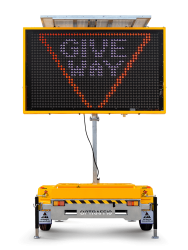
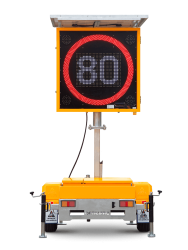
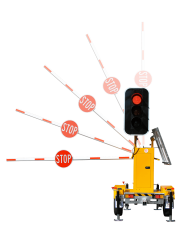
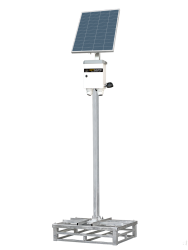



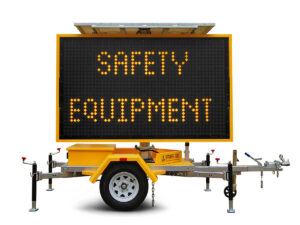
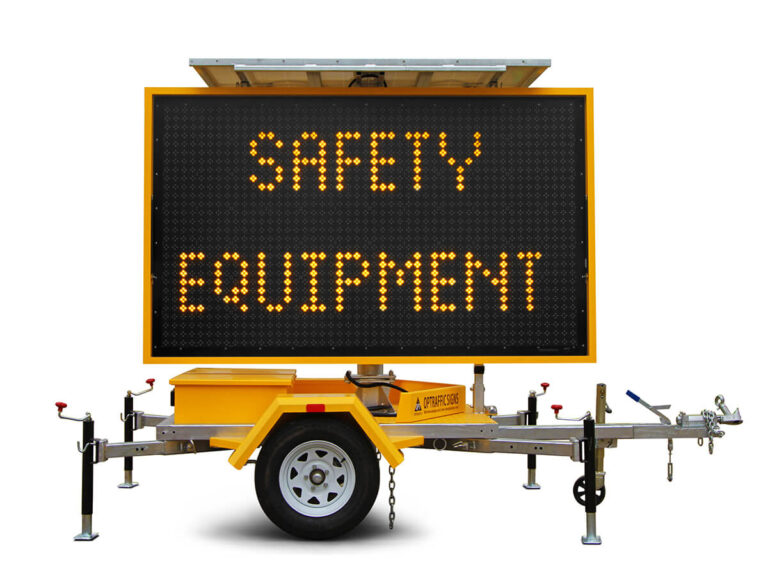
A message sign tells drivers what to do. It never reports back. A security camera trailer shows what is happening on site. It cannot change anything.
Run separately, each device leaves a gap the other could fill. This article works through four site problems where that gap costs money, and what each one requires in practice.
Key Takeaways
- Paired sign and camera view: Shows whether drivers followed the displayed message, not only that it displayed.
- Remote message update: Changes sign content from the office after footage reveals a queue or wrong turn.
- Timestamped visual record: Evidences what the sign displayed and how traffic behaved when an incident occurred.
- Single fleet view: Confirms both devices are powered and online before a crew leaves the depot.
- Matched deployment planning: Places sign and cameras as one layout rather than two unrelated hires.
Problem 1: Checking Whether a Message Sign Is Working
Every sign platform reports that a message is displaying. None report whether it worked.
Checking whether a message sign is working means two different things. The technical check confirms the unit is lit and online. The operational check asks whether drivers changed behaviour. Only the second matters to the client paying for the sign.
A camera covering the same approach answers the second question.
Three Failures a Status Report Cannot Show
- Wrong position. The sign sits past the decision point, so drivers read it after committing to a lane.
- Wrong wording. The message is technically correct and practically ambiguous, so drivers hesitate rather than act.
- Obstruction. A parked vehicle, a skip or summer foliage blocks a sightline that was clear at setup.
The third case has a compliance dimension in the US. MUTCD Section 2L.03 covers legibility and visibility of changeable message signs, setting expectations for the distance at which a message must be readable under day and night conditions (FHWA MUTCD). A sign that met that distance at setup may not meet it eight weeks later. Nothing in the sign’s own status data will say so.
Problem 2: Queue Detection at Site Access Points
Gate queues build quietly. A queue detection at site access points problem is usually discovered through a call from a haulier or a resident.
The cameras already point at the gate for security reasons. The same view shows the tailback forming.
That changes what the upstream sign does. Instead of one message running all week, the sign becomes a valve: hold deliveries, direct trucks to a secondary entrance, or warn through traffic before the queue reaches the carriageway.
| Situation | Camera trailer alone | Message sign alone | Both, one platform |
|---|---|---|---|
| Tailback forming at gate | Records the queue for later review | Displays whatever was set last week | Operator sees queue, updates upstream message |
| Delivery vehicles arriving early | Shows vehicles waiting on the verge | No awareness of arrivals | Sign holds or redirects arrivals |
| Queue reaching live carriageway | Evidence after the event | Static warning, unchanged | Warning updated before the spillback |
Problem 3: Monitoring Diversion Compliance
Long diversions fail quietly. Drivers who know the area take the old route anyway. Monitoring diversion compliance turns “is the signage adequate?” from an opinion into a count.
The count is only useful if it is designed. Four conditions make the numbers comparable.
- Frame the closure point, not the whole scheme. The camera must capture vehicles arriving at the closed road. That arrival is the failure event.
- Count a ratio, not a total. Divide arrivals at the closure by vehicles passing the advance sign over the same window. A raw total moves with traffic volume and proves nothing.
- Use a fixed sampling window. The same two hours on comparable weekdays. Continuous review costs staff time and produces noisier data than a matched sample.
- Re-run the identical window after any change. Wording, position and advance distance all change the ratio. Without a matched before-and-after, a change cannot be defended to a client or a council.
A high ratio points to three fixes in order of cost: reword the advance message, move it further back, or add a second unit at an earlier decision point.
Problem 4: Proving What a Message Sign Displayed During an Incident
Contractors underestimate this one until it happens.
After a collision or a claim, the contractor must show that warning was given. A sign content log proves the unit was instructed to display a message. It does not prove the message was visible, legible or unobstructed at that moment.
Proving what a message sign displayed during an incident requires the visual record beside the log. Four conditions decide whether that record is usable.
- Camera angle must show the driver’s view. A camera mounted behind the sign proves the sign was present. Only a view from the approach side shows what an oncoming driver could read.
- Clocks must be synchronised. Sign content logs and footage timestamps have to align, or the two records cannot be placed against each other.
- Retention must outlast the claim window. Liability claims surface months after the works finish. Retention should be specified against that window rather than left at a default.
- Retention must stay justified. In the UK, footage is personal data, and the ICO’s guidance on monitoring at work expects a defined, justified retention period rather than an indefinite one. Keeping everything forever is not the safe choice.
MUTCD Section 2L.01 sets the content boundary on the other side of the same record: changeable message signs are limited to traffic operational, regulatory, warning and guidance information, and advertising is not permitted. A visual record that shows an off-scope message is evidence against the contractor, not for them.
When the Pairing Is Not Worth It, and What It Does Not Do
Two deployments gain little from the combination.
Perimeter-only security. A storage yard with no traffic management role has nothing for a sign to do. Buy cameras.
Open-road schemes with no site assets. A lane closure with nothing to protect does not justify a camera trailer on security grounds.
The practical test is position. If the approach the sign addresses is the approach the cameras can see, the pairing works. If they face opposite directions across a large site, they are two separate jobs that share an owner.
Three limits apply even where the pairing fits:
- No automatic triggering. Cameras do not change sign content. A person reviews the footage, decides, and pushes the message.
- No merged compliance. Sign rules and recording rules are assessed separately, by different authorities.
- No substitute for site presence. Remote visibility shortens response time. It does not remove the visit when physical work is needed.
For event deployments, where several of these problems appear in one weekend, the wider equipment picture sits in this guide to mobile CCTV trailers for UK event security.
Conclusion
A sign that cannot observe and a camera that cannot act become one working loop when an operator sees both from the same screen.
Four problems close that way: knowing whether a message worked, catching a gate queue before it reaches the road, counting diversion compliance instead of debating it, and holding a record of what drivers could actually read.
Optraffic manufactures both product lines and supplies a single management platform with the equipment, so footage and sign content sit in one fleet view. Contact the Optraffic team to plan a paired layout for a specific site.
FAQ
Do the cameras change the message sign automatically?
No. Updating message sign content from site footage is an operator action. The platform places footage and sign control together, which shortens the decision.
How do cameras help with a sign that is already online?
By answering a different question. Checking whether a message sign is working confirms the unit is lit. Footage confirms whether drivers responded, and whether the sightline still exists.
What retention period suits incident evidence?
Long enough to outlast the claim window for that market and project type, and short enough to remain justified under applicable data protection rules.
How many vehicles should be counted for a diversion assessment?
Use a fixed window rather than a target count. Monitoring diversion compliance needs matched samples before and after a change, not a larger sample.
Which sites do not need the pairing?
Yards with no traffic management role, and open-road schemes with no site assets to watch.



Lighting First or Recording First? CCTV-Ready Light Tower vs Camera Trailer for Integrators and Hire Fleets
CCTV-ready light tower vs camera trailer: compare whose camera runs, which load gets night power, and how hire fleets use one unit for two jobs.
VMS Trailers for Renewable Energy Zone Construction: Oversize Deliveries, Detours and Community Notice
How VMS trailers support renewable energy zone construction: oversize delivery warnings, detours, night moves and community notice on REZ routes.
Imported vs Australian-Built VMS Trailers: Where Each Has the Edge
Imported vs Australian-built VMS trailers: where each has a real advantage, what compliance requires of both, and how to choose for your fleet.
What Should a VMS Trailer Quote Include in Australia? Line Items to Compare Before You Sign
What should a VMS trailer quote include? Ten line items to compare, from delivery and registration to software fees, warranty and local spare parts.
When to Order VMS Trailers for Bushfire Season: A Region-by-Region Guide for Australian Hire Fleets
When to order VMS trailers for bushfire season: a region-by-region guide for hire fleets, with order-by months, stock top-ups and pre-season checks.
What Makes a VMS Trailer Mine-Spec? Site Entry Requirements for Western Australian Mine Sites
Mine-spec VMS trailer requirements under WA’s 2026 mine traffic code: visibility, ID, isolation, documents and how to order a unit that passes site entry.