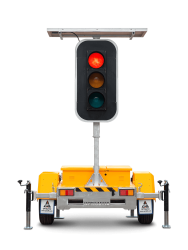
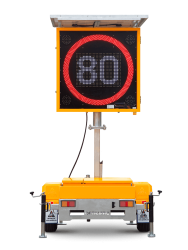
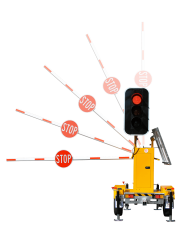
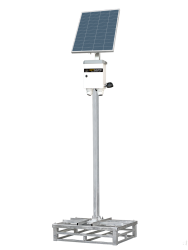



Hire companies and traffic control contractors often start a job by asking a version of the same question: how many portable traffic signal units does this intersection actually need? Optraffic’s team has walked through this sizing question with hire companies preparing multi-approach worksites, and the short version is that unit count follows intersection geometry, not a fixed rule. See Optraffic’s portable traffic signal range for the full lineup of two-way and multi-unit configurations.
Key Takeaways
- Two-way portable traffic signals: Handle single-lane closures where one direction of traffic waits at a time.
- Four-unit portable traffic signal setups: Control full four-way intersections with separate approach directions.
- RF-linked signal modules: Coordinate timing across all units without a wired connection between them.
- Optraffic Web System: Lets crews adjust cycle timing across every linked unit from one control point.
- Solar-powered units: Run each linked signal independently, without a shared power cable between modules.
Step 1: Count Controlled Approaches, Not Lanes
A portable traffic signal setup needs one unit per controlled approach direction — never one per lane. Confirm the approach count before ordering equipment:
- Identify every direction traffic enters the intersection from. Each entry direction that needs its own stop/go control counts as one approach.
- Merge multi-lane approaches into a single count. A two-lane approach moving the same direction still needs only one signal unit.
- Mark any approach with a separate turn phase. A protected turn lane may need its own unit if it can’t share timing with the through-lane unit.
- Flag pedestrian crossings separately. These require an added module, not an extra vehicle unit.
Step 2: Match Configuration to Intersection Type
| Setup | Typical unit count | Best fit for |
|---|---|---|
| Two-way portable traffic signal | 2 units | Single-lane closures, one-way alternating traffic |
| Three-way portable traffic signal | 3 units | T-junctions, driveway or side-road merges |
| Four-way portable traffic signal | 4 units | Full intersections with all approaches controlled |
| Pedestrian-added configuration | Base count + 1 or more | Any intersection with a marked crossing |
T-Junctions and Three-Way Setups
A T-junction typically needs three units — one per approach leg. Add a fourth if a marked pedestrian crossing sits on any leg of the junction. Where a T-junction sits close to a work zone entry, some crews also run a shuttle-mode setup instead of a fixed multi-unit configuration — that approach fits better where only one lane is usable at a time.
Four-Way Intersections
A full four-way intersection needs four units as the base configuration, one per approach. Confirm before mobilizing:
- Whether any approach has a protected turn phase requiring a separate unit
- Whether a pedestrian crossing needs its own module
- Whether a lane merge sits upstream of any approach, which may need an additional unit positioned before the intersection unit itself
For a closer look at the difference between two-unit and three-unit configurations before scaling up to a full four-way setup, see this two-way vs. three-way portable traffic signal comparison.
Step 3: Confirm Wireless Range Covers Every Unit
Contractors managing a multi-approach intersection also need to plan for sightline gaps between units. Each portable traffic signal unit in a multi-unit setup communicates with the others over a wireless RF link, not a shared cable. This matters where running cable between units isn’t practical — across an active lane, around a corner, or over uneven ground. The FHWA’s Manual on Uniform Traffic Control Devices, Part 6, covers temporary traffic control signals and reflects the same principle: temporary signal devices at an intersection or work zone need reliable coordination between units regardless of how they’re wired or linked.
Before mobilizing, verify:
- RF link range covers the full intersection footprint, including any units placed around corners or behind structures.
- One unit is designated as the timing reference, with the remaining units following its cycle over the wireless link.
- A single unit failure won’t take down the whole setup — most systems flag the affected unit so the crew can isolate it while the rest of the intersection keeps running. For a closer look at how crews handle a failed unit mid-shift, see this guide on responding to a portable traffic signal failure at an intersection.
- Link range needs headroom beyond the site boundary, not just edge-to-edge coverage — see this breakdown of long-range remote control for multi-unit roadworks sites for how hire companies plan range across larger sites.
Step 4: Set Up Centralized Timing Control
Once a portable traffic signal configuration is in place, timing adjustments need to reach every linked unit at once, not one at a time. Optraffic’s Web System lets a supervisor update the following across the full intersection setup from a single control point:
- Cycle timing
- Phase order
- All-red clearance intervals
This matters most in the first hours after setup, when actual traffic volumes often call for cycle adjustments that weren’t obvious from the initial site plan.
Common Sizing Mistakes to Avoid
- Counting lanes instead of approaches: A two-lane approach in one direction still needs only one signal unit, not one per lane.
- Forgetting the pedestrian crossing: A four-way intersection with a marked crossing needs a dedicated pedestrian module, not just four vehicle units.
- Ignoring sightline gaps: Units that can’t see each other still need to stay synchronized — confirm RF link range covers the full intersection footprint before mobilizing.
- Underestimating merge points: A lane merge upstream of the main intersection may need its own unit, separate from the intersection count.
FAQ
How many portable traffic signal units does a four-way intersection need?
A standard four-way intersection needs one portable traffic signal unit per approach direction — typically four units, plus an additional pedestrian module if the intersection has a marked crossing.
Can portable traffic signal units be linked without running cable between them?
Yes. Most multi-unit portable traffic signal setups use RF wireless links to coordinate timing across units, which avoids running cable across active lanes or uneven ground.
What happens if one unit in a multi-unit portable traffic signal setup loses connection?
Most systems flag the affected unit so the crew can isolate it, while the remaining linked units continue operating on the existing cycle.
Do all portable traffic signal units in a multi-unit setup need separate power sources?
Yes. Each solar-powered unit in a linked setup runs on its own power system, so there’s no shared power cable to plan around alongside the RF timing link.
For help sizing a portable traffic signal setup for a specific intersection layout, Optraffic’s team can review the site plan and suggest a configuration.



Lighting First or Recording First? CCTV-Ready Light Tower vs Camera Trailer for Integrators and Hire Fleets
CCTV-ready light tower vs camera trailer: compare whose camera runs, which load gets night power, and how hire fleets use one unit for two jobs.
VMS Trailers for Renewable Energy Zone Construction: Oversize Deliveries, Detours and Community Notice
How VMS trailers support renewable energy zone construction: oversize delivery warnings, detours, night moves and community notice on REZ routes.
Imported vs Australian-Built VMS Trailers: Where Each Has the Edge
Imported vs Australian-built VMS trailers: where each has a real advantage, what compliance requires of both, and how to choose for your fleet.
What Should a VMS Trailer Quote Include in Australia? Line Items to Compare Before You Sign
What should a VMS trailer quote include? Ten line items to compare, from delivery and registration to software fees, warranty and local spare parts.
When to Order VMS Trailers for Bushfire Season: A Region-by-Region Guide for Australian Hire Fleets
When to order VMS trailers for bushfire season: a region-by-region guide for hire fleets, with order-by months, stock top-ups and pre-season checks.
What Makes a VMS Trailer Mine-Spec? Site Entry Requirements for Western Australian Mine Sites
Mine-spec VMS trailer requirements under WA’s 2026 mine traffic code: visibility, ID, isolation, documents and how to order a unit that passes site entry.