


Find the Runtime That Fits Your Shift
Compare Optraffic solar light towers from the compact Mini to the six-lamp Super, by battery bank, LED output and hours per charge.

A solar light tower’s runtime on one charge comes from two figures on its spec sheet: stored battery energy and total LED wattage. More battery energy per watt of lighting means more hours per night. Optraffic’s solar range runs from above 16 hours (Mini) to above 35 hours (Super) on a full charge, depending on the model and its brightness setting. Service life is a separate question. It is measured in years, and the battery bank usually reaches end of life first.
A solar light tower does not wear out as a single object. It is an array, a battery bank, a set of LED fixtures, a charge controller, a mast, and a trailer — each with a different failure mode and a different point at which it stops being worth keeping. Asking how long the tower lasts is really asking which of those reaches end of life first, and whether replacing it makes sense. On almost every light tower in service, the answer is the battery bank, and everything else in the fleet-planning conversation follows from that.
Key Takeaways
- The battery bank sets the replacement cycle. It reaches end of life well before the array or the fixtures, so tower lifespan planning is battery planning.
- Panels and LEDs degrade rather than fail. Both lose output gradually, which means declining performance shows up long before anything stops working.
- “How long does it run” and “how long does it last” are different questions. Runtime is hours per charge and is a published specification; lifespan is service years and depends almost entirely on how the unit is used.
- Coastal and arid sites shorten service life through different mechanisms — salt attacks the structure, dust attacks harvest — and each calls for a different maintenance response.
- Depth of discharge does more damage than calendar time. A bank routinely run deep cycles out faster than one that never drops far, regardless of how long either has been on site.
- Chronic undercharging is the quietest form of damage. A bank that rarely reaches full charge loses capacity steadily, and the symptom is shorter runtime rather than an obvious fault.
- Replacement becomes the right call when several components converge, not when one fails — a bank at end of life alongside a degraded array is a different decision from a bank alone.
- Optraffic sizes battery capacity to lamp wattage on every solar model, from the single-battery Mini to the six-battery Super, so buyers can match runtime to shift length before they order.
Solar Light Tower Lifespan by Component
| Component | How it reaches end of life | What the symptom looks like | Relative service life |
|---|---|---|---|
| Battery bank | Cycling; capacity loss accumulates with each charge-discharge | Runtime shortens; unit dies before dawn | Shortest — sets the replacement cycle |
| LED fixtures | Gradual lumen depreciation, driver failure | Area dims; measured levels drift below requirement | Long; usually outlasts several battery banks |
| Solar array | Gradual output decline; delamination or cell damage from impact | Slower charging, especially in poor weather | Long; rarely the limiting component |
| Charge controller | Electronic failure, often heat or moisture related | Bank stops charging correctly or at all | Variable; replaceable in isolation |
| Mast and winch | Mechanical wear, cable fatigue, corrosion at joints | Binding sections, cable damage, lock failure | Long with maintenance; safety-critical |
| Trailer and chassis | Corrosion, frame fatigue from towing | Rust at welds and joints, coupling wear | Long; environment-dependent |
Two things follow from the table.
Nothing announces itself. Almost every entry degrades gradually rather than failing outright, which is why service life is usually reached without anyone noticing until the unit stops performing to spec.
The components are not replaced together. A battery bank, a controller, and a set of fixtures are separate purchases on separate cycles. Treating the tower as a single-lifespan asset produces the wrong replacement decision at both ends — scrapping a sound unit over a battery, or nursing a unit whose structure has gone.
The gap between those cycles can be wide. The LED lamps on Optraffic solar light towers have a rated lifespan of over 50,000 hours, according to the Mini Solar Light Tower specification. In most fleets, the battery bank needs replacement long before the lamps do.
Why the Battery Bank Sets the Replacement Cycle
The battery is the only component that degrades in proportion to use rather than time. Every charge-discharge cycle removes a small amount of usable capacity, permanently.
Three variables govern how fast that happens:
- Depth of discharge. How far the bank is drawn down each night. Shallow cycles cost less capacity than deep ones, and the relationship is not linear — running a bank hard costs disproportionately more than running it moderately.
- Charge completion. Whether the bank actually reaches full charge. Persistent partial charging causes steady capacity loss, and it is common on solar light towers deployed through winter or in shaded positions.
- Temperature. Both extremes matter. Sustained heat accelerates the chemistry; deep cold reduces available capacity while the bank is cold, which compounds a shortfall already in progress.
Chemistry determines how tolerant a bank is of all three, which is why battery type is the single most consequential specification in a solar tower’s long-term cost — set out in the guide to how battery type affects portable light tower performance.
The charging side matters as much as the bank itself. A controller that fails to bring the bank to full charge on short winter days produces exactly the chronic partial-charge pattern that shortens service life, which is why controller specification is a lifespan question rather than only an efficiency one — covered in the comparison of MPPT and PWM charge controllers.
How Many Hours Does a Solar Light Tower Run on a Full Charge?
Runtime is a nightly figure. Lifespan is a multi-year figure. Buyers who mix them up either oversize the fleet or end up with towers that go dark before the shift ends.
The nightly figure follows the ratio of battery energy to lamp load. Each Optraffic solar model pairs its LED output with a matched battery bank:
| Model | LED lamps | Battery bank (12 V) | Rated runtime per full charge |
|---|---|---|---|
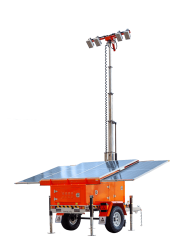
| Mini Solar Light Tower | 2 × 100 W | 1 × 200 Ah | Above 16 hours |
| Medi120 | 2 × 60 W | 2 × 150 Ah | Above 25 hours (Medi series) |
| Medi200 | 2 × 100 W | 2 × 200 Ah | Above 25 hours (Medi series) |
| Medi400 | 4 × 100 W | 4 × 200 Ah | Above 25 hours (Medi series) |
| Super (4-lamp) | 4 × 100 W | 4 × 200 Ah | Above 35 hours |
| Super (6-lamp) | 6 × 100 W | 6 × 200 Ah | Above 35 hours |
Runtime varies with the brightness setting. Lamp and battery figures come from the Mini, Medi and Super product specifications.
Rated runtime on site moves with four variables:
- Brightness setting. Running the lamps below full output stretches the same charge across more hours.
- Battery state of health. An aging bank stores less energy, so runtime shrinks long before the tower stops working. The effect of adding batteries is covered in how battery count changes runtime and brightness.
- Recharge between nights. Short winter days or several overcast days in a row can leave the bank partly charged at dusk.
- Temperature. Cold reduces the energy a battery can deliver on the night it is needed.
A tower that suddenly runs only a few hours usually points to a charging or battery fault rather than normal wear. Optraffic covers that diagnosis in why a solar light tower shuts off after only 2 hours.
How Many Hours Does a Light Tower Last by Power Source?
The answer to “how many hours does a light tower last” depends on what powers it. Each power source sets a different limit on how long one tower can stay lit:
| Power source | What limits hours of operation | Optraffic reference |
|---|---|---|
| Solar | Battery energy ÷ lamp wattage, refilled by daytime charging | Table above |
| Solar hybrid | Battery runtime, extended by a backup generator | Hybrid Light Tower: over 30 hours on a full charge, optional 5 kW gasoline generator |
| Diesel | Fuel tank capacity ÷ hourly fuel burn at the lamp load | Fuel capacity of a light tower generator |
| Grid / mains | Continuous while the supply stays connected | — |
Solar towers trade refuelling for a charge cycle. A diesel tower runs until the tank is empty and someone refills it. A solar tower runs until the battery is drained and then recharges itself the next day. On remote sites, that difference decides whether a crew has to come back every few days just to keep the lights on.
What Shortens Solar Light Tower Service Life on Site
| Environment | Primary mechanism | Component most affected | Maintenance response |
|---|---|---|---|
| Coastal and marine | Salt-laden air accelerates corrosion | Chassis, fasteners, electrical connections | Frequent washdown; inspect welds and joints; check connector corrosion |
| Arid and dusty | Dust film reduces light reaching cells | Array output, and through it the bank | Regular panel cleaning; expect faster soiling than published cleaning intervals assume |
| High heat | Elevated cell and battery temperature | Battery chemistry, controller electronics | Ventilation clearance; avoid enclosed or reflective positions |
| Freezing | Reduced available capacity; material brittleness | Battery, cabling, seals | Account for reduced winter capacity when planning runtime |
| High humidity and heavy rain | Moisture ingress at connections and enclosures | Controller, connectors, fixtures | Inspect seals and glands; verify enclosures close correctly after service |
Two of these are frequently underestimated:
- Dust does not damage the array — it starves it. A soiled panel produces less, the bank charges less completely, and the resulting chronic partial charge shortens battery life. The visible problem is on the panel; the cost lands on the battery.
Inside the tower, dust and water do a different kind of damage. Once they reach connectors, controllers or lamp housings, they cause corrosion and electrical faults rather than a gradual loss of output. Optraffic uses IP65-rated components on its solar light towers, sealing them against dust ingress and water jets on exposed sites.
- Coastal corrosion attacks the structure, not the electronics first. Chassis and mast integrity are safety-critical, and the material behaviour behind that is set out in the guide to light tower trailer chassis materials.
Usage Patterns That Accelerate Degradation
- Continuous operation without a full recovery window. The bank never returns to full charge, and capacity loss compounds shift after shift.
- Running fixtures at full output when the task does not require it. Deeper nightly discharge for illumination nobody is using.
- Frequent relocation over rough ground. Vibration and shock load the mast, winch cable, and chassis welds; transport, not operation, is where structural wear accumulates.
- Long idle storage at low state of charge. A bank left discharged degrades while doing no work at all — one of the more avoidable losses in a fleet.
- Deferred fault correction. A failing controller or damaged panel keeps operating and quietly damages the bank until someone investigates the shortened runtime.
Deployment planning is where most of this is decided, and matching the unit to the duty cycle before it ships prevents the pattern from starting — the trade-offs are set out in Optraffic’s overview of lighting and equipment for construction sites.
Maintenance That Extends Solar Light Tower Lifespan
- Clean the array on a site-appropriate interval, not a fixed one — dusty sites need it far more often than the default assumption
- Log runtime against the model’s rated hours so capacity loss is visible as a trend rather than discovered as a failure
- Inspect connections for corrosion and heat marking, particularly at the battery terminals and controller inputs
- Check the winch cable and mast locks before every raise — this is a safety item, not a longevity one
- Verify enclosures and glands reseal after any service work, since most moisture ingress starts with a maintenance visit
- Store at a healthy state of charge between deployments rather than putting units away flat
- Correct shading and orientation problems promptly — a position that charges poorly is damaging the bank every day it stays there
When Replacement Makes More Sense Than Repair
Individual components are replaceable, so a single failure rarely justifies retiring a unit. The decision changes when failures converge.
| Situation | Reasonable action |
|---|---|
| Battery bank at end of life, everything else sound | Replace the bank |
| Controller failure, bank healthy | Replace the controller; check what caused the failure |
| Array output declining, structure sound | Assess panels; the bank may be the real symptom source |
| Bank at end of life alongside significant array decline | Evaluate against a replacement unit |
| Structural corrosion at the chassis or mast | Retire — this is a safety limit, not an economic one |
| Runtime chronically short of specification despite a new bank | Investigate charging and shading before spending again |
The last row matters more than it looks. A replaced bank that still fails to hold rated runtime means the original bank was a symptom rather than the cause, and fitting another one repeats the loss.
Frequently Asked Questions
How many hours does a light tower last?
It depends on the power source. A solar light tower runs until its battery bank is drained and recharges the next day. A solar hybrid tower adds generator backup to stretch the run. A diesel tower runs until its fuel tank is empty. For solar models, compare battery capacity against LED wattage to estimate hours per night.
How many hours does a solar light tower run on a full charge?
Optraffic’s solar light towers run from above 16 hours (Mini) to above 35 hours (Super) on a full charge, with the Medi series above 25 hours. Runtime depends on the model’s battery bank, the LED wattage, the brightness setting and the condition of the batteries.
What determines how long a solar light tower lasts?
The battery bank, in almost every case. It degrades with each charge-discharge cycle while the array, fixtures, and structure degrade far more slowly, so the bank sets the replacement cycle and everything else is maintained around it.
Do solar panels or LEDs wear out on a light tower?
Both degrade rather than fail. Panels lose output gradually and LEDs lose lumen output over time, so the effect appears as slower charging and dimmer coverage rather than as a breakdown. Neither is usually the limiting component.
Why is my solar light tower running for less time than it used to?
Shortened runtime is the standard sign of battery capacity loss, but confirm the cause before replacing the bank. A soiled array, a new shading obstruction, or a controller not completing charge produce the same symptom and will damage a replacement bank the same way.
Does a coastal site really shorten light tower life?
Yes, through corrosion of the chassis, fasteners, and electrical connections rather than through the electronics. Structural corrosion is a safety limit, so coastal deployments justify closer inspection of welds, joints, and the mast.
When should a solar light tower be replaced rather than repaired?
When failures converge — a bank at end of life alongside meaningful array decline — or when the chassis or mast shows structural corrosion. A single component failure on an otherwise sound unit is a repair, not a replacement.
Conclusion
Solar light tower lifespan is not one number, and treating it as one leads to the wrong decision at both ends of a unit’s life. The battery bank reaches end of life first and is governed by discharge depth, charge completion, and temperature. The array and fixtures fade gradually and rarely limit anything. The structure outlasts both, until corrosion makes it a safety question rather than an economic one. Tracking observed runtime against rated runtime is the practical way to see where a unit sits, well before it stops performing.
Specify for the duty cycle, not just the day one
Compare Optraffic’s solar and hybrid light towers by coverage area, rated runtime, and power configuration, and match the unit to the shift pattern and the environment it will actually work in.


What to Check Before Buying 500 Portable Changeable Message Signs: 7 Batch Delivery Checks for Rental Fleets
What to check before buying 500 portable changeable message signs: one build across batches, spares, DDP delivery and per-shipment tests.
How to Plan Message Signs for Weekend Highway Closures: Lessons from Atlanta’s I-285 Westside Closures
How to plan message signs for weekend highway closures: 5 steps, a 48-hour checklist and fleet control lessons from Atlanta’s I-285 closures.
Does EN 12966 Apply to LED Modules? What the Standard Covers and What a Datasheet Cannot Prove
Does EN 12966 apply to LED modules? See what the standard covers, what a module datasheet proves and 5 questions to ask a supplier.
Build vs Buy a Vehicle-Mounted Message Sign: What Fleets and Integrators Should Check
Build vs buy a vehicle-mounted message sign? Compare compliance, controls, mounting and support before you choose.
Work Zone Speed Feedback Trailer Placement: Where to Set It Up and When to Move It
Work zone speed feedback trailer placement explained: where DOT rules and research say to set the trailer, when to move it and what fleets must log.
WZDx Device Feed Requirements: What Work Zone Contractors and Hire Fleets Must Supply
WZDx device feed requirements explained for contractors and hire fleets: what the feed holds, what DOT specs ask for and how to prepare equipment.