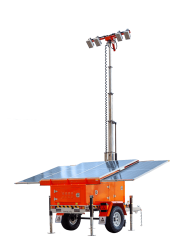



Light towers keep job sites, event grounds, and emergency response zones lit after dark, and the lamp technology inside the fixture drives most of the operating cost over the tower’s service life. LED light towers have become the default choice for new purchases, but many fleets still run halogen light towers or metal halide units bought years ago. This comparison looks at what actually changes — energy draw, lamp life, heat, and total cost of ownership — when a business weighs a halogen replacement against an LED upgrade.
Key Takeaways
- LED light towers use significantly less energy than halogen light towers or metal halide units — the U.S. Department of Energy states LED lighting uses at least 75% less energy than incandescent and halogen lighting.
- Standard LED fixtures are rated for 50,000+ hours versus roughly 15,000–20,000 hours for metal halide and a much shorter, lamp-dependent range for high-wattage halogen work lamps.
- Halogen light towers cost less upfront but carry higher long-term costs from bulb replacement, fuel/electricity draw, and more frequent servicing labor.
- Metal halide, not halogen, is the more common “traditional” light source on full-size towed light towers; halogen is more typical on smaller portable and tripod units — buyers should confirm which technology their current fleet uses before estimating savings.
- US job sites must meet OSHA illumination minimums under 29 CFR 1926.56, and mine sites carry a separate MSHA illumination standard — the applicable rule depends on where the tower is deployed, not on which lamp technology is chosen.
What Is a Halogen Light Tower, and How Does It Differ from LED and Metal Halide?
A halogen light tower uses a tungsten filament lamp filled with halogen gas, prized for low unit cost and instant full brightness with no warm-up delay. Halogen has been the standard choice on smaller portable and tripod-mounted towers for decades. The tradeoff is lamp life: high-wattage halogen work lamps (commonly 500W–1,500W) are rated for a wide range depending on the specific lamp — anywhere from a few hundred hours for some theatrical-grade lamps up to roughly 2,000–4,000 hours for standard-grade halogen bulbs. Buyers should check the manufacturer’s specification sheet for the exact lamp installed rather than assume a single number across all halogen fixtures.
A LED light tower replaces the filament with solid-state emitters that convert far more of the input energy directly into light rather than heat, which is why LED fixtures run cooler and last longer. A metal halide light tower — the technology most full-size towed units actually use — sits between the two on both energy draw and lamp life; see the next section for why this distinction matters.
Halogen fixtures also run hot: the filament operates at high temperature, and most of the input energy is released as heat rather than light. This means fixtures need clearance from flammable materials and should be handled with care once powered on, similar to any high-wattage incandescent-family lamp.
Where Metal Halide Light Towers Fit In
Most full-size towed light towers built before the LED transition use metal halide (HID) lamps, not halogen — a distinction this comparison should make clearly, since the two are often lumped together loosely as “traditional” lighting. Metal halide lamps are rated for roughly 15,000–20,000 hours, with light output gradually declining well before the lamp fails outright. Buyers replacing an older metal halide-equipped tower fleet should benchmark LED savings against metal halide’s actual power draw and lifespan, not against halogen figures, since the numbers differ meaningfully.
Halogen vs. LED Light Tower: Cost and Performance Comparison
| Factor | Halogen Light Tower | Metal Halide Light Tower | LED Light Tower |
|---|---|---|---|
| Typical rated life | ~300–4,000 hours (lamp-dependent) | ~15,000–20,000 hours | 50,000+ hours |
| Energy use vs. LED | Highest | High | Baseline — DOE states LED uses at least 75% less energy than halogen/incandescent sources |
| Warm-up time | None (instant full brightness) | Several minutes | None |
| Heat output | High | Moderate–high | Low |
| Typical upfront cost | Lowest | Moderate | Highest |
| Best fit | Short-term, low-budget, infrequent use | Legacy fleets already in service | New purchases, frequent or long-duration use |
Total Cost of Ownership: Why Upfront Price Isn’t the Full Picture
A halogen tower’s lower purchase price is real, but it’s only one line item. Frequent lamp replacement means more labor hours, more downtime while a tower is out of service, and a steady parts cost that a 50,000-hour LED light tower avoids for the life of most rental or ownership cycles. Higher energy draw compounds this on generator-powered towers, where every extra watt burns more fuel over a shift.
The crossover point depends on run-time: a tower used a few nights a month may never rack up enough hours for lamp replacement costs to matter much. A tower running continuously on a multi-month project will hit a halogen or metal halide lamp’s rated life — and the associated replacement labor — far sooner, which is where LED’s higher upfront cost is recovered fastest.
Regulatory Considerations for Job-Site and Mine-Site Lighting
Lamp technology and regulatory compliance are separate questions, and the applicable standard depends on where the tower is deployed rather than which lamp type is installed.
United States — general construction. OSHA’s illumination standard, 29 CFR 1926.56 (Table D-3), currently sets minimum foot-candle levels by activity: 3 foot-candles for excavation, waste areas, and loading platforms; 5 foot-candles for general construction area lighting; 10 foot-candles for plants and shops. None of these minimums specify a lamp technology — halogen, metal halide, and LED towers can all meet them if positioned and rated correctly for the area. Note for compliance teams: OSHA proposed rescinding 1926.56 (and the related 1926.26) in July 2025, arguing the numeric minimums were unnecessary given the General Duty Clause. As of this writing the standard remains in effect pending a final rule — confirm current status before relying on it for a compliance program.
United States — mine sites. Mining operations fall under a separate rule: MSHA’s surface illumination standard, 30 CFR 56.17001, requires that “illumination sufficient to provide safe working conditions shall be provided in and on all surface structures, paths, walkways, stairways, switch panels, loading and dumping sites, and work areas.” This standard is not part of the OSHA rescission proposal above. For remote mine and quarry sites where relamping requires a dedicated trip, LED’s longer service interval is often the deciding factor over lamp cost alone. See Optraffic’s Energy & Mining industry overview for deployment considerations specific to this sector.
United Kingdom and European Union. EU and UK Ecodesign regulations phased out most general-purpose halogen lamps between 2018 and 2023, but the regulations explicitly exempt high-power, industrial, and specialist lighting products from this restriction — the halogen lamps used in job-site light towers fall into this exempted category. Buyers in the UK or EU are not legally barred from using halogen light towers on regulatory grounds; the cost and lamp-life case for switching to LED applies on its own merits, independent of the lamp-sale restrictions that apply to general household lighting.

Choosing Between Halogen, Metal Halide, and LED Light Towers
- Choose a halogen light tower for short, infrequent deployments where minimizing purchase price matters more than long-run operating cost, and where instant full brightness with no controller is sufficient.
- Keep metal halide where a fleet is already equipped and the towers are mid-life — a full fleet swap has its own cost that should be weighed against remaining service life.
- Choose an LED light tower for new purchases, continuous or long-duration deployment, or remote sites where reducing generator run-time, fuel cost, or lamp-change labor matters most. Optraffic’s portable lighting tower lineup is built around LED fixtures for this reason.
For buyers evaluating exact lumen and coverage requirements before switching technologies, see Optraffic’s guide to sizing an LED light tower for the worksite.
Frequently Asked Questions
Do LED light towers really use less energy than halogen ones?
Yes. The U.S. Department of Energy states that LED lighting uses at least 75% less energy than incandescent and halogen lighting. Actual savings on a given tower depend on the specific halogen lamp wattage being replaced.
How long do halogen bulbs last in a light tower compared to LED?
It varies by lamp type — high-wattage halogen work lamps can range from a few hundred to a few thousand hours, while quality LED fixtures are commonly rated for 50,000+ hours. Check the specific lamp’s datasheet rather than relying on a single published number.
Is metal halide the same as halogen?
No. They are different lamp technologies. Most full-size towed light towers historically use metal halide, rated around 15,000–20,000 hours, while halogen is more common on smaller portable and tripod units. See Optraffic’s thermal management guide for LED light towers for how heat behavior differs across all three.
Does OSHA require a specific lamp type for construction site lighting?
No. OSHA’s 29 CFR 1926.56 sets minimum foot-candle levels by work area, not a required lamp technology. Halogen, metal halide, and LED towers can all satisfy the standard if positioned and rated correctly.
Does switching to LED reduce glare on a job site?
Glare depends more on fixture optics and positioning than on lamp technology alone — see Optraffic’s guide on reducing glare from a light tower for site-specific setup guidance.
Is an LED light tower worth the higher upfront cost for a short project?
Not always. For infrequent or short-duration use, a lower-cost halogen unit may never accumulate enough run-hours to make the LED’s operating-cost advantage pay back the price difference. For continuous or long-term deployment, LED typically pays back faster through lower fuel and lamp-replacement costs.
How can I verify a light tower’s real-world power draw before buying?
Request the manufacturer’s photometric and power-consumption data sheet for the specific fixture rather than relying on generic percentage claims, and confirm testing conditions match the intended deployment (fuel-powered generator vs. solar/battery).
Conclusion
Halogen light towers still have a place for short, infrequent, budget-constrained deployments, but the case for LED strengthens with every additional hour of run-time a project requires — and with every mile between the site and the nearest replacement lamp. Metal halide sits in between as the legacy technology most existing towed fleets are still running. For a broader look at how light tower technology has evolved and where each lamp type fits, see Optraffic’s comprehensive overview of light towers.


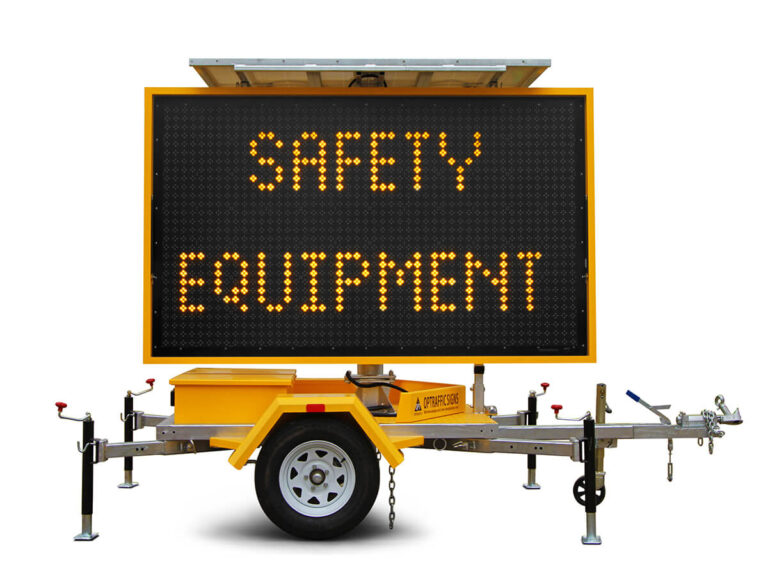
What Should a VMS Trailer Quote Include in Australia? Line Items to Compare Before You Sign
What should a VMS trailer quote include? Ten line items to compare, from delivery and registration to software fees, warranty and local spare parts.
When to Order VMS Trailers for Bushfire Season: A Region-by-Region Guide for Australian Hire Fleets
When to order VMS trailers for bushfire season: a region-by-region guide for hire fleets, with order-by months, stock top-ups and pre-season checks.
What Makes a VMS Trailer Mine-Spec? Site Entry Requirements for Western Australian Mine Sites
Mine-spec VMS trailer requirements under WA’s 2026 mine traffic code: visibility, ID, isolation, documents and how to order a unit that passes site entry.
Portable VMS Requirements in Western Australia: Main Roads Rules, Remote Access and Local Supply
Portable VMS requirements in Western Australia: Main Roads character heights, colours, remote access rules and where WA fleets source VMS trailers locally.
How Long Does It Take to Get a VMS Trailer in Australia? Local Stock vs Custom Builds
How long does it take to get a VMS trailer in Australia? Local stock arrives in 1–2 weeks; custom builds take about 6 weeks. See what drives the gap.

What to Check Before Buying a VMS Trailer in Australia: A Buyer’s Guide for Traffic Management and Hire Companies
What to check before buying a VMS trailer in Australia: AS 4852.2, size, colour, power, software fees, RAV registration and local stock, in order.