


Configured for Your Hardest Site, Not Your Average One
Folding solar wings and MPPT charge control keep cameras recording through short winter days and tight hire rotations.
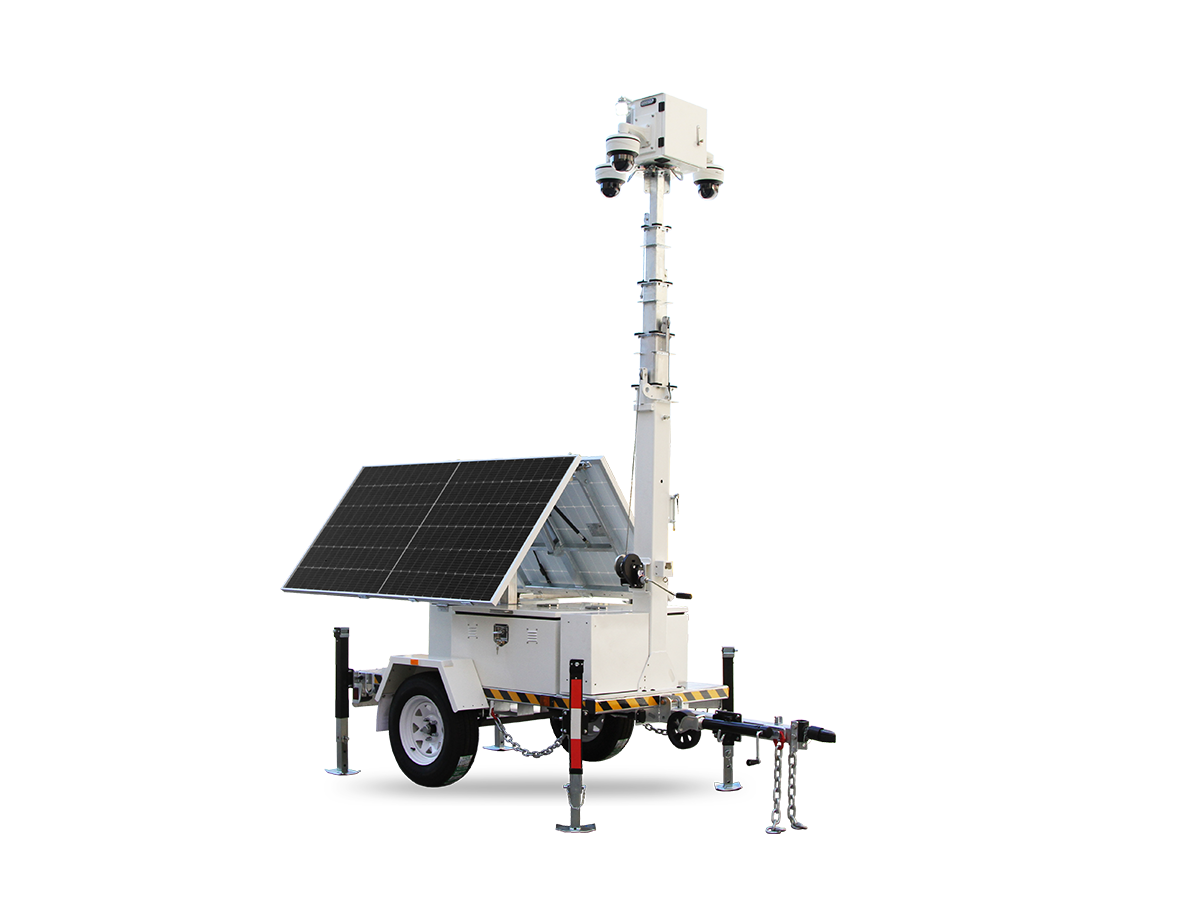
Two units can carry the same cameras and the same battery bank, yet only one keeps recording through a dull week. The difference often sits in the solar array’s geometry. This guide works through fixed vs folding solar panels on a camera trailer by buyer and site type, so hire fleets and integrators can match configuration to how a security camera trailer will actually be used. The Optraffic team designs chassis, mast and array together, and one question recurs when fleets compare units: are folding wings worth the extra step on every deployment?
Key Takeaways
- Folding wing array: Carries more panel area than a chassis travel width allows, supporting high-draw camera packages.
- Stowable array: Folds flat before storms, tows and yard storage, protecting hinges and panel faces.
- MPPT charge control: Holds the array at its maximum power point as low winter light and temperature shift.
- Single-factory power design: Matches array geometry to camera load, so configuration follows the site profile.
Why Fixed vs Folding Solar Panels on a Camera Trailer Starts With Towing Width
Every configuration decision starts with one constraint. A trailer travels on public roads, so its width must stay inside the towing limits of its market. That limit caps the flat panel area a chassis can carry.
A surveillance unit then has to power a continuously recording camera package. Infrared illumination, a 4G/5G router and onboard storage all add to the daily draw. On a sunny site, a roof-sized panel may cover that load. On a dull or high-latitude site, it often cannot.
A folding solar array on a trailer breaks the link between travel width and generating area. The wings stay inside the legal envelope in transit and open out on arrival. The same chassis then presents several times its stowed panel area.
Load decides whether that extra area matters. Size the camera draw before choosing an array, using the approach in how camera load determines runtime.
What a Folding Solar Array on a Trailer Gains and What It Costs
Neither configuration wins outright. They fail in different ways, and the right choice depends on how the fleet works.
| Factor | Fixed panel | Folding array |
|---|---|---|
| Generating area | Limited to the chassis footprint | Several times the stowed footprint |
| Deployed footprint | Same as parked trailer | Wider once wings open |
| Setup labour | None beyond parking | One extra step per deployment |
| Moving parts | None | Hinges, struts and locking hardware |
| Storm exposure | Permanently exposed | Can be folded flat and secured |
| Theft exposure | Panel edge always reachable | Protected only while stowed |
| Transport profile | Low | Low when stowed |
Two rows deserve a closer look. Folding only protects panels while they are stowed. An operating unit runs with wings open, so night-time theft protection applies to transport, yard storage and idle periods, not active surveillance.
The Deployed Footprint of a Folding Solar Array
Buyers rarely ask about the deployed footprint of a folding solar array. They should. Open wings need clear space on each side, free of hoardings, parked plant, kerbs and pedestrian routes.
On an open compound this costs nothing. On a narrow urban frontage, the wings may not open fully, or may block a walkway. A folding unit that cannot deploy its wings delivers fixed-panel output at folding-array cost. Check clearance during the site survey, as covered in choosing the spot before the mast goes up.
Camera Trailer Solar Configuration by Site Type
The table below matches camera trailer solar configuration by site type. Use it as a starting point, then test it against your own camera load.
| Buyer and site profile | Typical pattern | Better fit | Main reason | Watch out for |
|---|---|---|---|---|
| Rotating hire fleet | Moves monthly, mixed sites | Folding | Covers the worst site in the rotation | Crews skipping the unfold step |
| Long-static secure compound | One site, 12+ months | Either | Handling frequency is low | Winter output at high latitude |
| Tight urban frontage | Kerbside, hoarding lines | Fixed | Wings may not clear | Lower winter margin |
| Remote mining and energy, northern AU | Long hires, cyclone exposure | Folding | Stow before severe weather | Dust in hinge points |
| High-latitude winter work | UK, Tasmania, northern US | Folding | Area needed for short days | Battery sizing still decides |
| Short event hire | Days, fast turnaround | Fixed or compact unit | Setup speed matters most | Limited autonomy |
For Hire Fleets, Configuration Follows the Worst Site
A hire unit does not choose its next site. The fleet does, and the next site may be darker, windier or tighter than the last. Solar panels for a hire fleet camera trailer should therefore cover the hardest site in the rotation, not the average one.
For most rotating fleets, that points to folding arrays. The added area covers dull sites, and stowing protects panels in transport and between hires. Standardising one configuration across the fleet also simplifies spares and crew training. The trade-off is procedural: build the unfold step into every deployment, as the seven setup errors that cost hire fleets a return visit show.
For System Integrators Specifying to a Tender
Integrators should specify in a fixed order. First, the camera load. Second, the site’s latitude and season. Third, the available deployed footprint. Fourth, how often the unit moves.
Specifying the array before the load is the most common error. It produces either an undersized fixed panel or folding wings on a site that cannot open them.
For UK and Northern Winter Deployments
High-latitude winters punish small arrays. The Met Office reported that the UK received just 84% of its average winter sunshine in 2025/26, and every UK nation logged a top-ten dullest February.
Low sun also strikes a flat panel at a poor angle. Folding designs that allow tilt meet that low sun more directly, and MPPT charge control extracts more from weak light. For the battery and array maths, see will a solar camera trailer run through winter.
For Short Event Hire and Tight Sites
Short hires reward speed over autonomy. A unit on site for three days rarely needs winter-scale array area. A fixed panel or a smaller unit class often fits better, as surveillance trailer vs compact camera tower explains.
Do Bifacial Solar Panels on a Trailer Change the Answer?
Buyers increasingly ask about double-sided modules. Bifacial solar panels on a trailer rarely change the choice.
A bifacial module generates from its rear face using ground-reflected light. NREL notes that ground reflection supplies only a small share of a conventional panel’s light, and that bifacial benefit depends on ground albedo (NREL, via OSTI). Camera trailers park on soil, gravel and asphalt, all low-reflectance surfaces. The frame also shades part of the rear face.
Bifacial modules use glass on both faces, adding weight to a machine towed over rough tracks. Across security and surveillance deployments, a well-placed monofacial array remains the practical choice.
Three Questions That Settle the Choice
Before comparing units, answer three questions in writing:
- What is the darkest, tightest site this unit will serve? Configure for that site, not the average.
- Can the wings open fully where the unit will park? If not, folding area is paper capacity.
- Will crews unfold and stow on every deployment? If procedure cannot guarantee it, the advantage disappears.
Conclusion
Fixed and folding arrays solve different problems. Fixed panels suit short hires, tight frontages and bright static sites. Folding arrays suit rotating fleets, high-latitude winters and storm-exposed remote sites. The deciding factors are load, latitude, deployed footprint and redeployment frequency, in that order.
Optraffic manufactures chassis, mast, power system and camera integration in one factory, so array geometry is designed against the camera load it serves. Contact the Optraffic team to match an array configuration to your fleet’s site mix.
FAQ
Should a hire fleet choose fixed vs folding solar panels on a camera trailer?
Usually folding. Solar panels for a hire fleet camera trailer must cover the hardest site in the rotation. Folding arrays add area and stow safely between hires.
When is a fixed panel the better choice?
On short event hires, bright static sites and tight urban frontages. There, the deployed footprint of a folding solar array can block walkways or fail to open.
Does a folding array protect panels from theft?
Only while stowed. A folding solar array on a trailer runs with wings open during surveillance. Protection applies in transport, yard storage and idle periods.
How should integrators choose a configuration for a tender?
Work through camera trailer solar configuration by site type: camera load first, then latitude and season, then deployed footprint, then redeployment frequency.
Are bifacial panels worth specifying?
Rarely. Bifacial solar panels on a trailer depend on reflective ground and clearance. Site surfaces and low mounting remove most of the rear-side gain.




Lighting First or Recording First? CCTV-Ready Light Tower vs Camera Trailer for Integrators and Hire Fleets
CCTV-ready light tower vs camera trailer: compare whose camera runs, which load gets night power, and how hire fleets use one unit for two jobs.
VMS Trailers for Renewable Energy Zone Construction: Oversize Deliveries, Detours and Community Notice
How VMS trailers support renewable energy zone construction: oversize delivery warnings, detours, night moves and community notice on REZ routes.
Imported vs Australian-Built VMS Trailers: Where Each Has the Edge
Imported vs Australian-built VMS trailers: where each has a real advantage, what compliance requires of both, and how to choose for your fleet.
What Should a VMS Trailer Quote Include in Australia? Line Items to Compare Before You Sign
What should a VMS trailer quote include? Ten line items to compare, from delivery and registration to software fees, warranty and local spare parts.

When to Order VMS Trailers for Bushfire Season: A Region-by-Region Guide for Australian Hire Fleets
When to order VMS trailers for bushfire season: a region-by-region guide for hire fleets, with order-by months, stock top-ups and pre-season checks.
What Makes a VMS Trailer Mine-Spec? Site Entry Requirements for Western Australian Mine Sites
Mine-spec VMS trailer requirements under WA’s 2026 mine traffic code: visibility, ID, isolation, documents and how to order a unit that passes site entry.