


El Niño Road Closures: How Hire Fleets Prepare Message Sign Trailers for California’s Storm Season
Forecasters expect one of the strongest El Niño events on record this winter. California has already declared a state of emergency. That points to heavy storms, flooded roads, mudslides and sudden closures. El Niño road closures will not wait for fleets to catch up. Agencies and contractors will call for variable message signs within hours of each storm. The Optraffic team builds solar message sign trailers with remote control for exactly these callouts. This guide shows how hire fleets prepare units, messages and power before the first atmospheric river arrives.
Key Takeaways
- Remote message control: Switches closure and detour messages from a phone as storms open and close roads.
- Free Web System: Tracks every sign’s GPS location and status across a storm deployment, with no subscription fee.
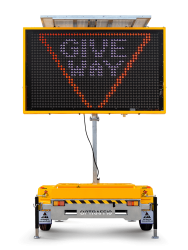
- Full-matrix message display: Shows detour arrows and symbols that drivers read faster than text alone.
- Solar-powered message signs: Keep closure warnings running at remote slide sites without refuelling trips.
- Auto-dimming LED display: Keeps storm messages readable through heavy rain, darkness and low cloud.
Why El Niño Road Closures Will Test California Fleets This Winter
Short answer: A very strong El Niño raises the odds of repeated storms. Each storm can close roads with little warning.
The Climate Prediction Center rated a very strong event this winter above 90% likely, Newsweek reported in September 2026. It also gave a 75% chance of record strength between October and December. California did not wait. Governor Newsom issued an emergency proclamation on September 21, 2026. The state then announced its winter storm and flood preparations on October 9. They include:
- About 4.4 million sandbags at 68 locations.
- More than 52,000 feet of portable flood barriers.
- Swiftwater rescue equipment for 13 local fire departments.
The state warns of flooding, landslides, debris flows and erosion. Each of these closes roads. Many closures happen on rural routes far from depots.
What Past Storm Seasons Show
California has seen this pattern before. During the January 2023 storms, Caltrans activated about 1,200 electronic highway signs to warn drivers. Fixed signs cover major highways. Local roads, canyon routes and detours depend on portable units. That is where hire fleets come in.
| Storm hazard | Typical road impact | Message sign role |
|---|---|---|
| Flash flooding | Low crossings and underpasses close fast | Warn of closure and point to the detour |
| Mudslides and debris flows | Canyon and hillside roads close for days | Hold long-term closure and detour messages |
| Coastal flooding and erosion | Coastal highways close or narrow | Advance warning and lane closure notices |
| High winds and fallen trees | Short, scattered closures | Rapid warnings on rural routes |
Preparing Message Sign Trailers Before Storm Season
Short answer: Service units, test power and load messages in November. Every trailer should leave the yard within hours.
Preparing message sign trailers before storm season decides how fast a fleet can respond. A storm is the wrong time to find a flat battery. Use this checklist before December:
- Test battery capacity and replace weak batteries.
- Clean solar panels and check panel brackets.
- Confirm 4G connectivity and remote access on every unit.
- Check tyres, lights, jacks and hitch hardware.
- Load storm message templates into each sign.
- Record each unit’s status in the fleet software.
Storm Season Fleet Allocation
Not every request arrives at once. Plan who gets units first:
- Contracted agencies and utilities with standing agreements.
- Routes with a history of slides or flooding.
- Remote sites far from other fleets.
- One-off requests from new customers.
Rank requests before the season, not during the first storm. Agree response times in advance. A contract that promises delivery within hours needs units staged near the risk areas. ### Staging Units Near High-Risk Routes
Distance costs hours in a storm. Fleets can stage units closer to known trouble spots before the season starts:
| Staging option | Best for | Trade-off |
|---|---|---|
| Main depot | Urban and suburban callouts | Long tows to rural slide sites |
| Satellite yard near canyon routes | Repeat mudslide and flood corridors | Extra yard cost and security |
| Pre-placed at agency sites | Contracted agencies with known risk roads | Units committed before storms arrive |
Agree with each agency where staged units may sit. Mark them in the fleet software, so dispatchers see every staged unit at once.
For timing logic from another hazard season, compare when to order message sign trailers for bushfire season.
Flood and Mudslide Road Closure Messages
Short answer: Keep each message short, name the road or exit, and change it as the closure develops.
Drivers in heavy rain have less time to read. Spray, wipers and darkness all cut reading time. Flood and mudslide road closure messages must work at a glance. California follows the CA MUTCD 2026, which took effect on January 18, 2026. Check its temporary traffic control rules before you set message formats.
| Closure phase | Example message | Sign position |
|---|---|---|
| Storm warning | STORM WARNING / AVOID TRAVEL TONIGHT | Main approaches before the storm |
| Road closed | ROAD CLOSED / FLOODING AHEAD | Before the last turn-off |
| Detour active | DETOUR / USE HWY 1 NORTH | At the detour turn |
| Long-term slide closure | ROAD CLOSED TO JAN 15 / LOCAL ACCESS ONLY | At both ends of the closed section |
| Reopening | ROAD OPEN / DRIVE WITH CARE | At the former closure point |
Follow these wording rules:
- Use no more than two phases per message.
- Name the road, exit or town, not just “detour.”
- Avoid dates or times that may change without notice.
- Remove storm messages as soon as conditions clear.
Detour Arrows Drivers Can Read in Rain
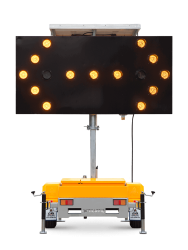
Text takes longer to read than symbols. Full-matrix signs can show arrows and simple graphics. Drivers in rain and spray read an arrow faster than a sentence. For complex detours, a map may help even more. See how full-color message signs show diversion maps.
Amber Full-Matrix or Full-Color Signs for Storm Closures?
Short answer: Use amber full-matrix signs as the storm workhorse. Add full-color signs only where complex, long-term detours need maps.
Power decides most storm deployments. Full-color displays draw more power than amber ones. See why full-color message signs draw more power than amber signs. Days of cloud make that gap matter. Color rules also add a check. MUTCD and state specs also limit color on portable signs. See what MUTCD and FHWA allow for color on message signs.
| Site type | Recommended display | Why |
|---|---|---|
| Remote flood or slide closure | Amber full-matrix | Longer battery reserve; widely accepted in specs; shows arrows |
| Detour turn-off | Amber full-matrix | An arrow and a road name are enough |
| Long-term closure with a complex detour | Full-color | Shows a diversion map drivers can follow |
| Urban site with easy recharging | Full-color optional | Power limits matter less |
Three-line message signs display text only. They cannot show arrows, so they suit simple notices rather than detour points.
Solar Power for Message Signs in Prolonged Storms
Short answer: Size batteries for several cloudy days in a row. Atmospheric rivers block the sun for long stretches.
A single storm may bring days of heavy cloud. Solar panels still charge in cloud, but at far lower output. Solar power for message signs in prolonged storms depends on battery reserve more than panel size.
Check these points before deployment:
- Battery reserve: Confirm how many days a unit runs without sun.
- Message load: Bright, constant messages use more power than simple ones.
- Auto-dimming: Lower brightness at night saves power and cuts glare.
- Panel position: Avoid tree cover and steep canyon shade.
- Remote monitoring: Watch battery levels from the office, not the roadside.
For sizing methods, see how to size a solar power system for a message sign trailer. For long deployments, compare solar and generator message sign trailers.
Remote Control During Storm Road Closures
Short answer: Remote control lets one supervisor update every sign as roads close and reopen. Crews stay out of the storm.
Storm closures change by the hour. A road closes at midnight and reopens at noon. Another slide closes a different route. Sending crews to each sign puts people on unstable, flooded roads.
Remote control during storm road closures removes most of those trips. A 4G-connected sign accepts new messages from a phone, tablet or PC. GPS confirms each unit stays where crews left it. Learn more about how 4G-connected portable traffic signs work.
One Screen for a Storm-Wide Fleet
A single storm may spread units across several counties. Operators need one screen showing every sign, its message and its battery level. This guide to web-based traffic device management for rental fleets explains what to look for. Many platforms charge a monthly fee per device. Storm units may sit idle for months between seasons. Compare yearly software costs before you buy.
Reliability matters most when weather is worst. Sealed enclosures, proven LED modules and low-maintenance designs keep signs readable through repeated storms. Each failed unit means a closure with no warning. Check enclosure seals and cable entries during the pre-season service, not after the first storm.
Lessons From Other Flood Seasons
Short answer: Agencies that pre-position signs and pre-load messages respond faster when roads flood.
Australian councils face similar flood seasons. Their approach offers useful lessons. See flood response traffic management equipment in Queensland. For evacuation-scale events, read how portable message signs support emergency evacuation. For fast single closures, see quick deployment of message boards for emergency road closures.
After the Storm: Recovery and Turnaround
Storm work does not end when the rain stops. Slide closures can last for weeks. Some units stay on site through the repair phase, while others return for the next storm. Plan the turnaround:
- Switch each sign to recovery messages as roads reopen.
- Check units for water ingress, mud and impact damage.
- Clean panels after debris and dust settle.
- Recharge and re-stage units before the next forecast storm.
The common thread is preparation. Fleets that stage units, load messages and test power before the season respond in hours. Fleets that wait for the first storm respond in days. These steps form part of wider traffic safety planning for road operators.
FAQ
When should California fleets prepare for El Niño storms?
Prepare in November. Most heavy storms arrive between December and March. Units should be serviced, charged and loaded with messages before then.
How long can a solar message sign run without sun?
It depends on battery size and message load. Check the rated autonomy for each unit. Plan for several cloudy days during atmospheric river events.
What should a flood road closure sign say?
State the closure and the action in two short phases. For example, ROAD CLOSED / FLOODING AHEAD, then DETOUR / USE HWY 1 NORTH. Name the road or exit drivers should use.
How many message signs does a storm road closure need?
Plan at least one sign at each end of the closed section. Add one at the detour turn-off. Long detours need extra signs to confirm the route. Count signs per closure before the season, then multiply by expected closures.
Which manual governs temporary signs in California?
California uses the CA MUTCD 2026, effective January 18, 2026. It substantially conforms to the national MUTCD 11th Edition. Check its temporary traffic control rules before deployment.
Conclusion
El Niño road closures will test California’s road networks this winter. Hire fleets that prepare now will answer calls in hours, not days. Service units, load storm messages, size power for cloudy weeks and set up remote control before December. Optraffic supplies solar message sign trailers with full-matrix displays and remote control. Every unit connects to the Optraffic Web System at no added software cost. Hire fleets and agencies can contact the Optraffic team to prepare units before the first storm arrives.
Facebook
Twitter
LinkedIn
Email
Newsletter
Subscribe to our Newsletter & Event right now to be updated.
Latest Posts


Latest Posts
What to Check Before Buying 500 Portable Changeable Message Signs: 7 Batch Delivery Checks for Rental Fleets
What to check before buying 500 portable changeable message signs: one build across batches, spares, DDP delivery and per-shipment tests.
2026-11-11
How to Plan Message Signs for Weekend Highway Closures: Lessons from Atlanta’s I-285 Westside Closures
How to plan message signs for weekend highway closures: 5 steps, a 48-hour checklist and fleet control lessons from Atlanta’s I-285 closures.
2026-11-11
Does EN 12966 Apply to LED Modules? What the Standard Covers and What a Datasheet Cannot Prove
Does EN 12966 apply to LED modules? See what the standard covers, what a module datasheet proves and 5 questions to ask a supplier.
2026-11-10
Build vs Buy a Vehicle-Mounted Message Sign: What Fleets and Integrators Should Check
Build vs buy a vehicle-mounted message sign? Compare compliance, controls, mounting and support before you choose.
2026-11-10
Work Zone Speed Feedback Trailer Placement: Where to Set It Up and When to Move It
Work zone speed feedback trailer placement explained: where DOT rules and research say to set the trailer, when to move it and what fleets must log.
2026-11-05
WZDx Device Feed Requirements: What Work Zone Contractors and Hire Fleets Must Supply
WZDx device feed requirements explained for contractors and hire fleets: what the feed holds, what DOT specs ask for and how to prepare equipment.
2026-11-04