




A hire desk quotes a weekly rate and wins the job. Six months later the contract has run at a loss.
Nothing went wrong with the equipment. The site moved eleven times, and nobody costed the moves. The Optraffic team sees this pattern across hire fleets running mobile CCTV towers on multi-site contracts.
Two camera towers. One trip.
Relocation is the cost nobody puts in the quote.
Key Takeaways
- Paired trailer towing: Moves two Optraffic towers on one trip, halving vehicle and driver time per position.
- Single-person deployment: Removes the second crew member from every relocation.
- Solar power on each unit: Eliminates power reconnection at each new position.
- Remote status checks: Confirm a unit is running without sending someone to look.
- Optraffic dual-purpose design: Cuts return trips when a site settles and the chassis is recovered.
What a Single Relocation Actually Costs
A relocation is not a transport line item. It is five costs occurring together, only one of which appears on a fuel receipt.
| Cost component | What drives it |
|---|---|
| Vehicle and fuel | Distance, tow rating, whether a suitable vehicle is free |
| Driver hours | Travel each way, hitching, setup, site induction |
| Coverage gap | Hours the site has no surveillance during the move |
| Scheduling overhead | Access windows, permits, coordinating with site supervisors |
| Recommissioning | Repositioning, levelling, confirming connectivity at the new spot |
Surveillance tower relocation cost per move is dominated by hours, not kilometres. A 30-minute drive still consumes most of a shift once induction and setup are counted.
The Cost Nobody Invoices
The coverage gap has no line item and no invoice. It still matters.
A site with no cameras between 9am and 3pm has no cameras during the exact window when deliveries, contractors and visitors move through it. Repeated across eleven moves, that adds up to days of unmonitored operation.
Why Moving Surveillance Towers Between Sites Costs More Than Expected
Moving surveillance towers between sites carries costs that scale differently from the equipment itself. Three assumptions cause most of the damage.
- One move is assumed, several happen. Linear projects and staged works relocate repeatedly by design.
- Two people are assumed available. Crewing a second person for every move doubles the labour line.
- The unit is assumed ready on arrival. Power, mounting and connectivity all need confirming at the new position.
Site conditions that create avoidable rework are listed in the Optraffic review of mobile CCTV tower deployment mistakes.
How Towing Two Camera Towers at Once Changes the Arithmetic
Towing two camera towers at once is the only variable in the list that halves several costs simultaneously.
| Per position | Single-unit moves | Paired towing |
|---|---|---|
| Trips for two positions | Two | One |
| Driver hours | Doubled | Shared across both units |
| Site inductions | Two | One |
| Coverage gap | Two separate gaps | One shared window |
| Vehicle availability required | Twice | Once |
The saving compounds on build-out and strike. A four-position site takes four trips to establish with single units, and two with paired trailers.
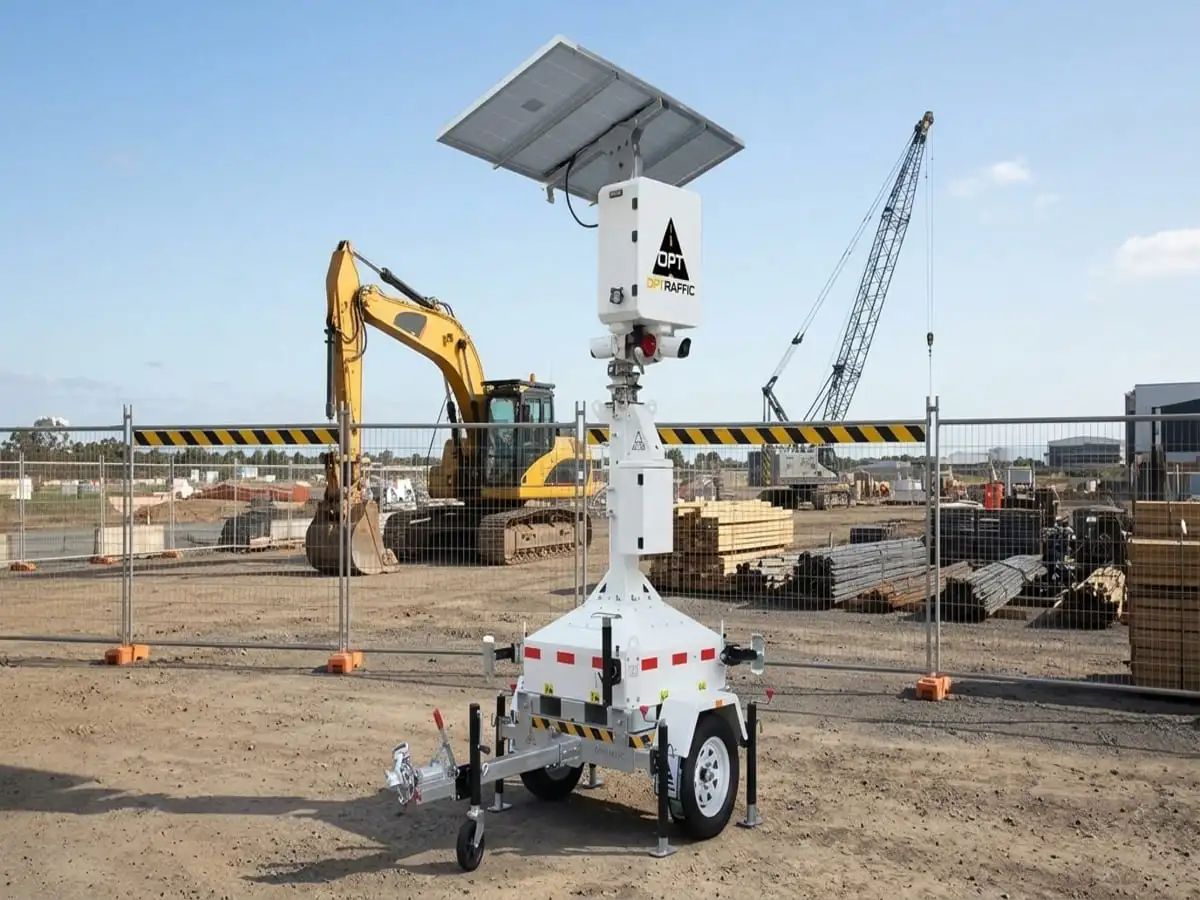
The Optraffic Mini Solar CCTV Tower Dual Trailer was designed around this arithmetic. Paired towing is not a convenience on a multi-position contract — it is what makes the position count affordable to deploy.
This was the point visitors raised most at Security Expo 2026 in Sydney this September, where more than fifty people stopped at the Optraffic stand on the opening day. Hire fleet managers did not ask about cameras first. They asked what two towers on one trailer meant for the number of trips their crews would run.
When Lifting Enters the Calculation
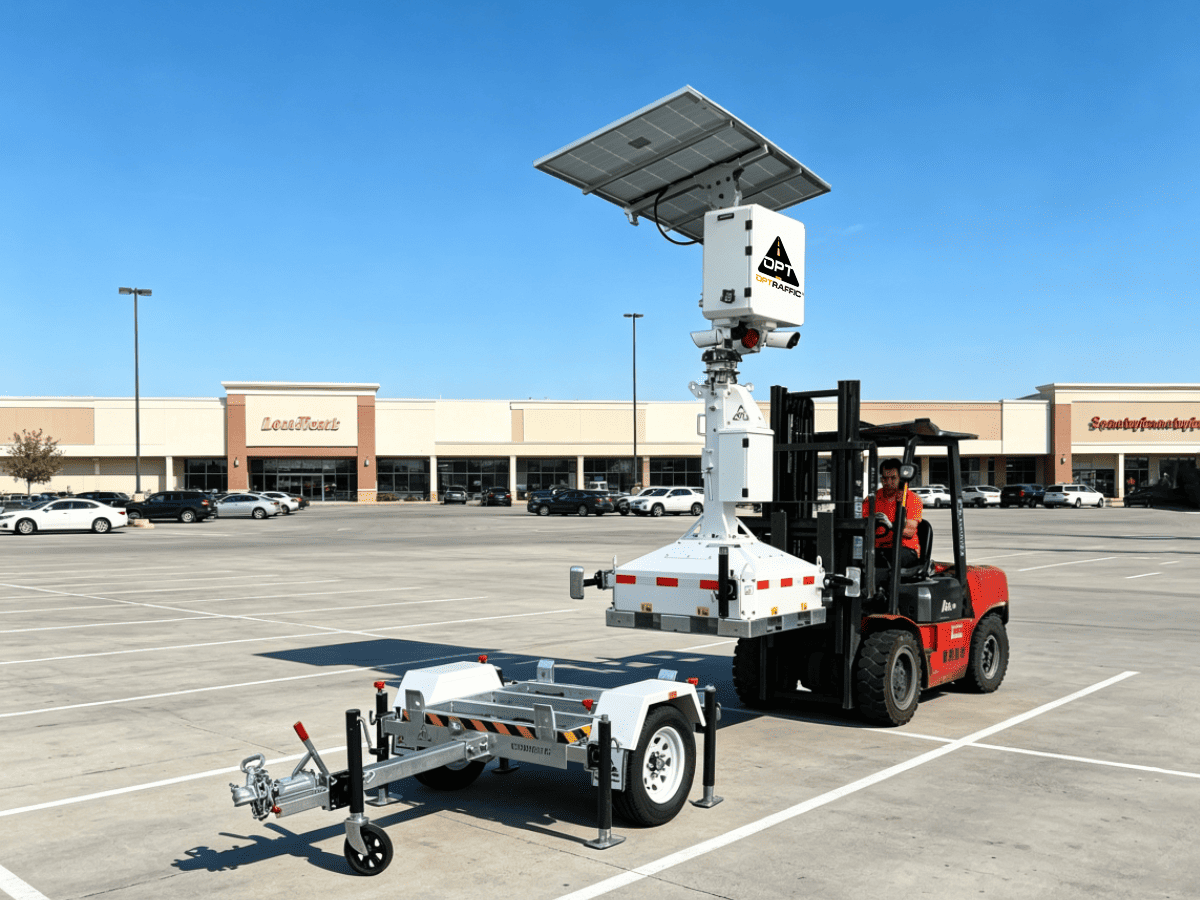
Some relocations involve removing a tower from its trailer rather than towing it. That introduces lifting plant, an operator and a lift plan.
Safe Work Australia’s forklift information sheet sets out the operator and load requirements that apply. Confirm plant availability during scoping, not on the day.
Reducing Site Visits for Camera Towers Without Reducing Coverage
Not every trip is a relocation. Many are checks, and checks are the easier cost to remove.
Trips That Do Not Move Anything
- Confirming a unit is still powered and recording.
- Retrieving footage after an incident.
- Checking battery state before a long weekend.
Each is a vehicle, a driver and half a shift. None of them changes where the equipment sits.
Reducing site visits for camera towers starts with remote access. Optraffic supplies the management platform with the equipment at no additional cost, so operators check status, view live feeds and pull recordings without travelling. Connectivity behaviour at difficult positions is covered in the Optraffic guide to remote security towers without on-site Wi-Fi.
Position for the Programme, Not the Phase
The cheapest relocation is the one that never happens. Positions chosen for the current work face often need moving within weeks.
Selecting a position that survives two or three phases removes moves from the schedule entirely. The sequence for choosing that position is set out in the Optraffic guide to security camera trailer positioning.
What Hire Fleets Should Include in a Multi-Site Quote
Six items belong in the quote before the weekly rate is set.
- Expected number of moves across the contract, from the client’s programme.
- Whether moves are single or paired, and the vehicle needed for each.
- Access windows at each site, including induction requirements.
- Who performs the move — client crew, hire crew, or subcontractor.
- Whether positions can be shared across phases to remove moves.
- Remote check capability, which removes trips that are not relocations.
Hire fleet turnaround on security equipment improves fastest when moves are priced as work, not absorbed as overhead. Ownership economics across a longer horizon are compared in the Optraffic analysis of buying versus renting portable security equipment.
Conclusion
Relocation is the cost that decides whether a multi-site surveillance contract makes money. It rarely appears in the specification and almost never appears in the quote.
Count the moves before setting the rate. Then reduce them, by pairing what travels together and by choosing positions that outlast the phase.
Multi-position layouts and how linked units are managed as one system are covered in the Optraffic guide to covering a large site with multiple camera towers, part of the wider Optraffic Security and Surveillance work.
FAQ
How much does it cost to relocate a surveillance tower?
Cost varies by distance and access, but hours dominate. Vehicle, driver time, site induction and recommissioning usually outweigh fuel on any move under an hour’s drive.
Can one person relocate a camera tower?
Yes, where the unit is designed for single-operator deployment. This removes the second crew member from every move and is the largest single saving on surveillance tower relocation cost per move.
Is it cheaper to move two towers together?
Yes. Towing two camera towers at once shares one trip, one driver and one induction across two positions, rather than repeating each.
How can a hire fleet reduce site visits?
Use remote status checks and footage retrieval. Reducing site visits for camera towers removes the trips that never move equipment, which are usually the majority.
Should relocation cost change which unit we specify?
Often, yes. Contracts with frequent moves favour paired towing and single-person setup. Contracts that settle early favour a unit whose chassis can be recovered.



Lighting First or Recording First? CCTV-Ready Light Tower vs Camera Trailer for Integrators and Hire Fleets
CCTV-ready light tower vs camera trailer: compare whose camera runs, which load gets night power, and how hire fleets use one unit for two jobs.
VMS Trailers for Renewable Energy Zone Construction: Oversize Deliveries, Detours and Community Notice
How VMS trailers support renewable energy zone construction: oversize delivery warnings, detours, night moves and community notice on REZ routes.
Imported vs Australian-Built VMS Trailers: Where Each Has the Edge
Imported vs Australian-built VMS trailers: where each has a real advantage, what compliance requires of both, and how to choose for your fleet.
What Should a VMS Trailer Quote Include in Australia? Line Items to Compare Before You Sign
What should a VMS trailer quote include? Ten line items to compare, from delivery and registration to software fees, warranty and local spare parts.
When to Order VMS Trailers for Bushfire Season: A Region-by-Region Guide for Australian Hire Fleets
When to order VMS trailers for bushfire season: a region-by-region guide for hire fleets, with order-by months, stock top-ups and pre-season checks.
What Makes a VMS Trailer Mine-Spec? Site Entry Requirements for Western Australian Mine Sites
Mine-spec VMS trailer requirements under WA’s 2026 mine traffic code: visibility, ID, isolation, documents and how to order a unit that passes site entry.