


A contractor orders four camera trailers for one site and specifies every unit identically. It seems efficient until the first incident.
The gate footage cannot resolve a plate. The compound camera saw the theft but not the face. The boundary unit was pointed the wrong way at the time. The Optraffic team sees this on sites that standardised the configuration across security camera trailers instead of matching each unit to its position.
Key Takeaways
- Optraffic camera options: Include PTZ, bullet and panoramic types, specified per trailer rather than per order.
- Position-matched configuration: Assigns identification duty to gates and wide awareness to open ground.
- Mixed configuration on one tower: Combines fixed and PTZ cameras so evidence continues while an operator pans.
- Per-project specification: Lets a hire fleet re-configure a trailer between contracts instead of buying another.
- Remote review: Confirms each camera is aimed and recording without a site visit.
Camera Types for a CCTV Camera Trailer
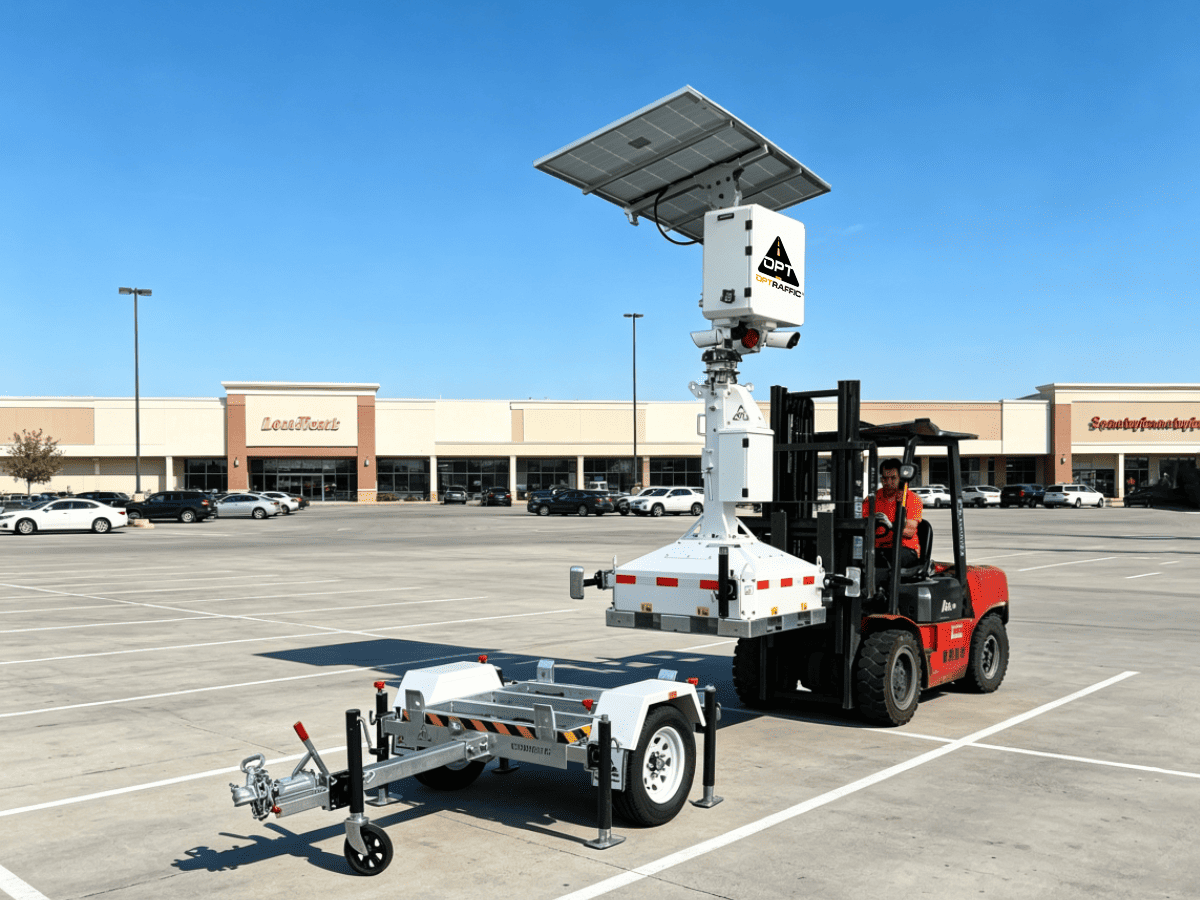
Four trailers, one specification, and a gate that couldn’t read a plate.
Choosing Cameras for a CCTV Camera Trailer: The Short Answer
Decide the task at each position first. Deterrence needs presence, detection needs coverage, and identification needs pixels on a face or a plate. Bullet cameras hold a fixed scene reliably, PTZ cameras follow activity across open ground, and panoramic cameras remove blind spots between fixed views. Most sites need a mix, not a standard.
Why Standard Camera Advice Does Not Apply Here
Most camera selection advice assumes a building. Mains power, a network cable, one camera per wall, and somebody indoors watching a screen.
A CCTV camera trailer on a temporary site has none of that. Selection is driven by what each position must prove, and by the fact that several units share one site with no cabling between them.
Start With the Surveillance Task, Not the Camera Type
Matching cameras to the surveillance task is the step that decides whether footage is usable later. Three tasks cover almost every position on a site.
| Task | What it must achieve | What failure looks like |
|---|---|---|
| Deterrence | Visible presence at approaches | Nothing recorded, but nothing attempted |
| Detection | Knowing something happened, and where | Event missed entirely |
| Identification | Resolving a face, a plate or a marking | Footage exists but proves nothing |
Security practitioners work to graded imaging categories — detect, observe, recognise, identify — set out in the AS/NZS 62676 series. The UK Home Office formalised the same approach in its CCTV Operational Requirements Manual, which asks buyers to define the problem before specifying equipment.
The distinction matters commercially. A client asking for “cameras on the gate” usually means identification, which is the most demanding category of the four.
Police crime prevention guidance treats these as separate outcomes too. Victoria Police advises builders to combine deterrence measures with recorded evidence and asset marking, rather than relying on cameras alone.
PTZ vs Bullet vs Panoramic Camera: What Each One Actually Does Best
The PTZ vs bullet vs panoramic camera decision is about behaviour, not image quality. All three record. They differ in what they are looking at when an incident occurs.
| Camera type | Strength | Limitation | Best position |
|---|---|---|---|
| Bullet (fixed) | Holds one scene continuously | Sees only that scene | Gates, doors, fuel bays, asset compounds |
| PTZ | Follows activity, zooms on demand | May be pointed elsewhere during an event | Open yards, haul roads, active work faces |
| Panoramic | Wide unbroken field, no blind gaps | Detail falls away with distance | Plazas, laydown areas, crowd spaces |
Why a PTZ Alone Is a Risk on an Unmonitored Site
A PTZ earns its place when somebody is watching. On a site with no live operator, it is pointed wherever it last stopped.
Fixed cameras record their zone regardless. That is why mixed configurations exist. Two-way comparison of PTZ against a single fixed camera is covered separately in the Optraffic guide to PTZ versus single-camera surveillance trailers; this article deals with configuring several units across one site.
Matching Camera Type for Site Entry Points and Other Positions
Camera choice follows the position, and positions follow the site’s risk. Camera type for site entry points is the least negotiable of the set.
| Position | Dominant task | Suggested configuration |
|---|---|---|
| Main vehicle gate | Identification | Fixed camera on the approach lane, tight field |
| Contractor or delivery gate | Identification | Fixed camera, plus wide view of the queue area |
| Asset compound, fuel, cable | Detection and identification | Fixed cameras on approaches, PTZ for the wider yard |
| Open laydown or yard | Detection | PTZ or panoramic, depending on live monitoring |
| Rear or blind boundary | Detection | Panoramic, or fixed pair covering both approaches |
| Public interface, footpath | Deterrence | Wide view, framed to avoid over-capture |
Framing at the public interface carries a legal dimension as well as a technical one. The Privacy Act 1988 and the Australian Privacy Principles govern what a system may collect, so a camera aimed at a footpath or a neighbouring yard needs justification.
Where each trailer sits within those zones follows the sequence in the Optraffic guide to security camera trailer positioning. Unit count and how trailers link across a large site are covered in the Optraffic guide to covering a large site with multiple camera towers.
Why a Mixed Camera Configuration on One Trailer Beats Standardising
A mixed camera configuration on one trailer solves the problem that standardisation creates. Fixed cameras hold the evidence positions while a PTZ covers the ground between them.
Three practical reasons hire fleets specify per unit rather than per order:
- Contracts differ. A car park and a haul road need different behaviour from the same asset.
- Re-configuration beats re-purchase. A unit respecified between hires earns across more contract types.
- One incident tests the whole layout. Whatever was fixed and recording at that moment is what the client receives.
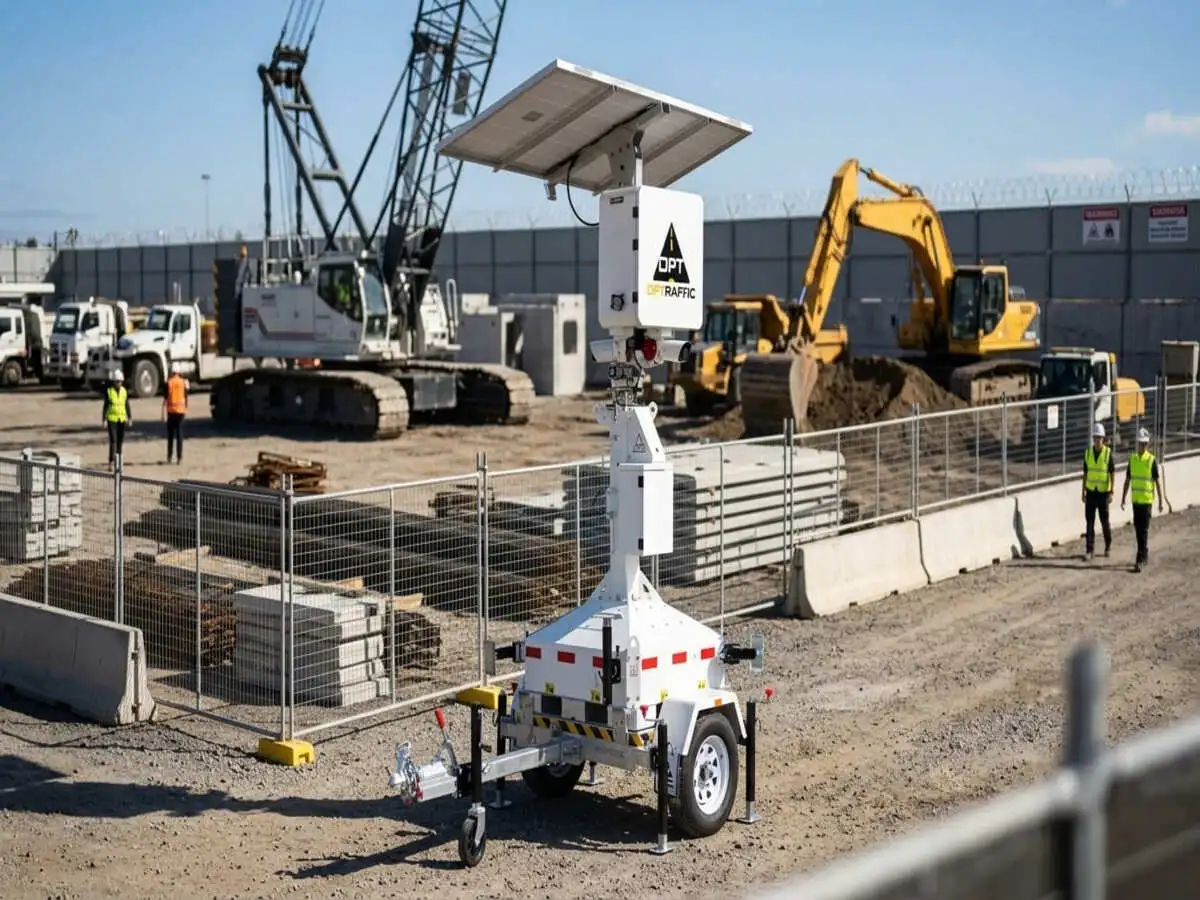
Optraffic lists PTZ, bullet and panoramic cameras as selectable options on the CCTV camera trailer range, specified per project rather than as a single fixed build. That flexibility matters most to fleets serving several sectors from one yard.
What Camera Choice and Evidence Quality Cannot Fix
Camera choice and evidence quality are related, but the camera is rarely the reason footage fails. Four other factors decide usability.
- Mounting height and angle. A camera too high captures the top of a head, not a face.
- Lighting and backlight. A gate camera facing headlights at night resolves nothing.
- Recording continuity. Footage that was not retained is the same as footage never captured.
- Retrieval speed. Evidence requested a week later is often needed within hours.
Common causes of unusable footage are listed in the Optraffic review of why CCTV trailer footage is not usable. Where recordings are held, and what happens when a link drops, is compared in the Optraffic guide to cloud storage versus on-board NVR.
What to Confirm Before Specifying Cameras
Five questions settle the configuration for every trailer on a site.
- What must this position prove? Deterrence, detection or identification.
- Is anyone watching live? Without a live operator, prioritise fixed coverage.
- What is the lighting at night? Backlit approaches need reframing, not more resolution.
- Will this unit move to a different task? Re-configurable units cover more contract types.
- Who reviews the footage, and how fast? Retrieval workflow belongs in the specification.
Australian sector context sits in the Optraffic overview of adaptive CCTV solutions across Australia, part of the wider Optraffic Security and Surveillance work.
Conclusion: What the Four-Trailer Site Should Have Specified
Return to the contractor from the opening. The same four units, specified by position rather than by order, would have looked like this.
- Main gate: fixed camera framed tight on the approach lane, for plate and driver identification.
- Plant and fuel compound: fixed cameras on the two approaches, plus a PTZ for the surrounding yard.
- Open laydown area: panoramic camera, because no operator watches it live overnight.
- Rear boundary: fixed pair covering both approach directions, aimed away from the neighbouring property.
Same hardware count. Same budget. A gate that resolves plates and a boundary that was pointing the right way.
The rule underneath it is short. Decide what each position must prove, then choose the camera that proves it. Fixed cameras hold the evidence positions, and PTZ or panoramic cameras cover the ground between them.
The Optraffic team works through this position by position with hire fleets and integrators before a site is specified.
FAQ
What is the difference between PTZ, bullet and panoramic cameras?
A fixed bullet camera holds one scene continuously. A PTZ pans, tilts and zooms to follow activity. A panoramic camera covers a wide unbroken field. The PTZ vs bullet vs panoramic camera choice depends on whether anyone is watching live.
Which camera type should cover a site entrance?
A fixed camera framed on the approach lane. Camera type for site entry points must support identification, which needs a consistent, tight field of view rather than a moving one.
Can one trailer carry more than one camera type?
Yes. A mixed camera configuration on one trailer is standard practice, because fixed cameras hold the evidence positions while a PTZ or panoramic camera covers the space between them.
Is a PTZ camera enough on its own?
Rarely, on an unmonitored site. A PTZ records wherever it last stopped, so an incident outside that view is missed. Pair it with fixed coverage.
Does a higher megapixel camera solve site security problems?
Rarely. On a temporary site, position, mounting angle and night-time backlight decide usability more than sensor resolution. A well-aimed camera at a gate outperforms a higher-resolution one pointed at the wrong lane.
Does a higher resolution camera fix unusable footage?
Not usually. Mounting angle, night-time backlight and retention settings cause more failures than sensor resolution does. Camera choice and evidence quality diverge whenever the position is wrong.



Lighting First or Recording First? CCTV-Ready Light Tower vs Camera Trailer for Integrators and Hire Fleets
CCTV-ready light tower vs camera trailer: compare whose camera runs, which load gets night power, and how hire fleets use one unit for two jobs.
VMS Trailers for Renewable Energy Zone Construction: Oversize Deliveries, Detours and Community Notice
How VMS trailers support renewable energy zone construction: oversize delivery warnings, detours, night moves and community notice on REZ routes.
Imported vs Australian-Built VMS Trailers: Where Each Has the Edge
Imported vs Australian-built VMS trailers: where each has a real advantage, what compliance requires of both, and how to choose for your fleet.
What Should a VMS Trailer Quote Include in Australia? Line Items to Compare Before You Sign
What should a VMS trailer quote include? Ten line items to compare, from delivery and registration to software fees, warranty and local spare parts.
When to Order VMS Trailers for Bushfire Season: A Region-by-Region Guide for Australian Hire Fleets
When to order VMS trailers for bushfire season: a region-by-region guide for hire fleets, with order-by months, stock top-ups and pre-season checks.
What Makes a VMS Trailer Mine-Spec? Site Entry Requirements for Western Australian Mine Sites
Mine-spec VMS trailer requirements under WA’s 2026 mine traffic code: visibility, ID, isolation, documents and how to order a unit that passes site entry.