


Can a Full-Matrix PCMS Simulate an Arrow Board? What MUTCD and FHWA Allow

Arrow boards run short in peak season. A contractor then asks a simple question. Can a full-matrix PCMS simulate an arrow board on the next lane closure? MUTCD says yes, as an option, with clear limits. This guide explains the rules, the flash settings and the cases that still need a dedicated arrow board. It also shows where Optraffic full-matrix message sign trailers fit that decision.
The Optraffic team checked one setting before writing this guide. The frame flash default in the Optraffic Web System is 0.5 seconds on and 0.5 seconds off. That equals 60 flashes per minute, which is too fast for arrow board use. The team confirmed that operators can lengthen both phases into the MUTCD range.
Key Takeaways
- Full-matrix display: Draws a true arrow graphic across the sign face, not character-based approximations.
- Adjustable frame flash timing: Sets arrow displays to 25–40 flashes per minute with 50 percent on-time.
- Bundled Web System: Switches a sign between text and a saved arrow program remotely, with no subscription fee.
- Named display templates: Store a compliant arrow program so crews load it instead of rebuilding timing on site.
What MUTCD Says About PCMS Arrow Board Simulation
PCMS arrow board simulation MUTCD rules sit in Section 6F.61 of the MUTCD 2009 Edition. Three paragraphs matter most:
- Paragraph 26 (Option): “A portable changeable message sign may be used to simulate an arrow board display.”
- Paragraph 15 (Standard): arrow displays flash 25 to 40 times per minute. Flashing mode needs a minimum element on-time of 50 percent. Sequential modes use equal phases of 25 percent each.
- Paragraph 25 (Standard): arrow boards indicate lane closures only. They shall not indicate a lane shift.
The FHWA Interpretation on Flashing Modes
Section 6F.60 bars animation and rapid flashing on a PCMS. That seemed to conflict with arrow modes. FHWA resolved the question in an official interpretation dated December 4, 2012. A PCMS that simulates an arrow board may use the flashing and sequential modes an arrow board uses.
Full-Matrix Message Sign Arrow Mode vs a Dedicated Arrow Board
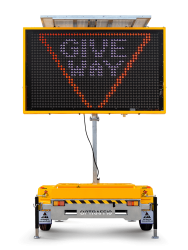
A full-matrix message sign arrow mode works because every pixel is addressable. The panel can draw a solid arrow, a chevron or a caution pattern. A character-matrix sign cannot, because its fixed character blocks break the arrow into pieces.
The full-matrix message sign explainer covers how the pixel grid works.
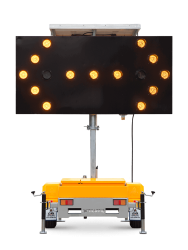
Size still matters. MUTCD Figure 6F-6 sets four arrow board types:
| Arrow board type | Minimum size | Legibility distance | Minimum elements | Typical use (6F.61 ¶06) |
|---|---|---|---|---|
| Type A | 48 × 24 in | 1/2 mile | 12 | Low-speed urban streets |
| Type B | 60 × 30 in | 3/4 mile | 13 | Intermediate-speed roads; mobile work on high-speed roads |
| Type C | 96 × 48 in | 1 mile | 15 | High-speed, high-volume projects |
| Type D | Arrow 48 in long | 1/2 mile | 12 | Vehicles authorized by the agency |
Matching the Sign Face to the Required Type
Compare the PCMS face with the type the traffic control plan names. A smaller face cannot match a Type C display or its one-mile legibility. Simulation fits best where the plan calls for a Type A or Type B arrow.
Setting a Full-Matrix Message Sign Arrow Mode That Meets the Flash Rate
Equal on and off times give exactly 50 percent on-time. The cycle length then sets the flash rate.
| On time (s) | Off time (s) | Flashes per minute | Within 6F.61 ¶15? |
|---|---|---|---|
| 0.5 | 0.5 | 60 | No — too fast |
| 0.75 | 0.75 | 40 | Yes — upper limit |
| 0.8 | 0.8 | 37.5 | Yes |
| 1.0 | 1.0 | 30 | Yes |
| 1.2 | 1.2 | 25 | Yes — lower limit |
Follow three steps before the sign leaves the yard:
- Build the arrow frame. Draw a solid arrow that fills most of the sign face.
- Set equal on and off times. Pick a value between 0.75 and 1.2 seconds.
- Save it as a named template. Crews then load a checked program on site.
Sequential Arrow on a Portable Changeable Message Sign
A sequential arrow on a portable changeable message sign needs more than one frame. Each phase must last an equal 25 percent of the cycle. Confirm that the controller can set frame times that short and that even before you promise a sequential display.
Full-Matrix Sign vs Arrow Board for Lane Closures: When Each Fits
The full-matrix sign vs arrow board for lane closures choice depends on speed, contract and duration.
Simulation fits when:
- The plan calls for a Type A or Type B arrow board.
- The agency or contract accepts PCMS simulation.
- The arrow board fleet is short, and the PCMS covers as backup.
- The closure is short, and the crew needs one device, not two.
A dedicated arrow board fits when:
- The plan calls for a Type C board on a high-speed road.
- The contract names an arrow board by type.
- The job needs a text message and an arrow at the same time.
- The work runs from a vehicle that needs a Type D board.
The arrow board flashing rate guide covers dedicated truck-mounted boards in more detail.
Arrow Board Caution Mode on Two-Lane Roads
Arrow board caution mode applies to shoulder work and one-lane closures on two-lane, two-way roads. Section 6F.61 Paragraph 18 limits arrow boards to caution mode in those cases. A simulated display follows the same rule. Program a caution pattern, such as flashing corners, alongside the arrow template.
Check State Rules Before Relying on PCMS Arrow Board Simulation
MUTCD Paragraph 26 is an option, not a requirement. A state manual or contract can still require a dedicated arrow board.
FHWA required states to adopt the 11th Edition, or a conforming state manual, by January 18, 2026. Check the current state manual before relying on the 2009 paragraph numbers in this guide.
State product lists can also matter. The guide to full-matrix PCMS on state DOT qualified products lists explains how listing works.
For fleets weighing the wider business case, read replacing three-line message signs with full-matrix units. The display types behind the decision sit in common types of message board signs.
Getting these checks right supports the wider traffic safety goal: a clear lane closure signal that drivers read early.
Conclusion
So, can a full-matrix PCMS simulate an arrow board? Yes, under MUTCD 2009 Section 6F.61 Paragraph 26. The display must flash 25 to 40 times per minute with 50 percent on-time. It must indicate lane closures only, and use caution mode where Paragraph 18 requires it. Size and contract terms decide whether simulation replaces a dedicated board or only backs it up.
The Optraffic team supplies full-matrix sign trailers with the Optraffic Web System at no additional cost. Operators set frame flash timing, save arrow templates and switch displays remotely. Optraffic builds the display, controller and trailer in-house, so the hardware and software work as one system.
Contact the Optraffic team to review arrow display settings for your next closure.
FAQ
Can a full-matrix PCMS simulate an arrow board?
Yes. MUTCD 2009 Section 6F.61 Paragraph 26 lets a portable changeable message sign simulate an arrow board display. The display must still meet the arrow board flash rate. A state or contract may require a dedicated board instead.
What flash rate does PCMS arrow board simulation MUTCD require?
PCMS arrow board simulation MUTCD rules use the arrow board standard: 25 to 40 flashes per minute. Flashing mode needs at least 50 percent on-time. Equal on and off times between 0.75 and 1.2 seconds meet both limits.
Does a PCMS arrow display break the no-animation rule?
No. FHWA’s December 2012 interpretation confirmed it. A PCMS simulating an arrow board may use the flashing and sequential modes an arrow board uses. Those modes do not count as prohibited animation.
Can a simulated arrow show a lane shift?
No. Section 6F.61 Paragraph 25 limits arrow boards to lane closures. A simulated arrow follows the same rule. Use other devices and signs for lane shifts.
When should I use arrow board caution mode?
Use arrow board caution mode for shoulder work and one-lane closures on two-lane, two-way roads. Section 6F.61 Paragraph 18 requires it. A simulated display should switch to a caution pattern in the same cases.
Facebook
Twitter
LinkedIn
Email
Newsletter
Subscribe to our Newsletter & Event right now to be updated.
Latest Posts


Latest Posts
What to Check Before Buying 500 Portable Changeable Message Signs: 7 Batch Delivery Checks for Rental Fleets
What to check before buying 500 portable changeable message signs: one build across batches, spares, DDP delivery and per-shipment tests.
2026-11-11
How to Plan Message Signs for Weekend Highway Closures: Lessons from Atlanta’s I-285 Westside Closures
How to plan message signs for weekend highway closures: 5 steps, a 48-hour checklist and fleet control lessons from Atlanta’s I-285 closures.
2026-11-11
Does EN 12966 Apply to LED Modules? What the Standard Covers and What a Datasheet Cannot Prove
Does EN 12966 apply to LED modules? See what the standard covers, what a module datasheet proves and 5 questions to ask a supplier.
2026-11-10
Build vs Buy a Vehicle-Mounted Message Sign: What Fleets and Integrators Should Check
Build vs buy a vehicle-mounted message sign? Compare compliance, controls, mounting and support before you choose.
2026-11-10
Work Zone Speed Feedback Trailer Placement: Where to Set It Up and When to Move It
Work zone speed feedback trailer placement explained: where DOT rules and research say to set the trailer, when to move it and what fleets must log.
2026-11-05
WZDx Device Feed Requirements: What Work Zone Contractors and Hire Fleets Must Supply
WZDx device feed requirements explained for contractors and hire fleets: what the feed holds, what DOT specs ask for and how to prepare equipment.
2026-11-04