


A site manager reviews footage on Monday morning. The camera did everything asked of it. Clear plate, clear faces, accurate timestamp.
The trailer of cable left on Saturday night regardless. The Optraffic team hears this after most incidents involving CCTV camera trailers at temporary entrances, and the conclusion buyers draw is usually the wrong one.
Key Takeaways
- Optraffic CCTV camera trailer: Streams live video and pushes automated event alerts while an incident is still happening.
- Elevated gate coverage: Records plates and driver detail at temporary entrances without fixed infrastructure.
- Solar-powered operation: Runs at gates with no mains supply and no cabling.
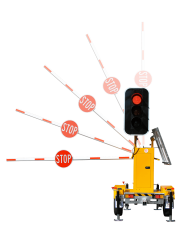
- Boom gate option: Available on the Ultra CCTV Camera Trailer for entrances that need physical restriction.
- Custom configurations: Optraffic scopes combined surveillance and access setups with the customer directly.
Camera Trailer or Boom Gate at the Gate
One supplier for both. Surveillance and vehicle access, specified together for your site.
Camera Trailer vs Boom Gate for Site Entry: The Short Answer
A camera records who came in. A barrier decides whether they get in. Sites lose material when they buy the first and needed the second, or when they install a barrier and have no record of who lifted it. The decision turns on what happens after hours, not on which technology is better.
Recording Entry vs Controlling Entry Are Two Different Jobs
Recording entry vs controlling entry is the distinction most temporary sites collapse by accident. The two solve different halves of the same problem.
| Function | What it achieves | What it cannot do |
|---|---|---|
| Camera at the entrance | Evidence, identification, live view, alerting | Physically stop a vehicle |
| Barrier at the entrance | Restricts vehicle movement | Say who lifted it, or what happened either side |
Neither is a substitute for the other. A gate without a camera produces an access log at best. A camera without a barrier produces evidence after the fact.
Why “We Have Cameras” Is Not an Access Control Answer
Insurers and principal contractors increasingly ask how a site controls access, not how it records it. Those are separate questions on a security plan.
Police crime prevention guidance treats them separately too. Victoria Police advises builders to secure and lock the site, and to record what moves on and off it — two measures, not one.
What Live View and Event Alerts Change at a Temporary Site Entrance
This is where the recording-only assumption breaks down. Live view and event alerts on site move the response from Monday morning to the moment itself.
From Reviewing Footage to Watching It Happen
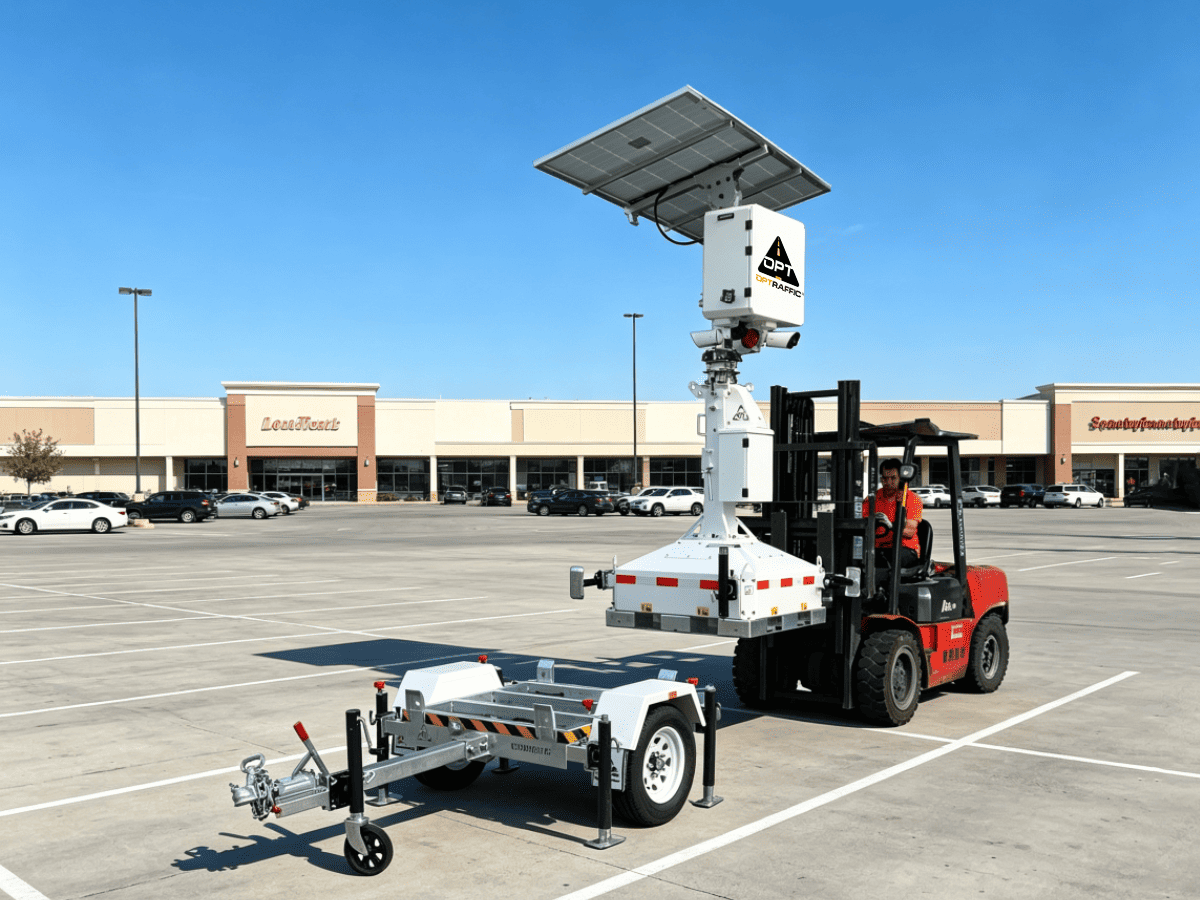
Optraffic camera trailers stream live video to a browser or mobile device and push automated event alerts. That combination changes what a site can do about an entry:
- Someone can look immediately, from wherever they are, rather than the next working day.
- A call can be made while the vehicle is still on site — to the site supervisor, a patrol, or police.
- The decision to escalate rests on live vision, not a report from a passer-by.
Deterrence changes too. Response that arrives during an incident interrupts it. Response that arrives afterwards documents it.
What This Does Not Replace
Live view narrows the response window. It does not close a gate.
Sites that must physically restrict vehicles still need a barrier at the entrance. Temporary site entrance security usually needs both functions where the entrance is unattended out of hours.
When a Camera Trailer at a Site Gate Is Enough on Its Own
A camera trailer at a site gate covers the requirement fully in several common cases.
- The entrance is already gated or fenced, and the gap is visibility rather than restriction.
- Access is supervised during working hours, and the risk sits outside them.
- The entrance changes position as the works advance, making a fixed barrier impractical.
- The client’s requirement is evidential — disputes, deliveries, damage claims, contractor attendance.
In each case the entrance already restricts vehicles, or restriction is not the problem. Adding a barrier solves nothing the site was struggling with.
Camera type at the entrance matters more than unit count here. Entry positions demand identification-grade framing, covered in the Optraffic guide to choosing cameras for a CCTV camera trailer.
When Pairing Surveillance With Vehicle Access Control Makes Sense
Pairing surveillance with vehicle access control earns its cost where the entrance is both unattended and open.
| Site condition | Camera only | Barrier only | Both |
|---|---|---|---|
| Fenced site, lockable gate | Suitable | — | Rarely needed |
| Open entrance, unattended after hours | Records the loss | Stops the vehicle, no record | Recommended |
| High-volume contractor access | Attendance record | Queue control | Recommended |
| Entrance moves with the works | Suitable | Impractical if fixed | Camera plus portable barrier |
| Public-facing access point | Evidence and deterrence | Restriction | Depends on the risk |
A boom gate is available as an option on the Ultra CCTV Camera Trailer, so an entrance can carry both functions from one supplier. How barrier types differ, and where each suits a site, is covered in the Optraffic guide to how boom gates work for access control.
Sites needing a combined arrangement, or an integration beyond the standard configurations, should raise it with the Optraffic team during scoping. Configurations are specified per project rather than sold as a fixed build.
What to Confirm Before Specifying a Temporary Entrance
Six questions settle the entrance before anything is quoted.
- Is the entrance physically closed after hours? If not, recording alone will document the loss.
- Who responds to an alert, and how fast? Live view is worth little without someone to act on it.
- What does the client actually need to prove? Attendance, delivery times, damage, or intrusion.
- Does the entrance move as the works advance? Fixed barriers become obstacles when it does.
- Is there mains power at the gate? Solar-powered units remove that dependency entirely.
- Who holds the footage, and for how long? Retention should be agreed before day one.
Where the entrance sits within the wider site layout, and how several units cover it together, is covered in the Optraffic guide to covering a large site with multiple camera towers, part of the wider Optraffic Security and Surveillance work.
Conclusion: What the Monday Morning Site Should Have Had
Return to the site manager reviewing footage after the fact. The camera was not the failure.
The entrance was open, nobody was watching during the event, and no alert reached anyone until the loss was discovered. Three changes would have altered the outcome:
- An alert during the entry, rather than a discovery two days later.
- A named responder who checks live vision and escalates.
- A physical restriction at an entrance left open after hours.
The rule underneath is short. Record what must be proved, restrict what must be stopped, and be honest about which of the two the site actually needs.
The Optraffic team scopes entrance configurations with hire fleets and integrators, including combined and custom arrangements, before a site is specified.
FAQ
Is a camera trailer enough to secure a site entrance?
It depends on whether the entrance closes. A camera trailer at a site gate provides evidence, live view and alerting, but it does not physically stop a vehicle entering an open entrance.
What is the difference between recording entry and controlling entry?
Recording entry vs controlling entry is the difference between evidence and restriction. A camera identifies who entered. A barrier determines whether they can.
Can you see a site entrance in real time?
Yes. Optraffic camera trailers stream live video to a browser or mobile device and send automated event alerts, so somebody can look while an entry is happening.
Can a camera trailer and a boom gate work at the same entrance?
Yes. A boom gate is available as an option on the Ultra CCTV Camera Trailer. Combined and custom arrangements are scoped with the Optraffic team per project.
Do you need mains power at the gate?
No. Solar-powered units operate at entrances with no mains supply, which is why temporary site entrance security rarely justifies trenching a permanent connection.




Lighting First or Recording First? CCTV-Ready Light Tower vs Camera Trailer for Integrators and Hire Fleets
CCTV-ready light tower vs camera trailer: compare whose camera runs, which load gets night power, and how hire fleets use one unit for two jobs.
VMS Trailers for Renewable Energy Zone Construction: Oversize Deliveries, Detours and Community Notice
How VMS trailers support renewable energy zone construction: oversize delivery warnings, detours, night moves and community notice on REZ routes.
Imported vs Australian-Built VMS Trailers: Where Each Has the Edge
Imported vs Australian-built VMS trailers: where each has a real advantage, what compliance requires of both, and how to choose for your fleet.
What Should a VMS Trailer Quote Include in Australia? Line Items to Compare Before You Sign
What should a VMS trailer quote include? Ten line items to compare, from delivery and registration to software fees, warranty and local spare parts.
When to Order VMS Trailers for Bushfire Season: A Region-by-Region Guide for Australian Hire Fleets
When to order VMS trailers for bushfire season: a region-by-region guide for hire fleets, with order-by months, stock top-ups and pre-season checks.
What Makes a VMS Trailer Mine-Spec? Site Entry Requirements for Western Australian Mine Sites
Mine-spec VMS trailer requirements under WA’s 2026 mine traffic code: visibility, ID, isolation, documents and how to order a unit that passes site entry.